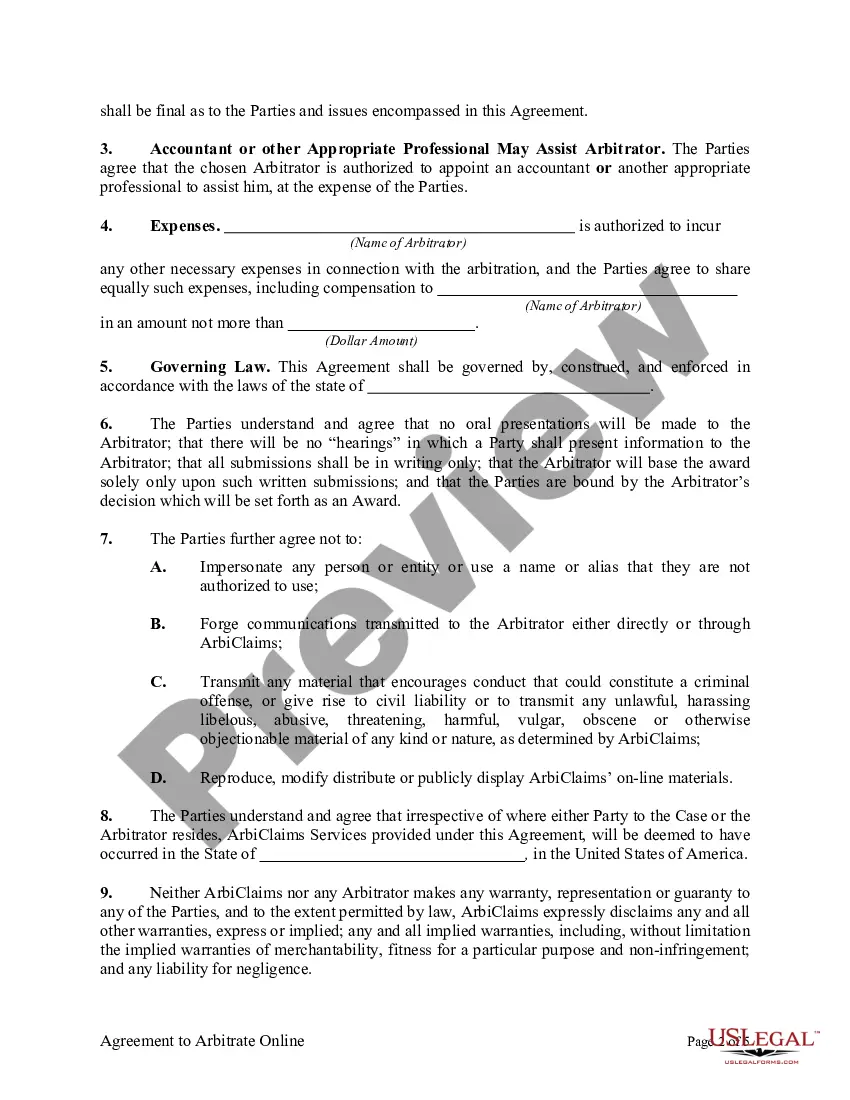
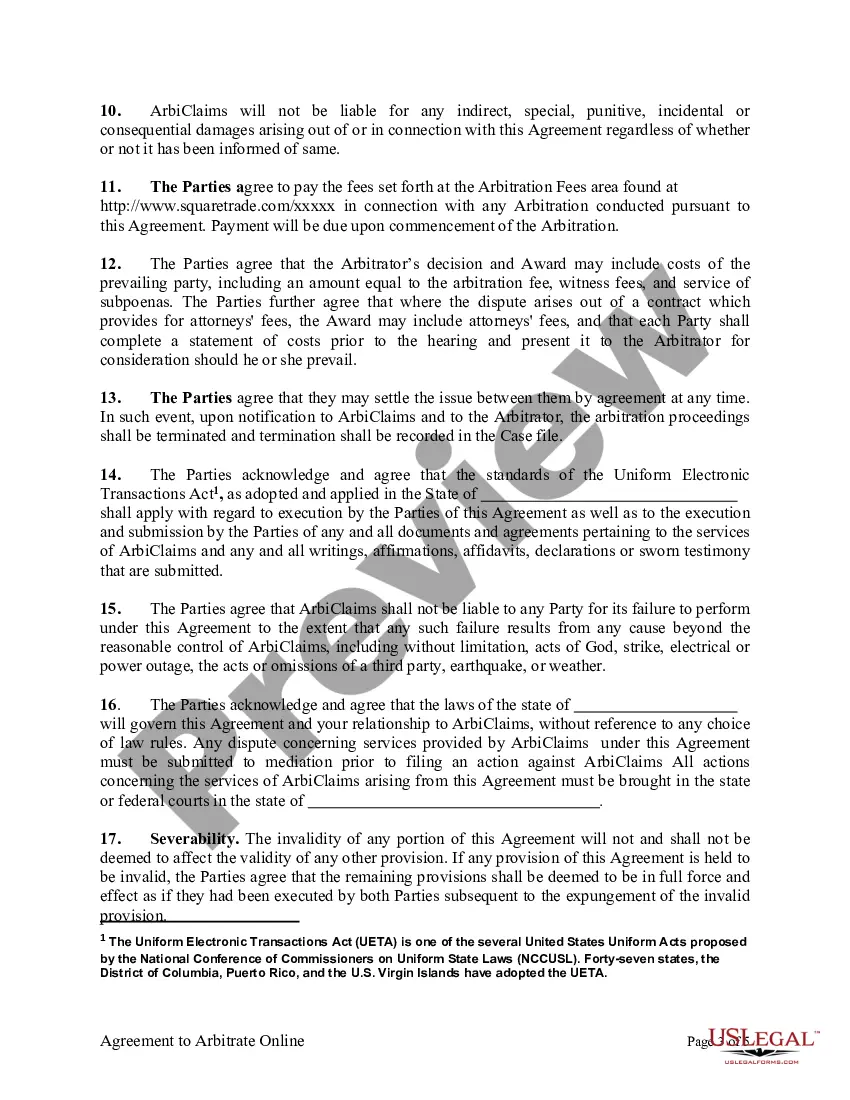
Agreement Arbitration Sample For Divorce In Salt Lake
Description





Get your form ready online
Our built-in tools help you complete, sign, share, and store your documents in one place.
Make edits, fill in missing information, and update formatting in US Legal Forms—just like you would in MS Word.
Download a copy, print it, send it by email, or mail it via USPS—whatever works best for your next step.
Sign and collect signatures with our SignNow integration. Send to multiple recipients, set reminders, and more. Go Premium to unlock E-Sign.
If this form requires notarization, complete it online through a secure video call—no need to meet a notary in person or wait for an appointment.
We protect your documents and personal data by following strict security and privacy standards.

Make edits, fill in missing information, and update formatting in US Legal Forms—just like you would in MS Word.

Download a copy, print it, send it by email, or mail it via USPS—whatever works best for your next step.

Sign and collect signatures with our SignNow integration. Send to multiple recipients, set reminders, and more. Go Premium to unlock E-Sign.

If this form requires notarization, complete it online through a secure video call—no need to meet a notary in person or wait for an appointment.

We protect your documents and personal data by following strict security and privacy standards.
Looking for another form?









Form popularity
FAQ
In Utah, the division of assets during a divorce does not follow a strict 50/50 rule. Instead, the state adheres to the principle of equitable distribution. This means the court will divide marital assets in a manner considered fair, though not necessarily equal.
You will be entitled to one half of all property ``acquired during the marriage''. Things like the 401K would be determined by virtue of the amount, within that account, earned during the marriage.
Specifically, she is entitled to get an equitable share in real property (land, house, buildings), personal property (movable assets like cars, jewelry, furniture, tools, dishes), and retirement/pension plan benefits. Aside from a share in the marital property, the wife may also get alimony and child support.
The length of marriage is one of the most critical factors in deciding alimony in Utah. A long-lasting marriage, typically ten years or more, may increase your chances of getting alimony.
Divorce arbitration can be beneficial when spouses prioritize privacy and flexible scheduling. Couples with complex financial situations, such as businesses or significant investments, may find value in the specialized expertise of an arbitrator.
Utah is an ``equitable distribution'' state, which basically means that marital assets are split up equitably in a divorce. That does not mean that everyone gets half of everything. Rather, everything is put into a ``pot'' of sorts, and divvied up equitably.
Utah law requires 30 days between filing and finalizing the divorce. This is called the waiting period.
Some reasons why an ex-spouse might not be entitled to receive alimony include: The ex-spouse does not meet the legally required level of financial need. You are not financially able to provide alimony to your ex-spouse. Your ex-spouse is at fault for the divorce, due to having an affair or another cause.
