Agreement Arbitration Sample Withdrawal In Pennsylvania
Description

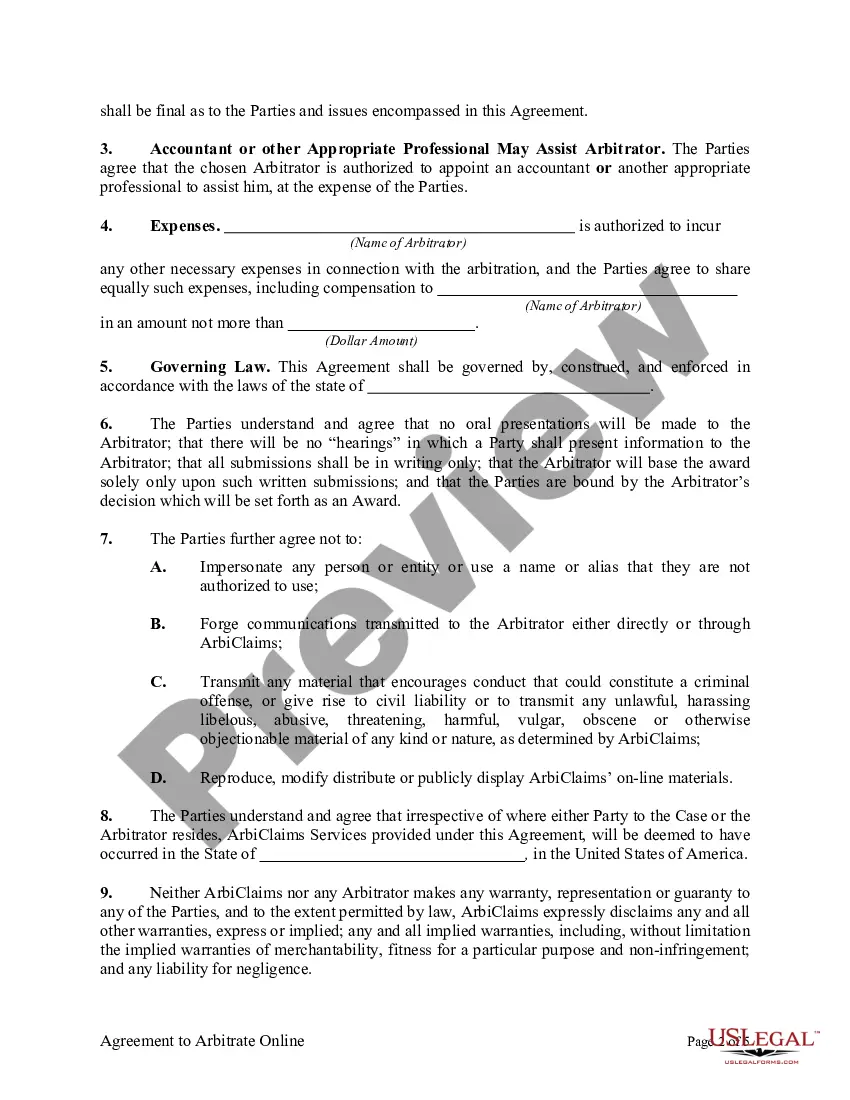




Get your form ready online
Our built-in tools help you complete, sign, share, and store your documents in one place.
Make edits, fill in missing information, and update formatting in US Legal Forms—just like you would in MS Word.
Download a copy, print it, send it by email, or mail it via USPS—whatever works best for your next step.
Sign and collect signatures with our SignNow integration. Send to multiple recipients, set reminders, and more. Go Premium to unlock E-Sign.
If this form requires notarization, complete it online through a secure video call—no need to meet a notary in person or wait for an appointment.
We protect your documents and personal data by following strict security and privacy standards.

Make edits, fill in missing information, and update formatting in US Legal Forms—just like you would in MS Word.

Download a copy, print it, send it by email, or mail it via USPS—whatever works best for your next step.

Sign and collect signatures with our SignNow integration. Send to multiple recipients, set reminders, and more. Go Premium to unlock E-Sign.

If this form requires notarization, complete it online through a secure video call—no need to meet a notary in person or wait for an appointment.

We protect your documents and personal data by following strict security and privacy standards.
Looking for another form?









Form popularity
FAQ
Outline a concise factual background and then move on to a discussion of the issues at the heart of the case. Your arguments should flow easily from the relevant facts and applicable law. And, by all means, avoid exaggeration of the strengths of your case as well as disparagement of the opposing side.
1305. Rule 1305 - Conduct of Hearing, Evidence (a) Initially all rulings on objections to evidence or on other issues which arise during the hearing shall be made by the chairperson of the board of arbitrators, and such rulings shall be final unless one of the other arbitrators disagrees with the same.
What is an arbitration agreement? It's typically a clause in a broader contract in which you agree to settle out of court, through arbitration cases, any dispute that arises with your counterpart.
But, in the absence of an agreement between all parties to end the proceedings, can a claimant unilaterally withdraw from an arbitration that it has commenced? The short answer is yes. No set of institutional rules prevents a party from abandoning claims it has raised in an arbitration.
“Any dispute, controversy or claim arising out of or relating to this contract, or the breach, termination or invalidity thereof, shall be settled by arbitration in ance with the UNCITRAL Arbitration Rules as at present in force.”
Rule 1304. If the plaintiff fails to appear or if, at the conclusion of the plaintiff's case, the board deems the evidence insufficient to support an award in favor of the plaintiff, it shall enter an award in favor of the defendant. If the board does not do so, the defendant may proceed to offer evidence.
But, in the absence of an agreement between all parties to end the proceedings, can a claimant unilaterally withdraw from an arbitration that it has commenced? The short answer is yes. No set of institutional rules prevents a party from abandoning claims it has raised in an arbitration.
Some contracts give you the right to opt out of the forced arbitration clause within a certain period of time, often 30 to 60 days, after signing the agreement by notifying the company that you wish to opt out. Check your contract for the deadline and for specific instructions for opting out.
While it has been held that arbitration agreements do not divest a court of jurisdiction, such agreements are binding upon the parties and will be enforced absent proof of duress, fraud or unconscionability. Lytle v. CitiFinancial Services, Inc., 810 A. 2d 643 (Pa.
Some contracts give you the right to opt out of the forced arbitration clause within a certain period of time, often 30 to 60 days, after signing the agreement by notifying the company that you wish to opt out. Check your contract for the deadline and for specific instructions for opting out.
