Agreement Arbitrate Document With Insurance Company In Ohio
Description





Get your form ready online
Our built-in tools help you complete, sign, share, and store your documents in one place.
Make edits, fill in missing information, and update formatting in US Legal Forms—just like you would in MS Word.
Download a copy, print it, send it by email, or mail it via USPS—whatever works best for your next step.
Sign and collect signatures with our SignNow integration. Send to multiple recipients, set reminders, and more. Go Premium to unlock E-Sign.
If this form requires notarization, complete it online through a secure video call—no need to meet a notary in person or wait for an appointment.
We protect your documents and personal data by following strict security and privacy standards.

Make edits, fill in missing information, and update formatting in US Legal Forms—just like you would in MS Word.

Download a copy, print it, send it by email, or mail it via USPS—whatever works best for your next step.

Sign and collect signatures with our SignNow integration. Send to multiple recipients, set reminders, and more. Go Premium to unlock E-Sign.

If this form requires notarization, complete it online through a secure video call—no need to meet a notary in person or wait for an appointment.

We protect your documents and personal data by following strict security and privacy standards.
Looking for another form?








Form popularity
FAQ
The Request must: be written in English, French or Spanish (the official languages of the Centre) include the name and contact details of all parties (including e-mail, street address and telephone number) be signed and dated by the requesting party or its representative.
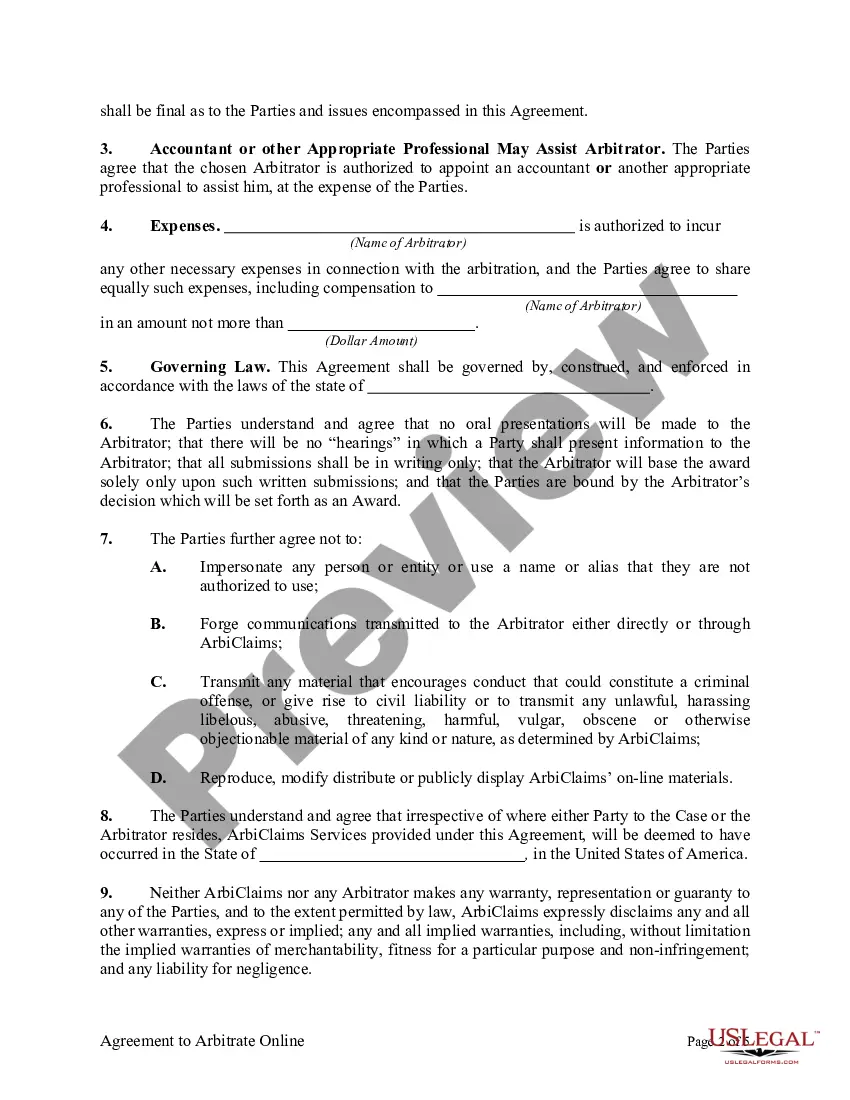
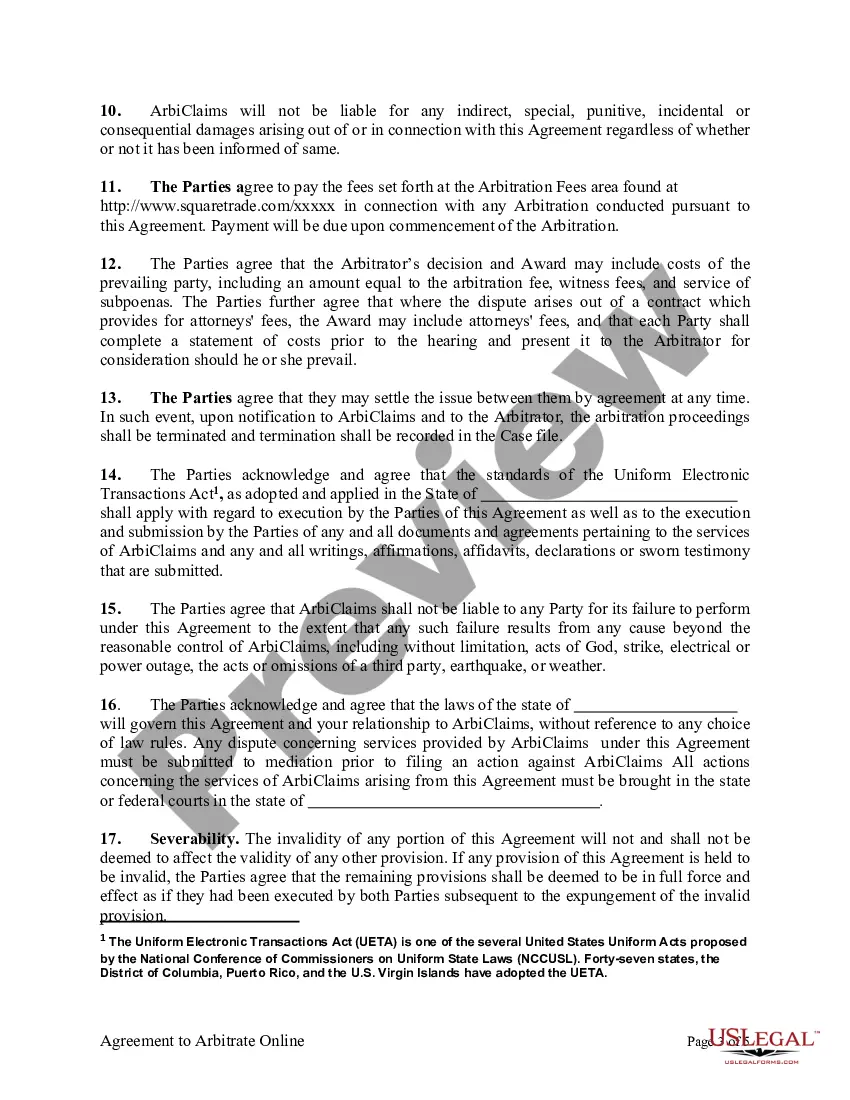
In a binding arbitration agreement, both parties agree—by contract—that the matter will be resolved by an arbitrator. This means that both parties have agreed to using arbitration should an insurance dispute arise. And, once the arbitrator makes a decision, this is the final judgment that will stand.
In general, a Request for Arbitration or a Notice of Arbitration must contain the names of each of the parties, the names of the parties' representatives, a description of the dispute giving rise to claims, a statement of the relief sought, a description of the agreement containing the arbitration clause, the choice of ...
A claimant will typically start arbitration by sending a document known as a “request for arbitration” or a “notice to arbitrate” to its opponent.
States have varying requirements for arbitrators, but most require you to have at least a bachelor's degree in law, political science or a similar field. You can gain experience for this role by completing internships and working in entry-level positions under the supervision of an experienced arbitrator.
Courts vary in requiring “mutuality” of agreement to submit claims to arbitration. That is, some courts require, as a condition of enforcement, that the employer agree to submit any clams it has against the employee to arbitration as well as requiring the employee to do so with claims against the employer.
Ohio has a public policy favoring the enforcement of arbitration provisions in contracts and ORC 2711.01(A) provides that such provisions will be enforced unless grounds exist in law or equity for revocation of the contract.
Settlement by agreement is the cheapest option and gives you the most control. Both mediation and arbitration are expensive, and arbitration is usually binding, so the ultimate decision is out of your control.
Arbitration may be used to settle an insurance dispute between an insurance provider and a policyholder. Instead of filing a lawsuit, the insurer and the policyholder both present their case to the arbitrator. The arbitrator reviews the facts and comes to a decision about how to resolve the dispute.
During the arbitration proceedings, they will listen to each side and make a decision regarding the case's outcome. The arbitrator's job is not to get both sides to agree on a settlement but to listen to the arguments and evidence presented by each side and make a settlement decision.
