Agreement Arbitration Document With Bank In Montgomery
Description

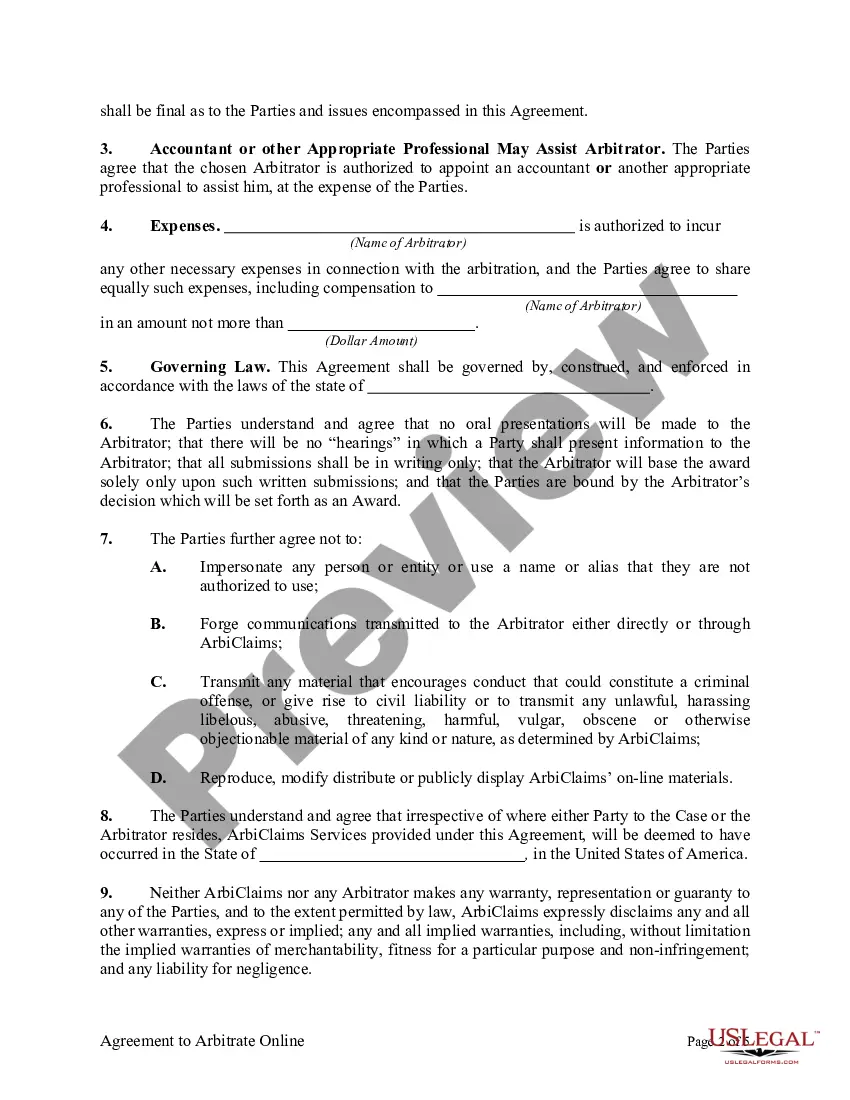




Get your form ready online
Our built-in tools help you complete, sign, share, and store your documents in one place.
Make edits, fill in missing information, and update formatting in US Legal Forms—just like you would in MS Word.
Download a copy, print it, send it by email, or mail it via USPS—whatever works best for your next step.
Sign and collect signatures with our SignNow integration. Send to multiple recipients, set reminders, and more. Go Premium to unlock E-Sign.
If this form requires notarization, complete it online through a secure video call—no need to meet a notary in person or wait for an appointment.
We protect your documents and personal data by following strict security and privacy standards.

Make edits, fill in missing information, and update formatting in US Legal Forms—just like you would in MS Word.

Download a copy, print it, send it by email, or mail it via USPS—whatever works best for your next step.

Sign and collect signatures with our SignNow integration. Send to multiple recipients, set reminders, and more. Go Premium to unlock E-Sign.

If this form requires notarization, complete it online through a secure video call—no need to meet a notary in person or wait for an appointment.

We protect your documents and personal data by following strict security and privacy standards.
Looking for another form?









Form popularity
FAQ
Arbitration is a contract-based form of binding dispute resolution. In other words, a party's right to refer a dispute to arbitration depends on the existence of an agreement (the “arbitration agreement”) between them and the other parties to the dispute that the dispute may be referred to arbitration.
In some instances, you may be able to sue if you signed a valid arbitration agreement. While courts generally favor arbitration agreements, they will allow you to file a lawsuit if either you didn't understand your rights or your claims fall outside the arbitration provision's scope.
A claimant will typically start arbitration by sending a document known as a “request for arbitration” or a “notice to arbitrate” to its opponent.
Banks, like Wells Fargo, use forced arbitration clauses in their contracts, forcing customers to sign away their right to go to court when opening a checking or savings account or getting a debit card or credit card.
What is an arbitration agreement? It's typically a clause in a broader contract in which you agree to settle out of court, through arbitration cases, any dispute that arises with your counterpart.
Arbitration agreements require that persons who signed them resolve any disputes by binding arbitration, rather than in court before a judge and/or jury. What is binding arbitration? Binding arbitration involves the submission of a dispute to a neutral party who hears the case and makes a decision.
Opting out of the arbitration agreement isn't damaging to you. You can always do arbitration if you would prefer that, although if you'd like to join class actions or sue the judge will throw out your case if you are still in this agreement.
Among the banks common to Pew's four annual studies, the percentage of institutions with an arbitration clause has risen from 59 to 72 percent. Among the 44 banks that were studied in 2016, almost three-quarters have an arbitration clause.
The brief should include identification of the parties, a concise description of the facts, and applicable case law and statutes. The briefs should be submitted to the arbitrator at least 2 days prior to the arbitration hearing.
Some 240 corporations registered forced arbitration clauses with AAA since the beginning of the pandemic, including the likes of Twitter, Square, StubHub, Marshalls, TJ Maxx, and more than 70 auto dealerships.
