Agreement Arbitration Sample For Divorce In Minnesota
Description

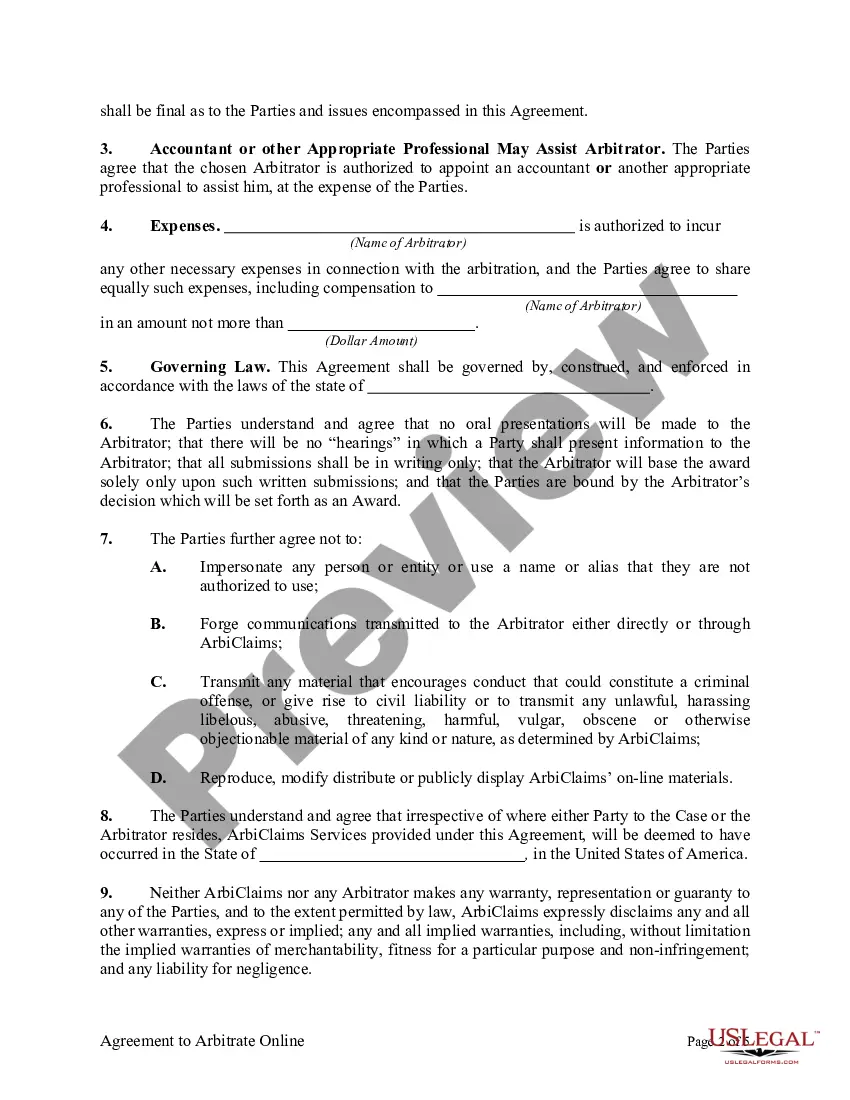




Get your form ready online
Our built-in tools help you complete, sign, share, and store your documents in one place.
Make edits, fill in missing information, and update formatting in US Legal Forms—just like you would in MS Word.
Download a copy, print it, send it by email, or mail it via USPS—whatever works best for your next step.
Sign and collect signatures with our SignNow integration. Send to multiple recipients, set reminders, and more. Go Premium to unlock E-Sign.
If this form requires notarization, complete it online through a secure video call—no need to meet a notary in person or wait for an appointment.
We protect your documents and personal data by following strict security and privacy standards.

Make edits, fill in missing information, and update formatting in US Legal Forms—just like you would in MS Word.

Download a copy, print it, send it by email, or mail it via USPS—whatever works best for your next step.

Sign and collect signatures with our SignNow integration. Send to multiple recipients, set reminders, and more. Go Premium to unlock E-Sign.

If this form requires notarization, complete it online through a secure video call—no need to meet a notary in person or wait for an appointment.

We protect your documents and personal data by following strict security and privacy standards.
Looking for another form?









Form popularity
FAQ
How To Write a Separation Agreement Name and address of both spouses. Details of the marriage. Beginning date of the separation. Statement of the intention to separate. Terms of use of the agreement. Specifications regarding the division of assets and the shared financial or child responsibilities of both parties.
Divorce arbitration offers a way to resolve disputes about property division, spousal support, and other financial matters outside a traditional courtroom. In this process, a neutral third party makes a binding decision after hearing evidence and arguments from both spouses.
Anyone can draft their own separation agreement and as long as it includes certain information, is signed by both spouses and witnessed it is legally binding.
However Minnesota, like most states, follow the equitable distribution method—meaning, the court will divide all marital property between the spouses a way it decides is equitable or fair, but not necessarily in an equal 50/50 split.
The law is that you and your spouse are financial partners during the marriage and are presumed entitled to share in both the assets and income the partnership made. You must make a full disclosure of your finances. For most people, life-styles change after a divorce.
Summary Dissolution to Get Divorced Quickly In Minnesota, the legal word for divorce is dissolution, and there are two types: regular and summary. Summary dissolution is a fast track to divorce, allowing you to finalize your divorce in as little as one month.
Generally, uncontested divorces in Minnesota can take about four to six weeks to finalize. This is often dependent on the calendars of the attorneys or judges involved. If the parties choose a summary dissolution, the divorce can occur within 30 days after filing a petition.
The length of your marriage is one factor judges must consider when equitably dividing marital property in Minnesota. There is no magic number for how long you must be married to automatically be awarded half.
