Agreement Arbitration Document With Class Action Waiver In Illinois
Description

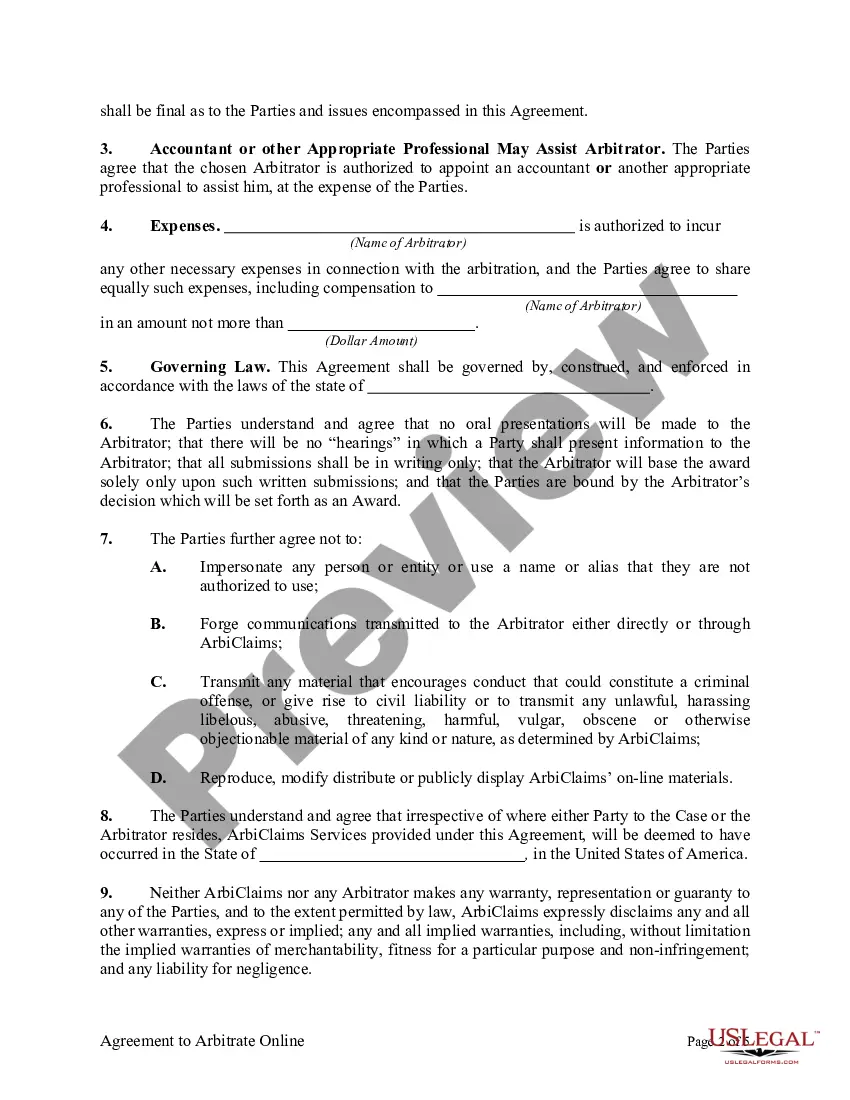




Get your form ready online
Our built-in tools help you complete, sign, share, and store your documents in one place.
Make edits, fill in missing information, and update formatting in US Legal Forms—just like you would in MS Word.
Download a copy, print it, send it by email, or mail it via USPS—whatever works best for your next step.
Sign and collect signatures with our SignNow integration. Send to multiple recipients, set reminders, and more. Go Premium to unlock E-Sign.
If this form requires notarization, complete it online through a secure video call—no need to meet a notary in person or wait for an appointment.
We protect your documents and personal data by following strict security and privacy standards.

Make edits, fill in missing information, and update formatting in US Legal Forms—just like you would in MS Word.

Download a copy, print it, send it by email, or mail it via USPS—whatever works best for your next step.

Sign and collect signatures with our SignNow integration. Send to multiple recipients, set reminders, and more. Go Premium to unlock E-Sign.

If this form requires notarization, complete it online through a secure video call—no need to meet a notary in person or wait for an appointment.

We protect your documents and personal data by following strict security and privacy standards.
Looking for another form?







Form popularity
FAQ
Most employers in the U.S. now require employees to accept a mandatory arbitration clause—waiving their right to sue in court as a condition of work. Arbitration clauses are often buried in the fine print of one-sided employment contracts that businesses impose, and that workers have no power to contest.
The Scope of the Clause. This section of the clause is critical; it sets the boundaries for which disputes the tribunal is authorised to determine. Choice of Rules. The Number of Arbitrators. Appointing Authority. Choice of Venue. The language of the proceedings. Finality. Exclusion of the right of appeal.
Without a valid arbitration agreement, no arbitration can take place or award can be rendered. In other words, a valid arbitration agreement is the cornerstone of any arbitration proceedings. Townsend, J.M., Drafting Arbitration Clauses: Avoiding the 7 Deadly Sins, Dispute Resolution Journal, 2003, p. 1.
Section 7 of the Arbitration Act 1996 confirms that the doctrine of separability applies to arbitration agreements. It makes clear that even if the main contract never came into existence, the arbitration agreement can still be binding.
Some potential consequences may include: Breach of Contract: If arbitration is a contractual requirement and one party refuses to participate, they may be in breach of the contract. The non-complying party may be held liable for damages resulting from the breach.
See 9 U.S.C. § 1. In Concepcion, the U.S. Supreme Court ruled that class action waivers in arbitration agreements are enforceable.
Class-Action Waivers – Illinois Supreme Court found class arbitration waiver unenforceable. (Ill. 2006). Arbitration clause held to be substantively unconscionable.
Under California law, you cannot be fired solely for refusing to sign an arbitration agreement. The California Labor Code provides strong protections for employees, ensuring that refusal to sign an arbitration agreement cannot be used as grounds for termination.
1 In the context of arbitration, waiver occurs when a party consciously and intentionally gives up its right to arbitrate a particular dispute, thereby choosing litigation as the preferred method of dispute resolution.
The Scope of the Clause. This section of the clause is critical; it sets the boundaries for which disputes the tribunal is authorised to determine. Choice of Rules. The Number of Arbitrators. Appointing Authority. Choice of Venue. The language of the proceedings. Finality. Exclusion of the right of appeal.
