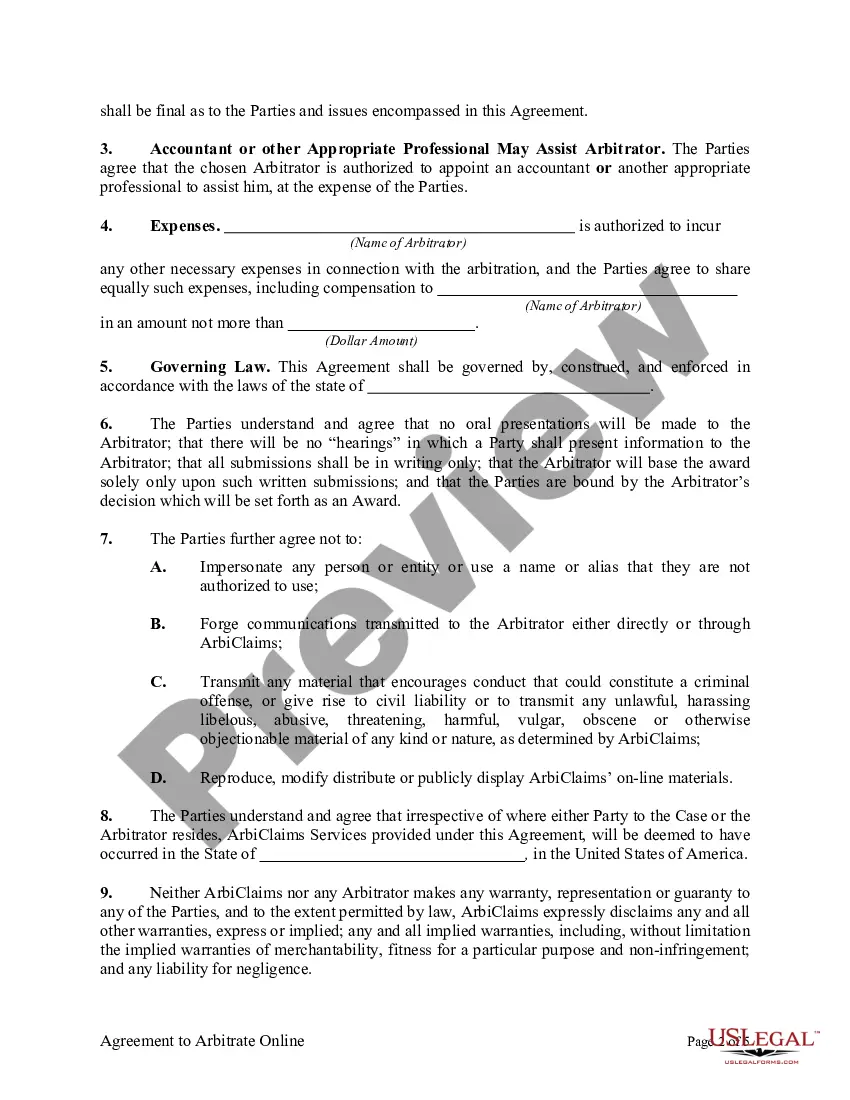
Arbitration Agreement Format India In Alameda
Description





Get your form ready online
Our built-in tools help you complete, sign, share, and store your documents in one place.
Make edits, fill in missing information, and update formatting in US Legal Forms—just like you would in MS Word.
Download a copy, print it, send it by email, or mail it via USPS—whatever works best for your next step.
Sign and collect signatures with our SignNow integration. Send to multiple recipients, set reminders, and more. Go Premium to unlock E-Sign.
If this form requires notarization, complete it online through a secure video call—no need to meet a notary in person or wait for an appointment.
We protect your documents and personal data by following strict security and privacy standards.

Make edits, fill in missing information, and update formatting in US Legal Forms—just like you would in MS Word.

Download a copy, print it, send it by email, or mail it via USPS—whatever works best for your next step.

Sign and collect signatures with our SignNow integration. Send to multiple recipients, set reminders, and more. Go Premium to unlock E-Sign.

If this form requires notarization, complete it online through a secure video call—no need to meet a notary in person or wait for an appointment.

We protect your documents and personal data by following strict security and privacy standards.
Looking for another form?






Form popularity
FAQ
Alternative Dispute Resolution (ADR) Information Packet. The person who files a civil lawsuit (plaintiff) must include the ADR Information Packet with the complaint when serving the defendant. Cross complainants must serve the ADR Information Packet on any new parties named to the action.
The Superior Court of Alemeda County, Local Rules, rule 3.30(c) directs that a filing party must deliver to the clerk in the assigned department “an identical courtesy copy of any paper filed, lodged, or otherwise submitted in support of, in opposition to, or in connection with any motion or application.”
Arbitration notice: in case of dispute between the parties arise, the party will send a notice to the defaulting party for initiating the procedure of arbitration known as arbitration notice. 3. Appointment of Arbitrator: party appoint arbitrator as they think fit to resolve the dispute.
Rule 3.31. Unless otherwise authorized by the court, discovery meet and confer obligations require an in-person, telephonic, or video conference between parties.
Alternative Dispute Resolution (ADR) Information Packet. The person who files a civil lawsuit (plaintiff) must include the ADR Information Packet with the complaint when serving the defendant. Cross complainants must serve the ADR Information Packet on any new parties named to the action.
ADR ensures that any dangerous goods transported by road can cross international borders freely if the goods, vehicles and drivers comply with its rules. ADR has been in force since 1968 and is administered by the United Nations Economic Commission for Europe ( UNECE ).
Alternative Dispute Resolution, commonly referred to as ADR, is a term which covers many alternatives to traditional methods for resolving conflicts or disputes. ADR has been used as a tool in resolving workplace disputes arising from poor communication, personality conflicts, or alleged discrimination.
The arbitrator will explain the process. Each side may present an uninterrupted opening statement setting forth its position as to the facts and the law. After opening statements, the parties present their evidence and witnesses. The arbitrator swears in the witnesses and makes rulings on the admissibility of evidence.
Local Rule 7-3 states, in relevant part: Unless otherwise provided for in these Rules, counsel contemplating the filing of any motion shall first contact opposing counsel to discuss thoroughly, preferably in person, the substance of the contemplated motion and any potential resolution.
Construction. The provisions of this section shall not apply to noise sources associated with construction provided the activities take place between the hours of a.m. to p.m. Monday through Fridays or a.m. to p.m. on Saturdays.
