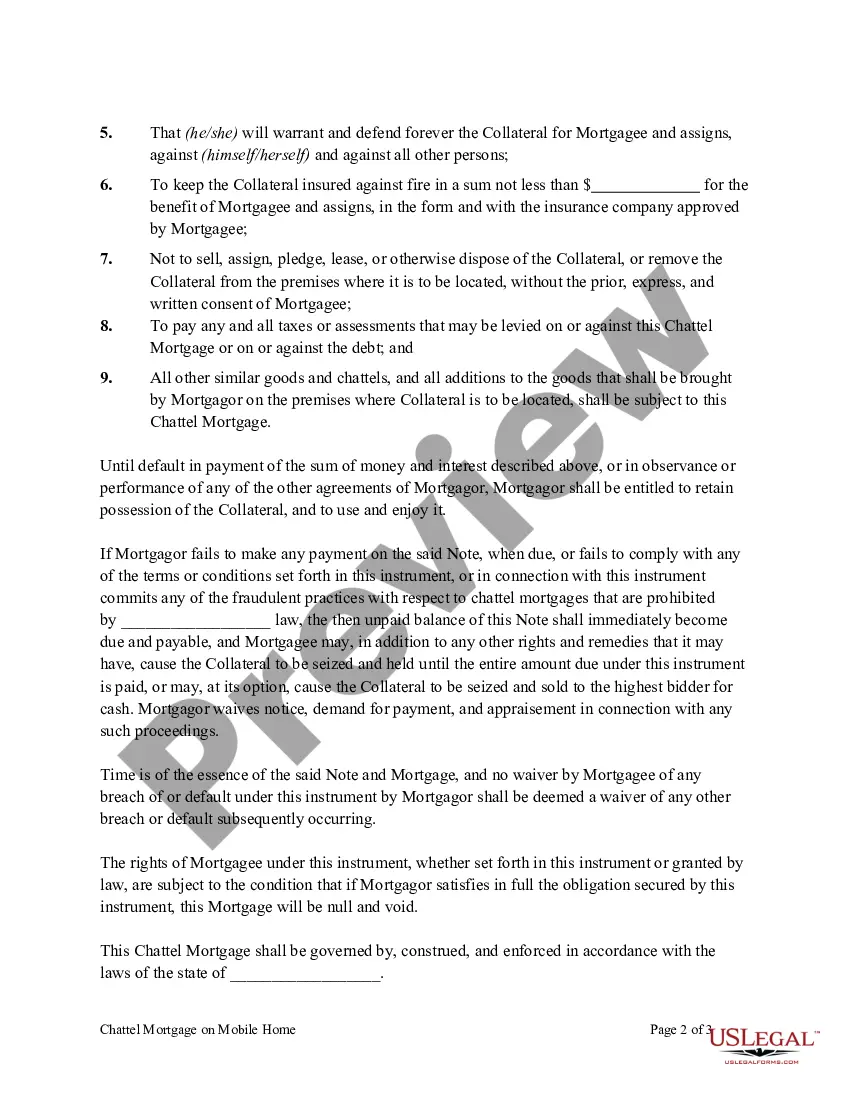
Chattel Mortgage Form With Extra Judicial Foreclosure In Texas
Description

Get your form ready online
Our built-in tools help you complete, sign, share, and store your documents in one place.
Make edits, fill in missing information, and update formatting in US Legal Forms—just like you would in MS Word.
Download a copy, print it, send it by email, or mail it via USPS—whatever works best for your next step.
Sign and collect signatures with our SignNow integration. Send to multiple recipients, set reminders, and more. Go Premium to unlock E-Sign.
If this form requires notarization, complete it online through a secure video call—no need to meet a notary in person or wait for an appointment.
We protect your documents and personal data by following strict security and privacy standards.

Make edits, fill in missing information, and update formatting in US Legal Forms—just like you would in MS Word.

Download a copy, print it, send it by email, or mail it via USPS—whatever works best for your next step.

Sign and collect signatures with our SignNow integration. Send to multiple recipients, set reminders, and more. Go Premium to unlock E-Sign.

If this form requires notarization, complete it online through a secure video call—no need to meet a notary in person or wait for an appointment.

We protect your documents and personal data by following strict security and privacy standards.
Looking for another form?









Form popularity
FAQ
Section 51.016 of the Texas Property Code permits a mortgagee, trustee or substitute trustee to rescind a nonjudicial foreclosure of residential property.
Judicial foreclosure is required in certain situations such as foreclosures involving home equity loans, reverse mortgages, or property owners' association assessments.
Foreclosures are generally judicial in the following states: Connecticut, Delaware, District of Columbia (sometimes), Florida, Hawaii, Illinois, Indiana, Iowa, Kansas, Kentucky, Louisiana (executory proceeding), Maine, Nebraska (sometimes), New Jersey, New Mexico, New York, North Dakota, Ohio, Oklahoma (if the ...
In nonjudicial foreclosures, a lawsuit must be filed in order to obtain a judgment to collect the deficiency. In judicial foreclosures, a second lawsuit needs to be filed. These lawsuits must be filed within two years of the sale.
Texas utilizes a non-judicial foreclosure process, as outlined in Section 51.002 of the Texas Property Code. This means that in most cases, lenders can foreclose on a property without going through the court system, provided certain conditions are met.
Conducting the Sale Foreclosure auctions are generally held the first Tuesday of each month between a.m. and p.m. at the county courthouse. The sale must begin at the time stated in the notice of sale, but no later than three hours after the time scheduled on the notice of sale.
Step 2: Notice of Sale or Order of Sale In a judicial foreclosure, once the court has issued their judgment granting the foreclosure, the clerk of the court will prepare an Order of Sale directing the sheriff or constable to sell the property at auction.
If you default on your mortgage payments in Texas, the lender may foreclose using a judicial or nonjudicial method.
Texas is a power of sale jurisdiction, meaning that a lender can go through with the sale of your property without having to go to court. As a result, foreclosures in Texas can be very quick, sometimes being completed about two or three months after the process begins, though this is quicker than average.
Texas is a combination of a judicial and non-judicial foreclosure state; in short it allows for non-judicial foreclosures but ONLY if the lender or lienholder has a deed of trust as stated previously. Without a deed of trust the lender must obtain a court order to proceed with the foreclosure sale.
