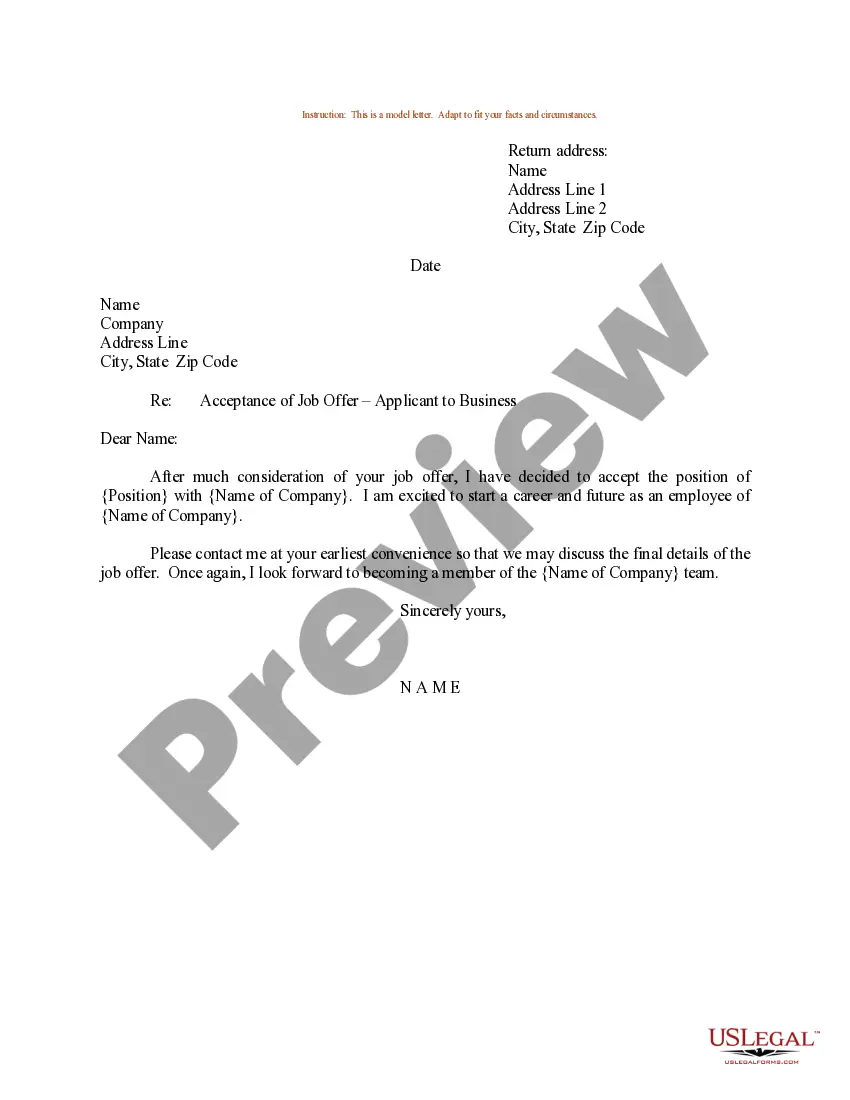
Job Acceptance Letter From Employer In Minnesota
Description
Get your form ready online
Our built-in tools help you complete, sign, share, and store your documents in one place.
Make edits, fill in missing information, and update formatting in US Legal Forms—just like you would in MS Word.
Download a copy, print it, send it by email, or mail it via USPS—whatever works best for your next step.
Sign and collect signatures with our SignNow integration. Send to multiple recipients, set reminders, and more. Go Premium to unlock E-Sign.
If this form requires notarization, complete it online through a secure video call—no need to meet a notary in person or wait for an appointment.
We protect your documents and personal data by following strict security and privacy standards.

Make edits, fill in missing information, and update formatting in US Legal Forms—just like you would in MS Word.

Download a copy, print it, send it by email, or mail it via USPS—whatever works best for your next step.

Sign and collect signatures with our SignNow integration. Send to multiple recipients, set reminders, and more. Go Premium to unlock E-Sign.

If this form requires notarization, complete it online through a secure video call—no need to meet a notary in person or wait for an appointment.

We protect your documents and personal data by following strict security and privacy standards.
Looking for another form?
Form popularity
FAQ
Employment verification is the process of confirming a job candidate's past work history. Doing so ensures the candidate has the experience necessary to perform the intended job well. Employment verification can also reveal false employment claims, gaps in employment, or fabrication of job titles.
All employers must complete a Form I-9, Employment Eligibility Verification, to verify an employee's identity and employment authorization. Federal law also protects employees from discrimination based on national origin or citizenship status.
Contact the company's hiring manager or recruiter you have been working with directly. Send a professional email politely requesting the offer letter. Express your enthusiasm for the opportunity and state that you are ready to accept the offer. Provide your preferred contact information and availability
There is no hard and fast rule about how long employers will take to get back to you with a job offer (or a job rejection). The hiring process can vary from employer to employer, the type of job you are applying for, and the industry in which you work. You could get an offer in a day or two or it could take weeks.
It's where you agree to the terms and conditions of your employment laid out in the offer letter. You can include details like your: job title. start date. salary (optional)
Where appropriate, and if requested, employers may give details about an employee's job responsibilities and past performance, including reviews and evaluations.
Information that can be provided includes: Dates of employment, Title (job classification), Employment history (all position, dates and salary since date of hire), Gross salary for the past two years, Year to date salary, and. Annual salary.
An employer can give out the following information only with a Release signed by you: written employee evaluations and your response to them, written disciplinary warnings and actions in the last 5 years, and. written reasons for why you left the job.
An offer letter is generally not considered a legal contract in the traditional sense. It outlines the terms of employment but usually doesn't bind the employee or employer legally, especially in at-will employment scenarios.
How to Write a Job Offer Acceptance Letter Thank the employer. Start off the acceptance letter by thanking the employer for the offer. Accept the job offer. Clarify any remaining points in the offer. Specify your starting date. End on a positive note.
