Business Meeting Format In Sacramento
Description



Get your form ready online
Our built-in tools help you complete, sign, share, and store your documents in one place.
Make edits, fill in missing information, and update formatting in US Legal Forms—just like you would in MS Word.
Download a copy, print it, send it by email, or mail it via USPS—whatever works best for your next step.
Sign and collect signatures with our SignNow integration. Send to multiple recipients, set reminders, and more. Go Premium to unlock E-Sign.
If this form requires notarization, complete it online through a secure video call—no need to meet a notary in person or wait for an appointment.
We protect your documents and personal data by following strict security and privacy standards.

Make edits, fill in missing information, and update formatting in US Legal Forms—just like you would in MS Word.

Download a copy, print it, send it by email, or mail it via USPS—whatever works best for your next step.

Sign and collect signatures with our SignNow integration. Send to multiple recipients, set reminders, and more. Go Premium to unlock E-Sign.

If this form requires notarization, complete it online through a secure video call—no need to meet a notary in person or wait for an appointment.

We protect your documents and personal data by following strict security and privacy standards.
Looking for another form?




Form popularity
FAQ
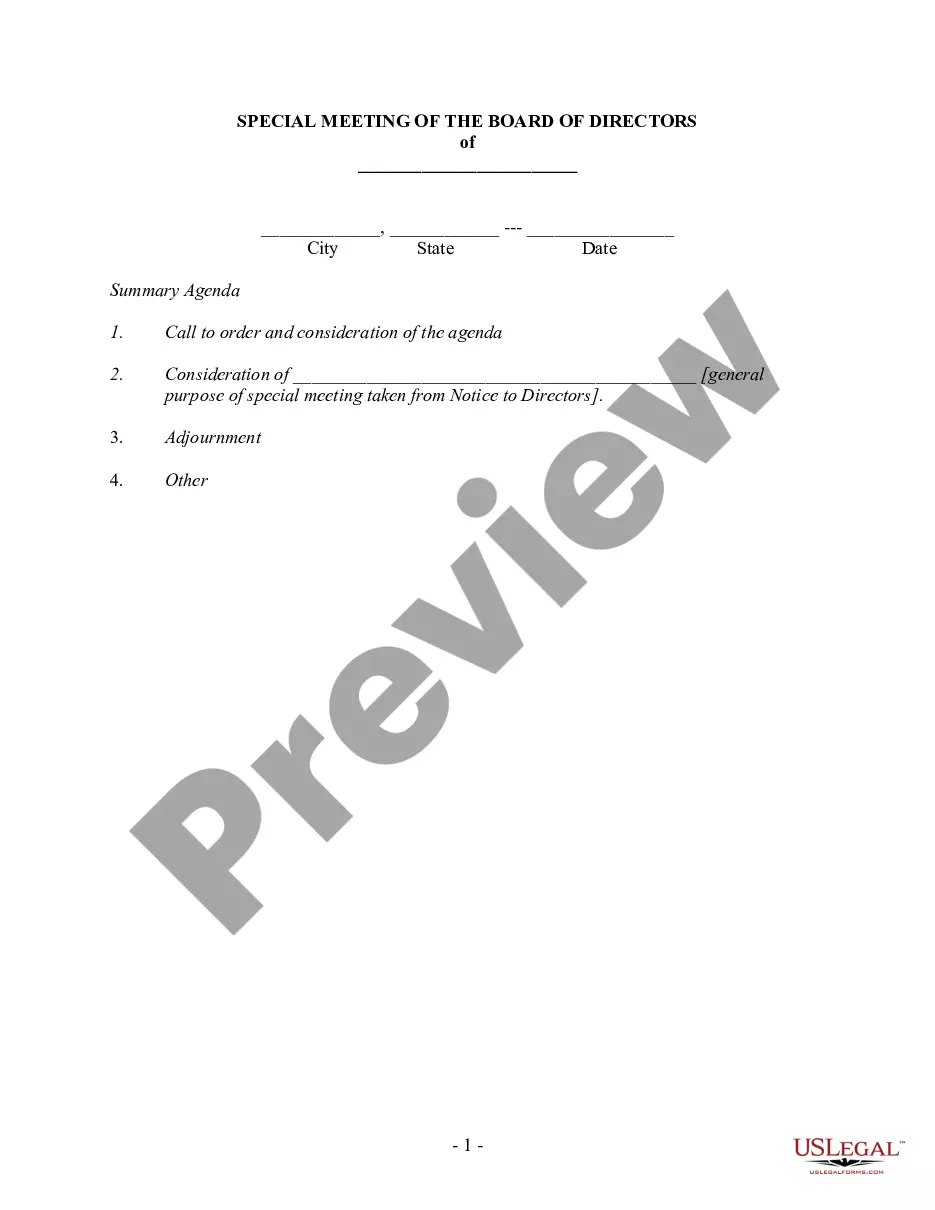
Robert's Rules of Order Cheat Sheet Here is our cheat sheet with Five Steps to Meeting Success: Create an agenda centered around the meeting goal using order of business to prioritize: first minutes, then reports, followed by time-sensitive situations, unfinished business, general items, and new business.
8 Meeting Etiquette Rules to Implement in Your Organization 1 Be punctual. 2 Come prepared. 3 Ensure a quiet space for virtual meetings. 4 Follow the agenda. 5 Be an active participant. 6 Give others the opportunity to speak. 7 Ask clarifying questions. 8 Be attentive to your body language.
The structure of a business meeting is an outline of specific activities that helps a team to progress and be effective. Following a business meeting structure can help ensure that the team keeps its focus on a topic and accomplishes the objective of a meeting.
How to Write a Meeting Agenda? 5 Key Steps Establish the meeting type. Not informing your team about the type of meeting they'd be attending can cause a lot of confusion. State the objective of the meeting. Identify specific meeting topics. Allocate time to discuss each topic. Include a list of necessary documents.
Two books The Robert's Rules of Order Newly Revised 12th Edition is the foremost authority on parliamentary procedure, and the Robert's Rules of Order Newly Revised In Brief 3rd Edition is the only authorized concise guide.
How to run a meeting Call the meeting to order. Your manager or other designated chairperson is responsible for this step. Take roll call. Read and approve past meeting minutes. Review reports. Address high-priority agenda items. Deal with any unfinished business. Cover new items of business. Adjourn the meeting.
Ing to Robert's Rule, all meetings should follow a strict agenda that adds structure to the meeting. The agenda should be prepared before the meeting and should be followed from top to bottom. Each point should be addressed and discussed before moving on to the next.
Create an agenda centered around the meeting goal using order of business to prioritize: first minutes, then reports, followed by time-sensitive situations, unfinished business, general items, and new business.
4. Set an agenda for the meeting Determine the goals of the meeting . Write down the questions you want to address. Ask attendees for input. Estimate the amount of time you need to spend on each topic. Determine the purpose of each task. Identify who will lead each topic. Conclude each meeting with a review.
Effective Facilitation Techniques to Start a Meeting as a Host Start the meeting on time. Your opening words (IEEI). Confirm the agenda. Review the ground rules. Review the parking boards. Make introductions if needed. Encourage participation. Stay on track.
