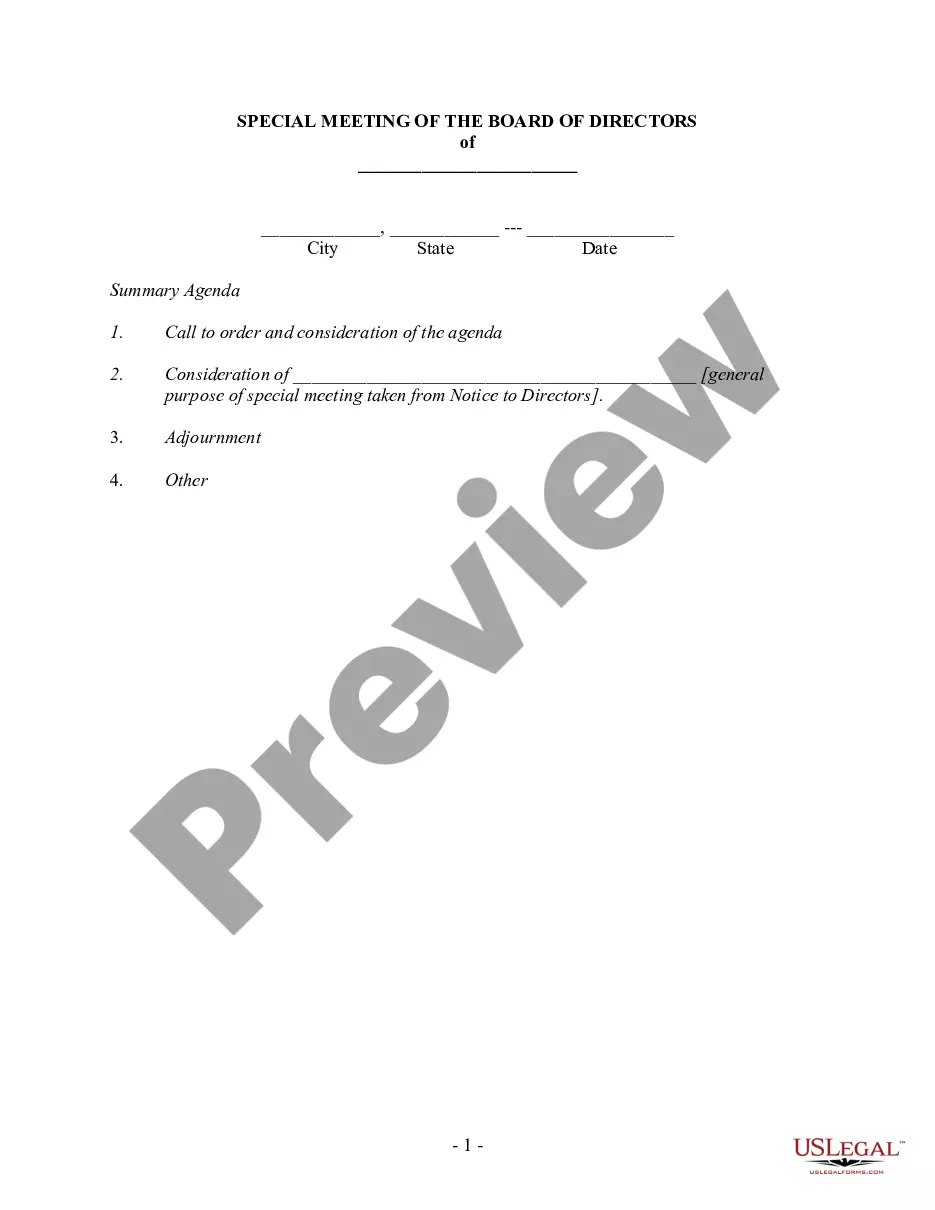
Annual Board Directors Template For Nonprofits In Allegheny
Description



Get your form ready online
Our built-in tools help you complete, sign, share, and store your documents in one place.
Make edits, fill in missing information, and update formatting in US Legal Forms—just like you would in MS Word.
Download a copy, print it, send it by email, or mail it via USPS—whatever works best for your next step.
Sign and collect signatures with our SignNow integration. Send to multiple recipients, set reminders, and more. Go Premium to unlock E-Sign.
If this form requires notarization, complete it online through a secure video call—no need to meet a notary in person or wait for an appointment.
We protect your documents and personal data by following strict security and privacy standards.

Make edits, fill in missing information, and update formatting in US Legal Forms—just like you would in MS Word.

Download a copy, print it, send it by email, or mail it via USPS—whatever works best for your next step.

Sign and collect signatures with our SignNow integration. Send to multiple recipients, set reminders, and more. Go Premium to unlock E-Sign.

If this form requires notarization, complete it online through a secure video call—no need to meet a notary in person or wait for an appointment.

We protect your documents and personal data by following strict security and privacy standards.
Looking for another form?




Form popularity
FAQ
Starting 2025, all Pennsylvania corporations, nonprofits, non-professional LLCs, and LPs will need to file an Annual Report with the Pennsylvania Department of State, Bureau of Corporations and Charitable Organizations. It costs $7 for for-profit companies, $0 for nonprofits.
Pennsylvania used to require that LLCs file a report every 10 years (called a Decennial Report). However, starting in 2025, every Pennsylvania LLC will be required to file a report every year (called an Annual Report).
Annual Reports in Pennsylvania. Pennsylvania Business Owners: You must file an Annual Report starting in 2025. Know the requirements and deadlines. Beginning in 2025, most domestic and foreign filing associations are required to file an Annual Report DSCB:15-146.
Nonprofit board member positions There are usually four Officers: President or Board Chair, Vice President or Vice Chair, Secretary, and Treasurer, and the terms unique to each will be defined in the nonprofit's bylaws. The president is the head of the board.
Nonprofit board member positions There are usually four Officers: President or Board Chair, Vice President or Vice Chair, Secretary, and Treasurer, and the terms unique to each will be defined in the nonprofit's bylaws. The president is the head of the board.
10 ways to find board members for your mission-driven... Recruit from your existing volunteer pool. Become part of your donors' networks. Take recommendations and nominations from current board members. Identify potential members that represent the reason your nonprofit was founded.
Start by looking at: Start with your dedicated and active volunteers. Consider your donors. Ask your current board and staff for nominations or recommendations. Reach out to those beyond your nonprofit, like youth, or people in business or from other organizations.
With that in mind, the federal government requires a minimum of three board members to acquire coveted 501c3 tax-exempt status. Tristan is pondering why a nonprofit needs board members. As a basic rule of thumb, three is the magic number.
While the IRS does not impose any maximum limitations, an efficient range for many nonprofits is between eight and 14 members. Some organizations have as many as 20 or more, but this is not ideal because it is difficult to govern this many individuals.
The most common nonprofit board member positions are a president (also called the chairperson), vice-chair, secretary, and treasurer. A president, secretary, and treasurer are the mandatory positions, but many nonprofits also have a vice-chair.
