Injunctive Relief For Copyright Infringement In Florida
Description


Get your form ready online
Our built-in tools help you complete, sign, share, and store your documents in one place.
Make edits, fill in missing information, and update formatting in US Legal Forms—just like you would in MS Word.
Download a copy, print it, send it by email, or mail it via USPS—whatever works best for your next step.
Sign and collect signatures with our SignNow integration. Send to multiple recipients, set reminders, and more. Go Premium to unlock E-Sign.
If this form requires notarization, complete it online through a secure video call—no need to meet a notary in person or wait for an appointment.
We protect your documents and personal data by following strict security and privacy standards.

Make edits, fill in missing information, and update formatting in US Legal Forms—just like you would in MS Word.

Download a copy, print it, send it by email, or mail it via USPS—whatever works best for your next step.

Sign and collect signatures with our SignNow integration. Send to multiple recipients, set reminders, and more. Go Premium to unlock E-Sign.

If this form requires notarization, complete it online through a secure video call—no need to meet a notary in person or wait for an appointment.

We protect your documents and personal data by following strict security and privacy standards.
Looking for another form?









Form popularity
FAQ
One remedy is injunctive relief, which restrains the defendant from future copying of the work. A preliminary injunction can be sought early in the case to restrain copying during the lawsuit.
A party seeking an injunction under general Florida case law must demonstrate: 1) irreparable harm; 2) a clear legal right; 3) an inadequate remedy at law; 4) consideration of the public interest.
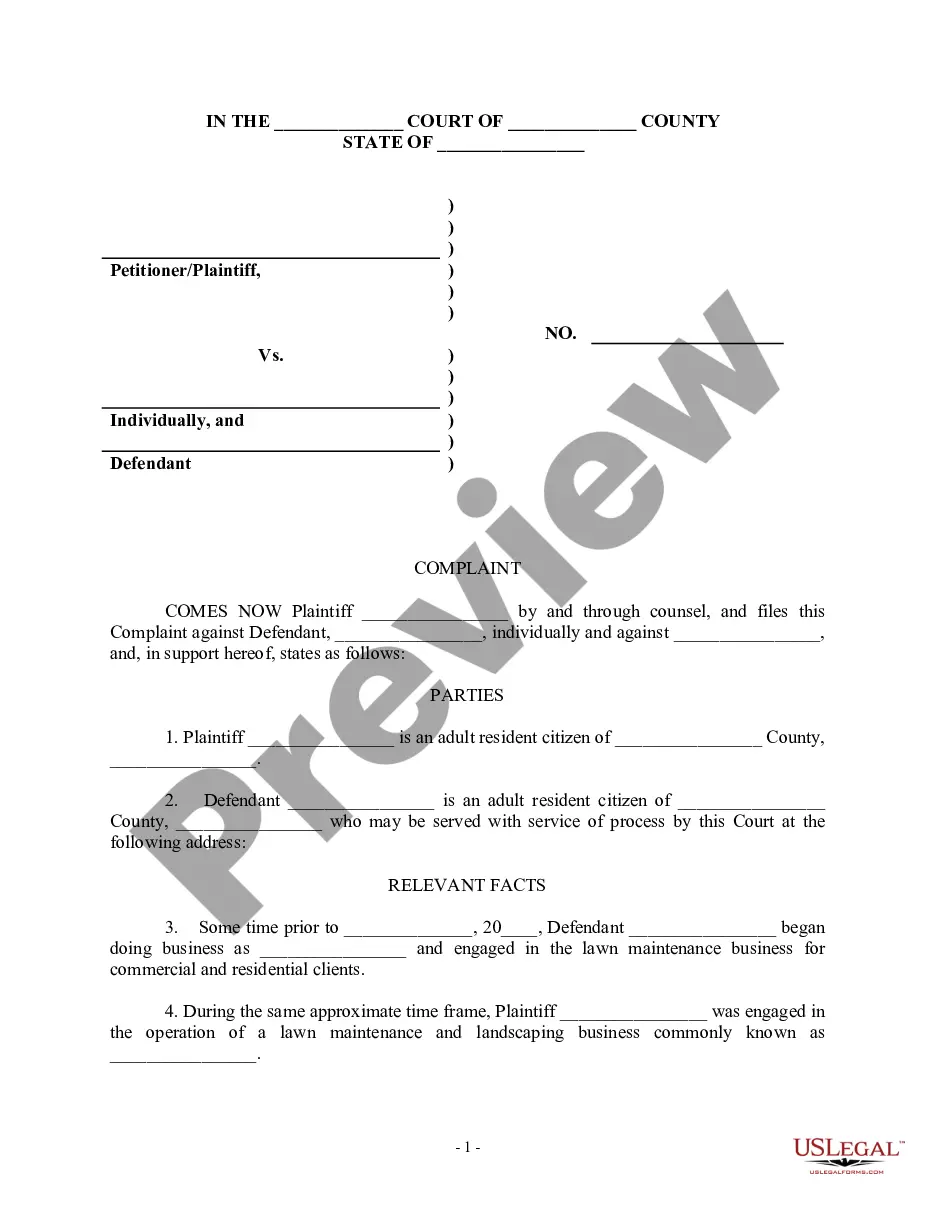
Write a short and plain statement of the claim. Do not make legal arguments. State as briefly as possible the facts showing that each plaintiff is entitled to the injunction or other relief sought.
Although the test for obtaining a TRO or PI may vary slightly across jurisdictions, generally a plaintiff seeking preliminary injunctive relief must satisfy a four-factor test: (1) that he or she is likely to succeed on the merits of his claims; (2) that he or she is likely to suffer irreparable harm without ...
A party seeking an injunction under general Florida case law must demonstrate: 1) irreparable harm; 2) a clear legal right; 3) an inadequate remedy at law; 4) consideration of the public interest.
Although the test for obtaining a TRO or PI may vary slightly across jurisdictions, generally a plaintiff seeking preliminary injunctive relief must satisfy a four-factor test: (1) that he or she is likely to succeed on the merits of his claims; (2) that he or she is likely to suffer irreparable harm without ...
Standard of Proof In Florida, a petitioner for an injunction must establish by “preponderance of the evidence” (i.e. greater weight of the evidence) that he or she is either a victim of domestic violence or is in imminent danger of being a victim of domestic violence.
These courts consider: (1) the likelihood of success on the merits; (2) irreparable harm if the injunction is not granted; (3) whether a balancing of the relevant equities favors the injunction; and (4) whether the issuance of the injunction is in the public interest.
