Emergency Injunction Form With Decimals In Cook
Description
















Get your form ready online
Our built-in tools help you complete, sign, share, and store your documents in one place.
Make edits, fill in missing information, and update formatting in US Legal Forms—just like you would in MS Word.
Download a copy, print it, send it by email, or mail it via USPS—whatever works best for your next step.
Sign and collect signatures with our SignNow integration. Send to multiple recipients, set reminders, and more. Go Premium to unlock E-Sign.
If this form requires notarization, complete it online through a secure video call—no need to meet a notary in person or wait for an appointment.
We protect your documents and personal data by following strict security and privacy standards.

Make edits, fill in missing information, and update formatting in US Legal Forms—just like you would in MS Word.

Download a copy, print it, send it by email, or mail it via USPS—whatever works best for your next step.

Sign and collect signatures with our SignNow integration. Send to multiple recipients, set reminders, and more. Go Premium to unlock E-Sign.

If this form requires notarization, complete it online through a secure video call—no need to meet a notary in person or wait for an appointment.

We protect your documents and personal data by following strict security and privacy standards.
Looking for another form?








Form popularity
FAQ
Two elements have to be taken into consideration to determine the grant of mandatory injunction, these are: (a) What acts are necessary in order to prevent a breach of the obligation; and, (b) The requisite acts must be such as the Court is capable of enforcing.
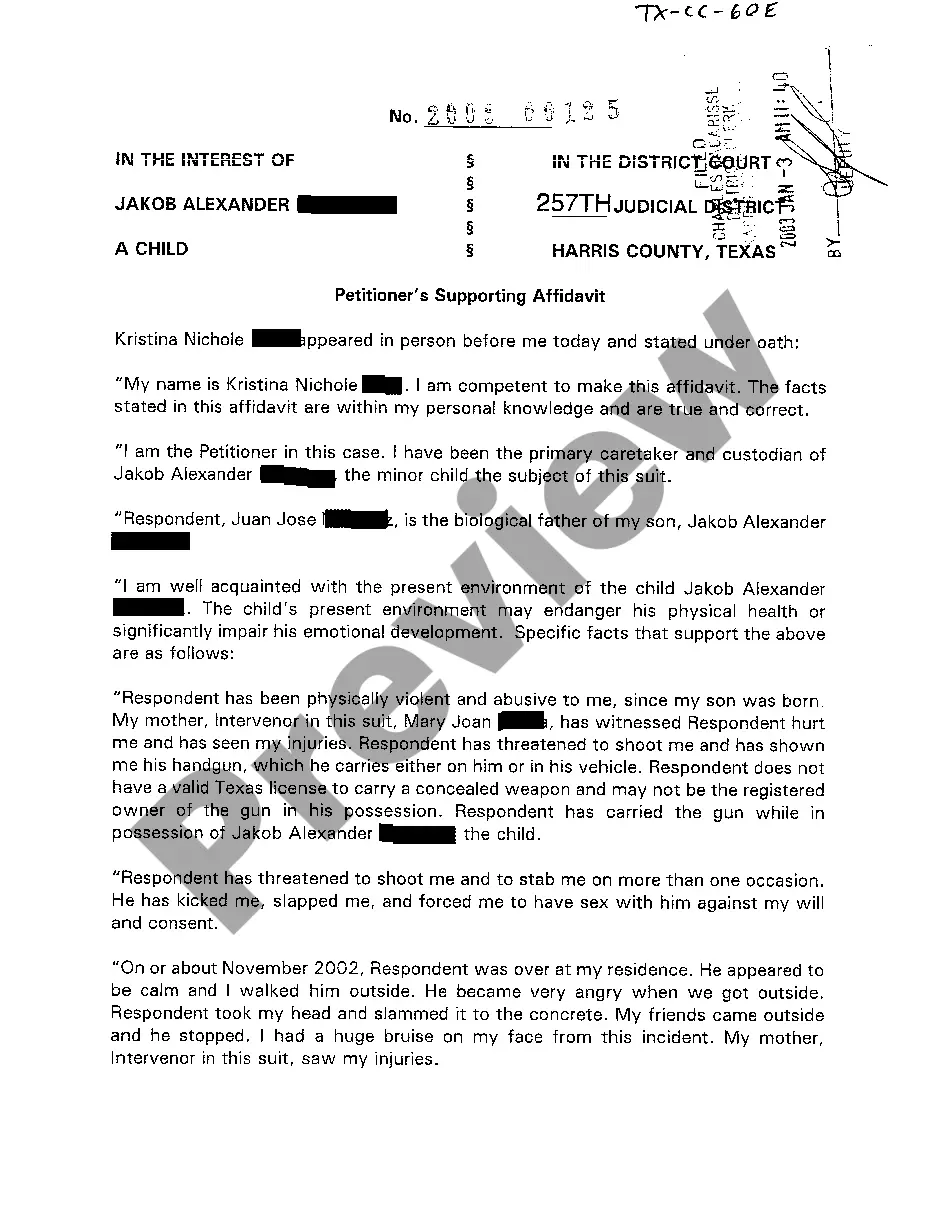
In order to get an injunction, you have to file a Petition with the court. You must also attach an affidavit to your Petition. Be sure that you properly plead your Petition. The Petition must be based on facts and not conclusions.
The party seeking a preliminary injunctive relief must demonstrate: (1) irreparable injury in the absence of such an order; (2) that the threatened injury to the moving party outweighs the harm to the opposing party resulting from the order; (3) that the injunction is not adverse to public interest; and (4) that the ...
Natural Resources Defense Council, Inc., 555 U.S. 7 (2008), is applicable to all other litigants seeking preliminary injunctions, and requires that a party seeking a preliminary injunction must establish: (1) it is likely to succeed on the merits, (2) it is likely to suffer irreparable harm in the absence of ...
In the case of a hearing, the applicant will present their arguments to a judge. If the judge is persuaded to make an order, they will grant an interim injunction and list a 'return hearing'. At the return hearing, the court will listen to the arguments of both parties and decide whether to make a 'final injunction'.
To seek a permanent injunction, the plaintiff must pass the four-step test: (1) that the plaintiff has suffered an irreparable injury; (2) that remedies available at law, such as monetary damages, are inadequate to compensate for the injury; (3) that the remedy in equity is warranted upon consideration of the balance ...
In the case of a hearing, the applicant will present their arguments to a judge. If the judge is persuaded to make an order, they will grant an interim injunction and list a 'return hearing'. At the return hearing, the court will listen to the arguments of both parties and decide whether to make a 'final injunction'.
An injunction or temporary restraining order is an order from the court prohibiting a party from performing or ordering a specified act, either temporarily or permanently.
Emergency injunctions are legal pleas for the court to take action to preserve the status quo while the legal process is underway. The idea is that unless the court intervenes, irreparable harm will be done.
An equitable remedy in which a court orders a party to perform, or refrain from performing, a particular act. A prohibitory injunction is an order forbidding a party from performing an act; a mandatory injunction is an order to perform an act.
