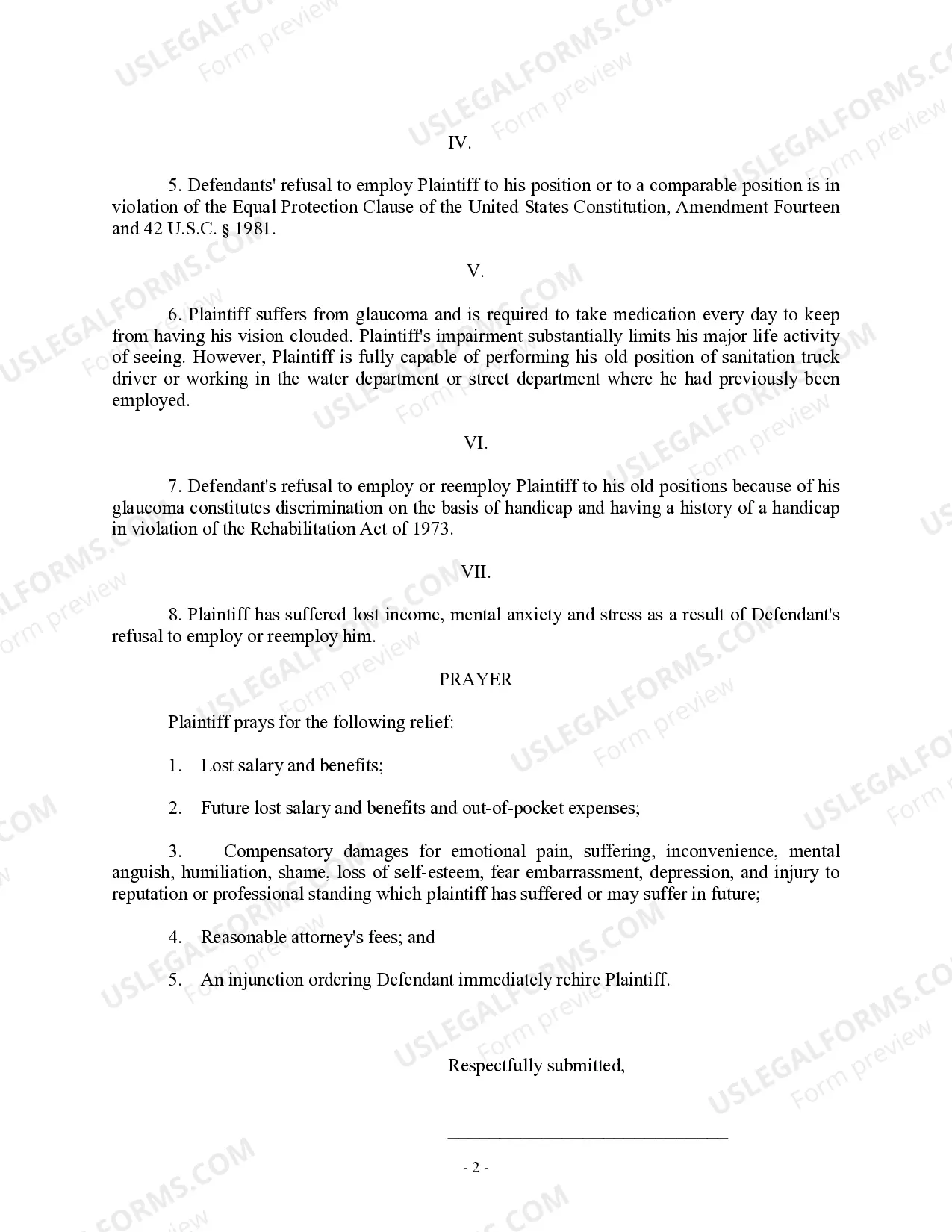
Plaintiff seeks to recover actual, compensatory, liquidated, and punitive damages for discrimination based upon discrimination concerning his disability. Plaintiff submits a request to the court for lost salary and benefits, future lost salary and benefits, and compensatory damages for emotional pain and suffering.
Discrimination For Woman In Wayne
Category:
State:
Multi-State
County:
Wayne
Control #:
US-000286
Format:
Word;
Rich Text
Instant download
Description
Free preview





Get your form ready online
Our built-in tools help you complete, sign, share, and store your documents in one place.
Built-in online Word editor
Make edits, fill in missing information, and update formatting in US Legal Forms—just like you would in MS Word.
Export easily
Download a copy, print it, send it by email, or mail it via USPS—whatever works best for your next step.
E-sign your document
Sign and collect signatures with our SignNow integration. Send to multiple recipients, set reminders, and more. Go Premium to unlock E-Sign.
Notarize online 24/7
If this form requires notarization, complete it online through a secure video call—no need to meet a notary in person or wait for an appointment.
Store your document securely
We protect your documents and personal data by following strict security and privacy standards.

Make edits, fill in missing information, and update formatting in US Legal Forms—just like you would in MS Word.

Download a copy, print it, send it by email, or mail it via USPS—whatever works best for your next step.

Sign and collect signatures with our SignNow integration. Send to multiple recipients, set reminders, and more. Go Premium to unlock E-Sign.

If this form requires notarization, complete it online through a secure video call—no need to meet a notary in person or wait for an appointment.

We protect your documents and personal data by following strict security and privacy standards.
Looking for another form?







Form popularity
FAQ
If you've experienced unlawful discrimination, you can complain to the person or organisation who's discriminated against you. You can also make a discrimination claim in the civil courts. Read this page to find out what you should do before you take action about unlawful discrimination.
Q: What Are the Chances of Winning an EEOC Case? A: The EEOC has a very high success rate when it comes to court decisions, reaching favorable outcomes in nearly 96% of all district court cases stemming from EEOC complaints.
Include the following in your complaint letter: Your name, address and telephone number. The name, address, and telephone number of your attorney or authorized representative, if you are represented. The basis of your complaint. The date(s) that the incident(s) you are reporting as discrimination occurred.
Ing to various legal industry analyses, plaintiffs in employment discrimination lawsuits might win at trial in approximately 1 out of 4 cases. However, this rate can fluctuate based on jurisdiction and the nature of the case.
Many cases of intentional discrimination are not proven by a single type of evidence. Rather, many different kinds of evidence-direct and circumstantial, statistical and anecdotal-are relevant to the showing of intent and should be assessed on a cumulative basis.
However, discrimination is a state of mind and, therefore, notoriously hard to prove. Sophisticated employers are well aware that discrimination is illegal. Thus, most cases are established through circumstantial evidence.
Evidence in a discrimination case in California typically includes: emails, text messages, recordings, disciplinary forms, termination documents, or a copy of your employment contract if one exists. If you're like most Californians, you spend an inordinate amount of time at work.
When it comes to California discrimination lawsuits, the potential payout varies greatly depending on the company's size. Take small businesses with fewer than 100 employees - they're looking at a maximum payout of $50,000. But scale up to 101-200 employees, and that number jumps to $100,000.
Gender discrimination that is severe or pervasive creating a hostile environment is against several federal and state laws and Stanford's policies: California state laws for housing/employment and education , Stanford's Protected Identity Harm Reporting , and Stanford's Nondiscrimination Policy .
Evidence takes several forms. It includes your testimony, which is the very first evidence gathered by EEOC. It also includes written materials such as evaluations, notes by your employer, letters, memos, and the like. You will be asked to provide any documents you may have that relate to your case.