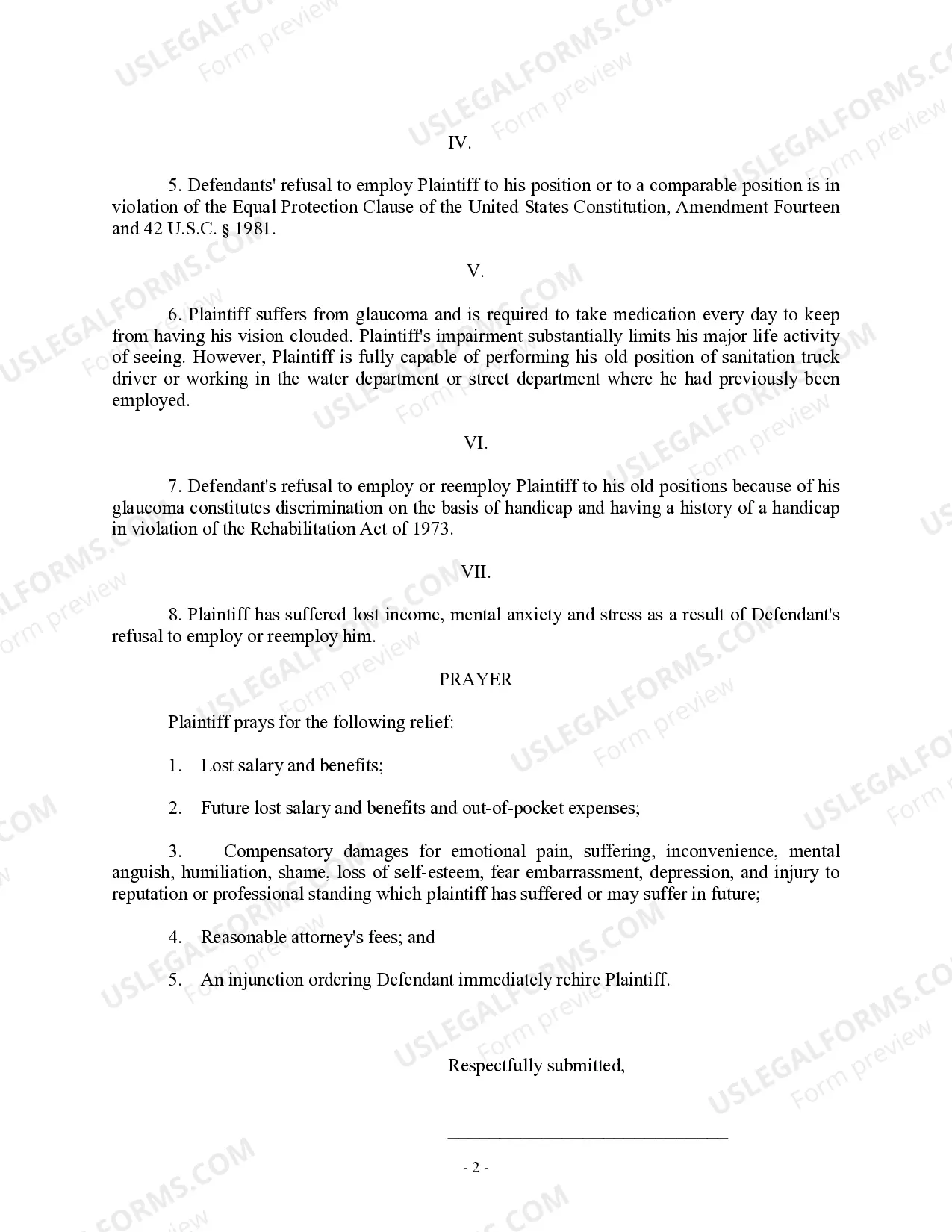
Plaintiff seeks to recover actual, compensatory, liquidated, and punitive damages for discrimination based upon discrimination concerning his disability. Plaintiff submits a request to the court for lost salary and benefits, future lost salary and benefits, and compensatory damages for emotional pain and suffering.
Discrimination With Gender In Washington
State:
Multi-State
Category:
Control #:
US-000286
Format:
Word;
Rich Text
143 downloads
Description
Free preview





Get your form ready online
Our built-in tools help you complete, sign, share, and store your documents in one place.
Built-in online Word editor
Make edits, fill in missing information, and update formatting in US Legal Forms—just like you would in MS Word.
Export easily
Download a copy, print it, send it by email, or mail it via USPS—whatever works best for your next step.
E-sign your document
Sign and collect signatures with our SignNow integration. Send to multiple recipients, set reminders, and more. Go Premium to unlock E-Sign.
Notarize online 24/7
If this form requires notarization, complete it online through a secure video call—no need to meet a notary in person or wait for an appointment.
Store your document securely
We protect your documents and personal data by following strict security and privacy standards.

Make edits, fill in missing information, and update formatting in US Legal Forms—just like you would in MS Word.

Download a copy, print it, send it by email, or mail it via USPS—whatever works best for your next step.

Sign and collect signatures with our SignNow integration. Send to multiple recipients, set reminders, and more. Go Premium to unlock E-Sign.

If this form requires notarization, complete it online through a secure video call—no need to meet a notary in person or wait for an appointment.

We protect your documents and personal data by following strict security and privacy standards.
Looking for another form?

Form popularity
FAQ
Having limited access to all-gender restrooms. Disfavoring someone based on gender. Using crude and harmful language based on their gender or gender expression. Intimidating someone based on their gender.
Yes, the Washington Law Against Discrimination prohibits discrimination on the basis of sexual orientation and gender identity in the areas of employment, housing, public accommodation, credit, and insurance. That prohibition became part of the Washington State Law Against Discrimination (RCW 49.60) on June 8, 2006.
Having limited access to all-gender restrooms. Disfavoring someone based on gender. Using crude and harmful language based on their gender or gender expression. Intimidating someone based on their gender.
RCW Chapter 49.60 is a State law that protects all people in Washington from unfair and discriminatory practices in employment, real estate transactions, public accommodations, credit, insurance, as well as health care whistleblower, and state employee whistleblower complaints.
Article 6. 1. Man and woman are equal in all fields of social and family life. 2. Man and woman are not discriminated in terms of gender.
You generally have to file a complaint with the CRD or EEOC before you can file a lawsuit in civil court. You are first required to obtain a “right to sue” notice before your case can be taken to court. You can request an immediate right to sue notice, without having to go through a complete CRD or EEOC investigation.
Evidence in a discrimination case in California typically includes: emails, text messages, recordings, disciplinary forms, termination documents, or a copy of your employment contract if one exists. If you're like most Californians, you spend an inordinate amount of time at work.
You generally have to file a complaint with the CRD or EEOC before you can file a lawsuit in civil court. You are first required to obtain a “right to sue” notice before your case can be taken to court. You can request an immediate right to sue notice, without having to go through a complete CRD or EEOC investigation.