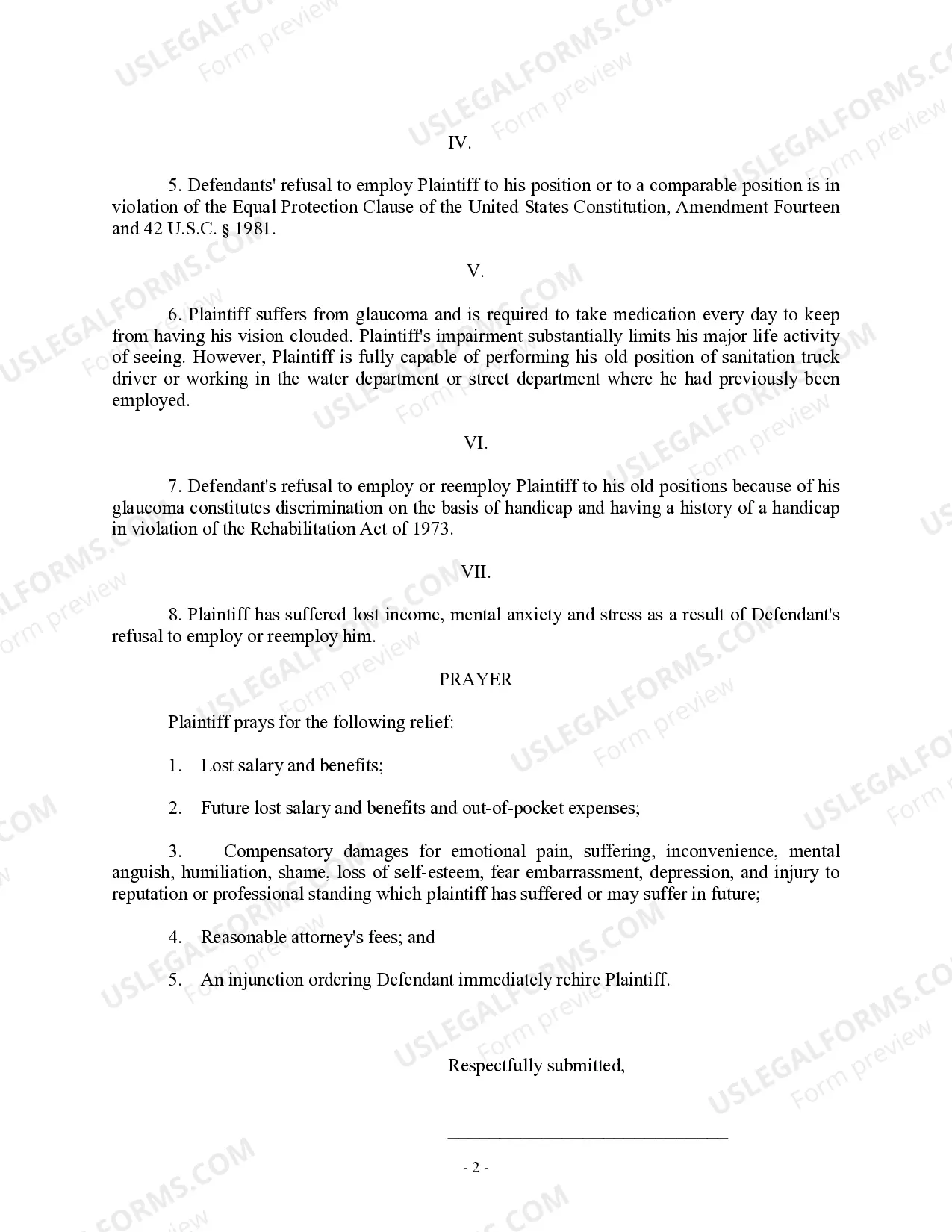
Plaintiff seeks to recover actual, compensatory, liquidated, and punitive damages for discrimination based upon discrimination concerning his disability. Plaintiff submits a request to the court for lost salary and benefits, future lost salary and benefits, and compensatory damages for emotional pain and suffering.
Discriminatory For Employees In Wake
State:
Multi-State
Category:
County:
Wake
Control #:
US-000286
Format:
Word;
Rich Text
143 downloads
Description
Free preview





Get your form ready online
Our built-in tools help you complete, sign, share, and store your documents in one place.
Built-in online Word editor
Make edits, fill in missing information, and update formatting in US Legal Forms—just like you would in MS Word.
Export easily
Download a copy, print it, send it by email, or mail it via USPS—whatever works best for your next step.
E-sign your document
Sign and collect signatures with our SignNow integration. Send to multiple recipients, set reminders, and more. Go Premium to unlock E-Sign.
Notarize online 24/7
If this form requires notarization, complete it online through a secure video call—no need to meet a notary in person or wait for an appointment.
Store your document securely
We protect your documents and personal data by following strict security and privacy standards.

Make edits, fill in missing information, and update formatting in US Legal Forms—just like you would in MS Word.

Download a copy, print it, send it by email, or mail it via USPS—whatever works best for your next step.

Sign and collect signatures with our SignNow integration. Send to multiple recipients, set reminders, and more. Go Premium to unlock E-Sign.

If this form requires notarization, complete it online through a secure video call—no need to meet a notary in person or wait for an appointment.

We protect your documents and personal data by following strict security and privacy standards.
Looking for another form?









Form popularity
FAQ
Ten types of discrimination Age discrimination. Disability. Gender/sexual orientation. Gender identity/gender expression. Genetic information. Military status/military obligations. National origin. Religion.
The following would be considered illegal discrimination if there is evidence that the decision was made based on a protected characteristic: Sexual Harassment. Refusal to Provide Services. Unfair Lending Practices. Misrepresenting the Availability of Housing. Refusal to Allow “Reasonable Modifications” Refusing Rental.
Age. Age discrimination involves treating someone (an applicant or employee) less favorably because of age. Disability. Genetic Information. Unlawful Workplace Harassment (Harassment) ... National Origin. Pregnancy. Race/Color. Religion.
Keep a Written Record: The first step in documenting employment discrimination is to keep a written record of every incident that occurs. Your records should include dates, times, locations, who was involved, who witnessed it, and details of what exactly happened.
It is okay to walk away and focus on your healing. Speak up when you are ready. Don't be afraid to have your voice heard. Engage in self-care activities. Your well-being is the key in fighting against discrimination. Embrace your strengths and identity. Seek professional support.
Unfair and Discriminatory Hiring Practices That Go Unnoticed Discrimination Based on Sexual Orientation or Gender Identity. Unconscious Bias in Resume Screening. Nepotism. Racial Discrimination. Salary History Inquiries.
If you've experienced unlawful discrimination, you can complain to the person or organisation who's discriminated against you. You can also make a discrimination claim in the civil courts. Read this page to find out what you should do before you take action about unlawful discrimination.
Document the information during or directly after the event so the details are as accurate as possible. Next, save copies of memos or emails that exhibit illegal or unfair practices. To support your claim, the last step is: ask witnesses to record their observations of what happened to support your claim.
Epithets, slurs, jokes, negative stereotyping or threatening, intimidating or hostile acts that relate to a person's race, color, religion, gender, national origin, age or disability.
You need to inform the person or organisation you want to take action against, why you want to take action. You do this by sending them a letter called a letter before claim. Your letter should explain what happened to you and why you think unlawful discrimination has taken place.