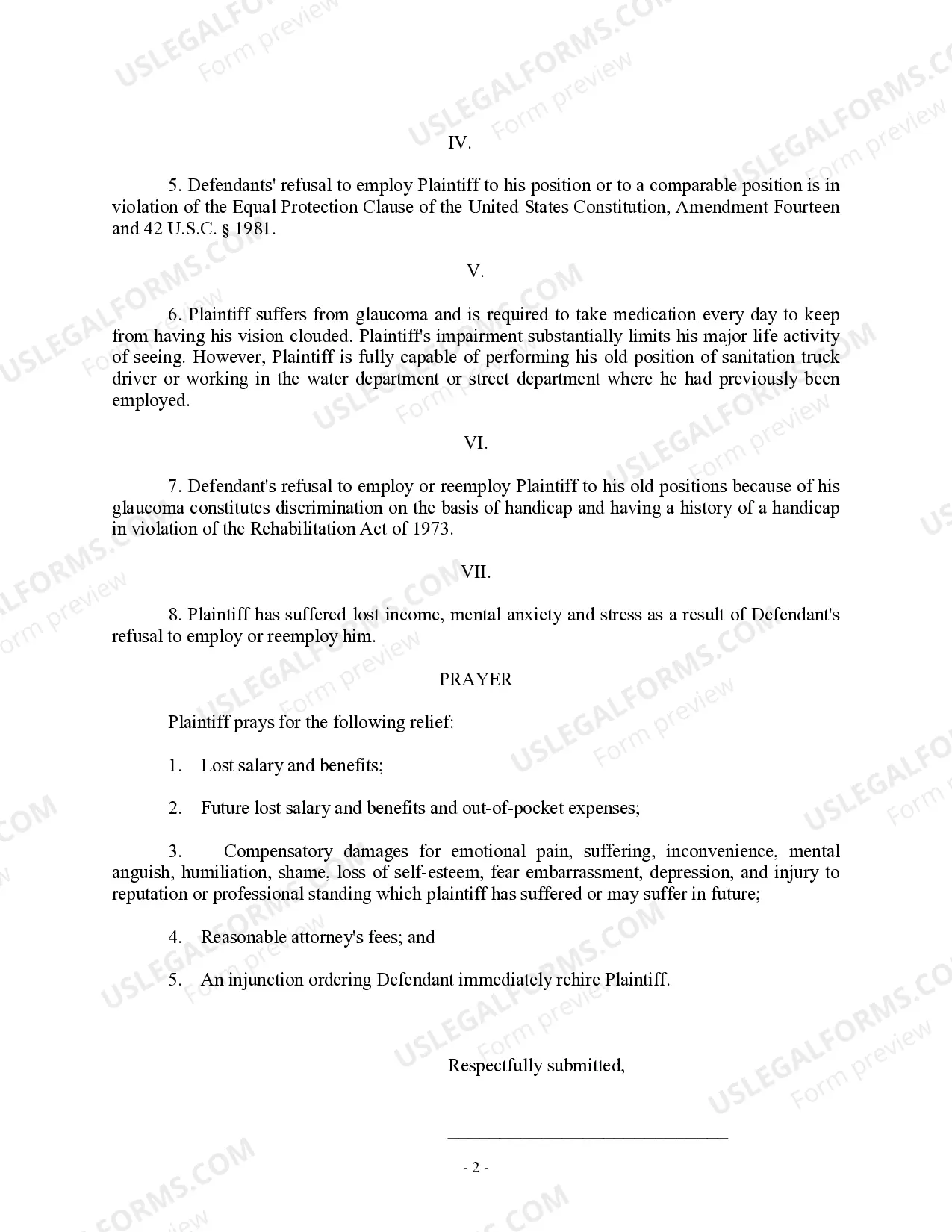
Plaintiff seeks to recover actual, compensatory, liquidated, and punitive damages for discrimination based upon discrimination concerning his disability. Plaintiff submits a request to the court for lost salary and benefits, future lost salary and benefits, and compensatory damages for emotional pain and suffering.
Discrimination With Ai In Maryland
State:
Multi-State
Category:
Control #:
US-000286
Format:
Word;
Rich Text
143 downloads
Description
Free preview





Get your form ready online
Our built-in tools help you complete, sign, share, and store your documents in one place.
Built-in online Word editor
Make edits, fill in missing information, and update formatting in US Legal Forms—just like you would in MS Word.
Export easily
Download a copy, print it, send it by email, or mail it via USPS—whatever works best for your next step.
E-sign your document
Sign and collect signatures with our SignNow integration. Send to multiple recipients, set reminders, and more. Go Premium to unlock E-Sign.
Notarize online 24/7
If this form requires notarization, complete it online through a secure video call—no need to meet a notary in person or wait for an appointment.
Store your document securely
We protect your documents and personal data by following strict security and privacy standards.

Make edits, fill in missing information, and update formatting in US Legal Forms—just like you would in MS Word.

Download a copy, print it, send it by email, or mail it via USPS—whatever works best for your next step.

Sign and collect signatures with our SignNow integration. Send to multiple recipients, set reminders, and more. Go Premium to unlock E-Sign.

If this form requires notarization, complete it online through a secure video call—no need to meet a notary in person or wait for an appointment.

We protect your documents and personal data by following strict security and privacy standards.
Looking for another form?








Form popularity
FAQ
An example is when a facial recognition system is less accurate in identifying people of color or when a language translation system associates certain languages with certain genders or stereotypes.
AI liability and current law Ultimately, liability for negligence would lie with the person, persons or entities who caused the damage or defect or who might have foreseen the product being used in the way that it was used.
The risks of AI for workers are greater if it undermines workers' rights, embeds bias and discrimination in decision-making processes, or makes consequential workplace decisions without transparency, human oversight, and review. There are also risks that workers will be displaced entirely from their jobs by AI.
Maryland law, HB 1202, prohibits an employer from using a facial recognition service for the purpose of creating a facial template during an applicant's pre-employment interview, unless the applicant consents by signing a specified waiver. This workplace AI law went into force on October 1, 2020.
If the hostile work environment is being caused by discrimination in the workplace, an employee must be harassed based on their actual or perceived belonging to a protected class, which includes their race, national origin, color, religion, age, gender, sexual orientation, pregnancy status, and disability status.
Currently, there is no comprehensive federal legislation or regulations in the US that regulate the development of AI or specifically prohibit or restrict their use.
Currently, there is no comprehensive federal legislation or regulations in the US that regulate the development of AI or specifically prohibit or restrict their use.
You'll want to address the person by name, include the date at the top of the letter, and your name, address, and phone number at the bottom. After the salutation, state the following: A description of the events or incidents you believed to be discriminatory, and when they occurred.
Evidence takes several forms. It includes your testimony, which is the very first evidence gathered by EEOC. It also includes written materials such as evaluations, notes by your employer, letters, memos, and the like. You will be asked to provide any documents you may have that relate to your case.