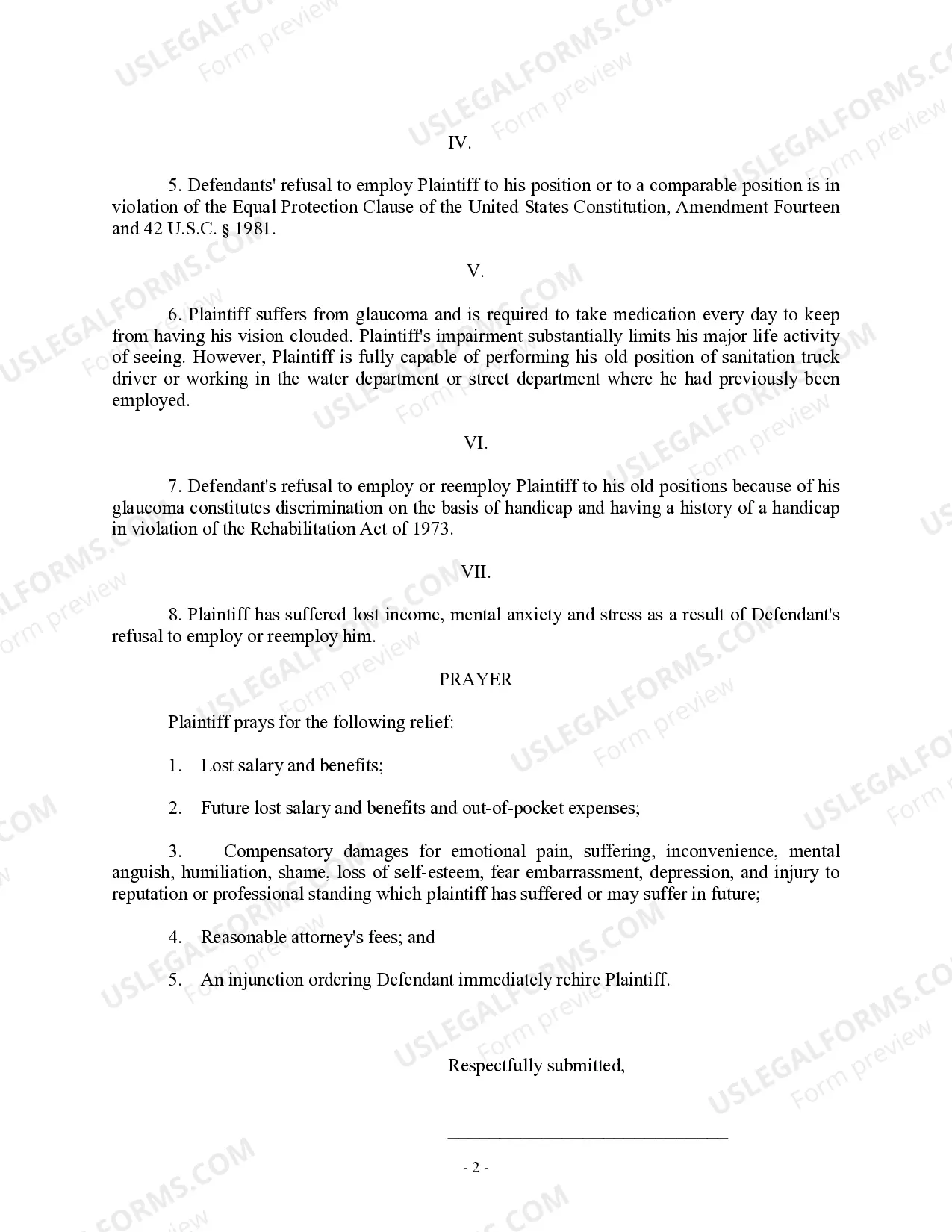
Plaintiff seeks to recover actual, compensatory, liquidated, and punitive damages for discrimination based upon discrimination concerning his disability. Plaintiff submits a request to the court for lost salary and benefits, future lost salary and benefits, and compensatory damages for emotional pain and suffering.
Discriminatory For Language In King
State:
Multi-State
Category:
County:
King
Control #:
US-000286
Format:
Word;
Rich Text
143 downloads
Description
Free preview





Get your form ready online
Our built-in tools help you complete, sign, share, and store your documents in one place.
Built-in online Word editor
Make edits, fill in missing information, and update formatting in US Legal Forms—just like you would in MS Word.
Export easily
Download a copy, print it, send it by email, or mail it via USPS—whatever works best for your next step.
E-sign your document
Sign and collect signatures with our SignNow integration. Send to multiple recipients, set reminders, and more. Go Premium to unlock E-Sign.
Notarize online 24/7
If this form requires notarization, complete it online through a secure video call—no need to meet a notary in person or wait for an appointment.
Store your document securely
We protect your documents and personal data by following strict security and privacy standards.

Make edits, fill in missing information, and update formatting in US Legal Forms—just like you would in MS Word.

Download a copy, print it, send it by email, or mail it via USPS—whatever works best for your next step.

Sign and collect signatures with our SignNow integration. Send to multiple recipients, set reminders, and more. Go Premium to unlock E-Sign.

If this form requires notarization, complete it online through a secure video call—no need to meet a notary in person or wait for an appointment.

We protect your documents and personal data by following strict security and privacy standards.
Looking for another form?




Form popularity
FAQ
You should use inclusive language (gender neutral, non-sexist, non-gender specific) that includes women and treats men and women equally. ✓ Use titles and modes of address consistently for men and for women. (e.g. Use Ms in preference to Miss/Mrs, unless this is preferred.)
8 Best Practices to Avoid Discriminatory Language Use people-first language. Avoid gender assumptions. Use gender-inclusive language. Use an augmented writing tool. Create a “discriminatory language in the workplace policy” ... Be mindful of racial, national, and cultural bias.
Inclusive communication puts people first, avoiding stereotypical, archaic or offensive terms. People are not defined by attributes such as race, gender or disability. A person's race, religion, gender or disability should only be mentioned when absolutely necessary.
Discriminatory examples: “In a manly way.” “Oh, that's women's work.”
Top Tips for Challenging Discriminatory Language Ask questions. Challenge the language, not the person. Mention how it makes you feel. Help them understand. Upstander assembly. Banter vs. Diversity Day. Reporting Tools.
Linguistic discrimination (also called glottophobia, linguicism and languagism) is unfair treatment of people based upon their use of language and the characteristics of their speech, such as their first language, their accent, the perceived size of their vocabulary (whether or not the speaker uses complex and varied ...
Top Tips for Challenging Discriminatory Language Ask questions. Challenge the language, not the person. Mention how it makes you feel. Help them understand. Upstander assembly. Banter vs. Diversity Day. Reporting Tools.
The following tips can be used to avoid discriminatory language in the workplace: Use gender-inclusive words, such as 'they,' 'she/he' and 'server' instead of 'waitress. ' Use appropriate words to describe disabilities, such as 'a person with a vision disability' instead of a 'blind person.
Language discrimination occurs when a person is treated differently because of her native language or other characteristics of her language skills. For example, an employee may be experiencing language discrimination if the workplace has a “speak-English-only” policy but her primary language is one other than English.
Linguistic discrimination (also called glottophobia, linguicism and languagism) is unfair treatment of people based upon their use of language and the characteristics of their speech, such as their first language, their accent, the perceived size of their vocabulary (whether or not the speaker uses complex and varied ...