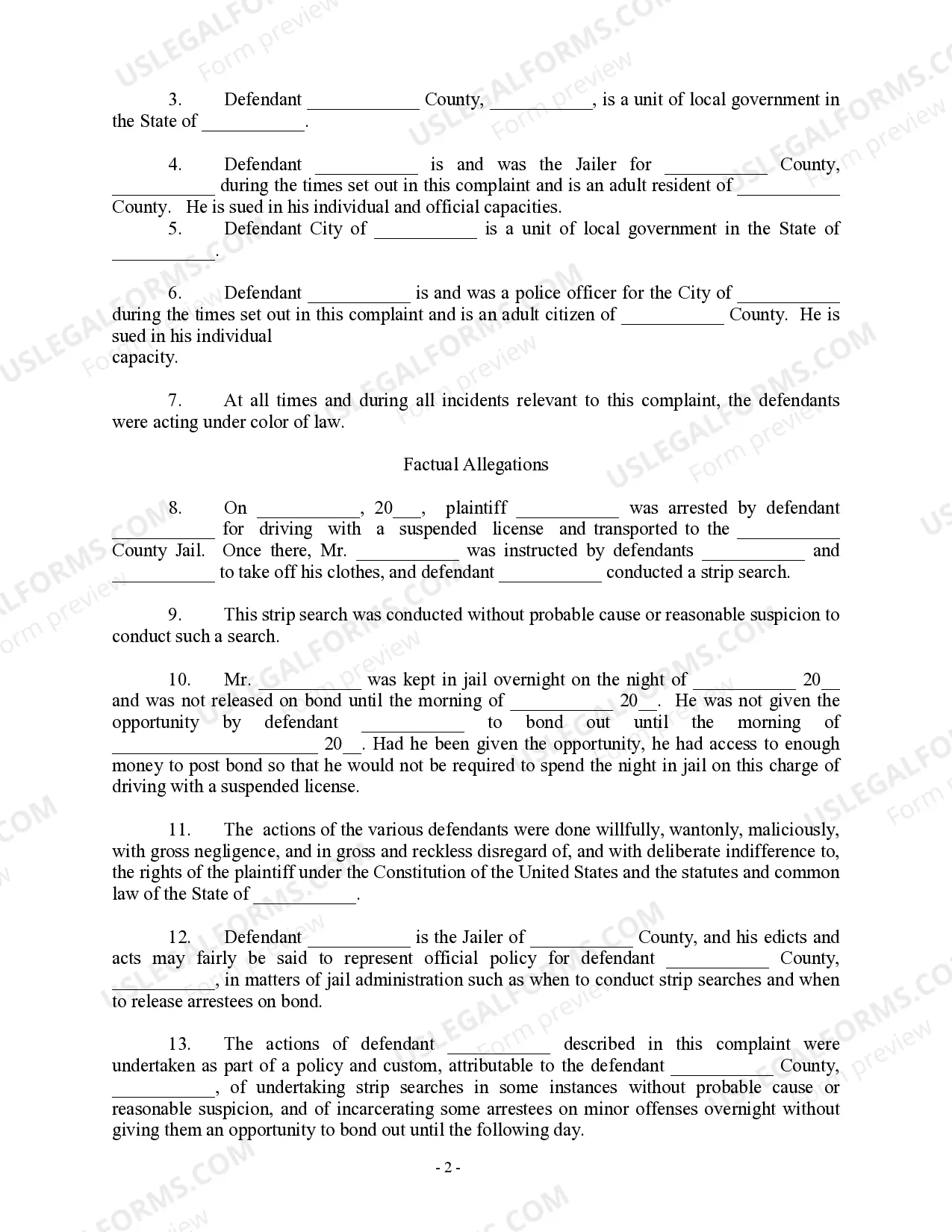
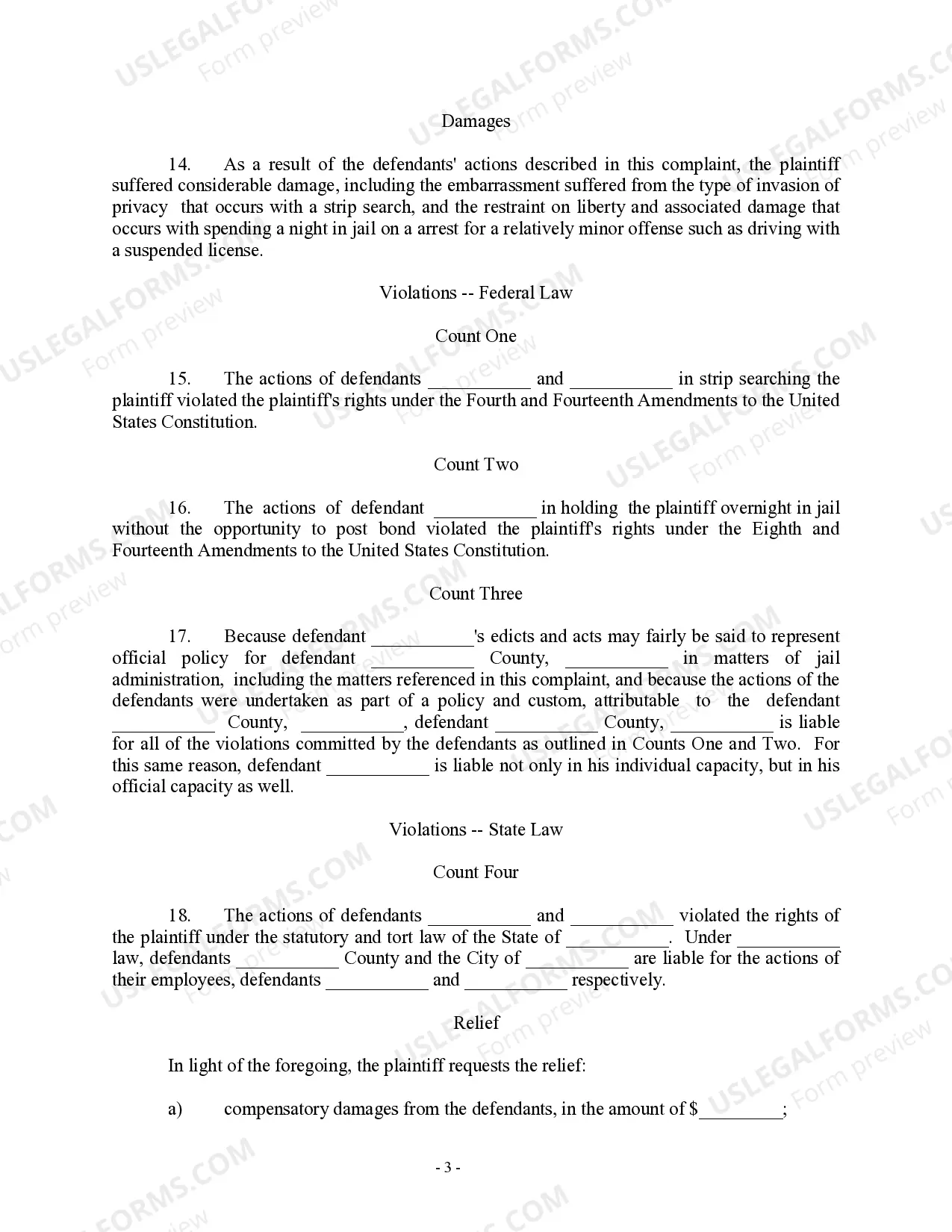
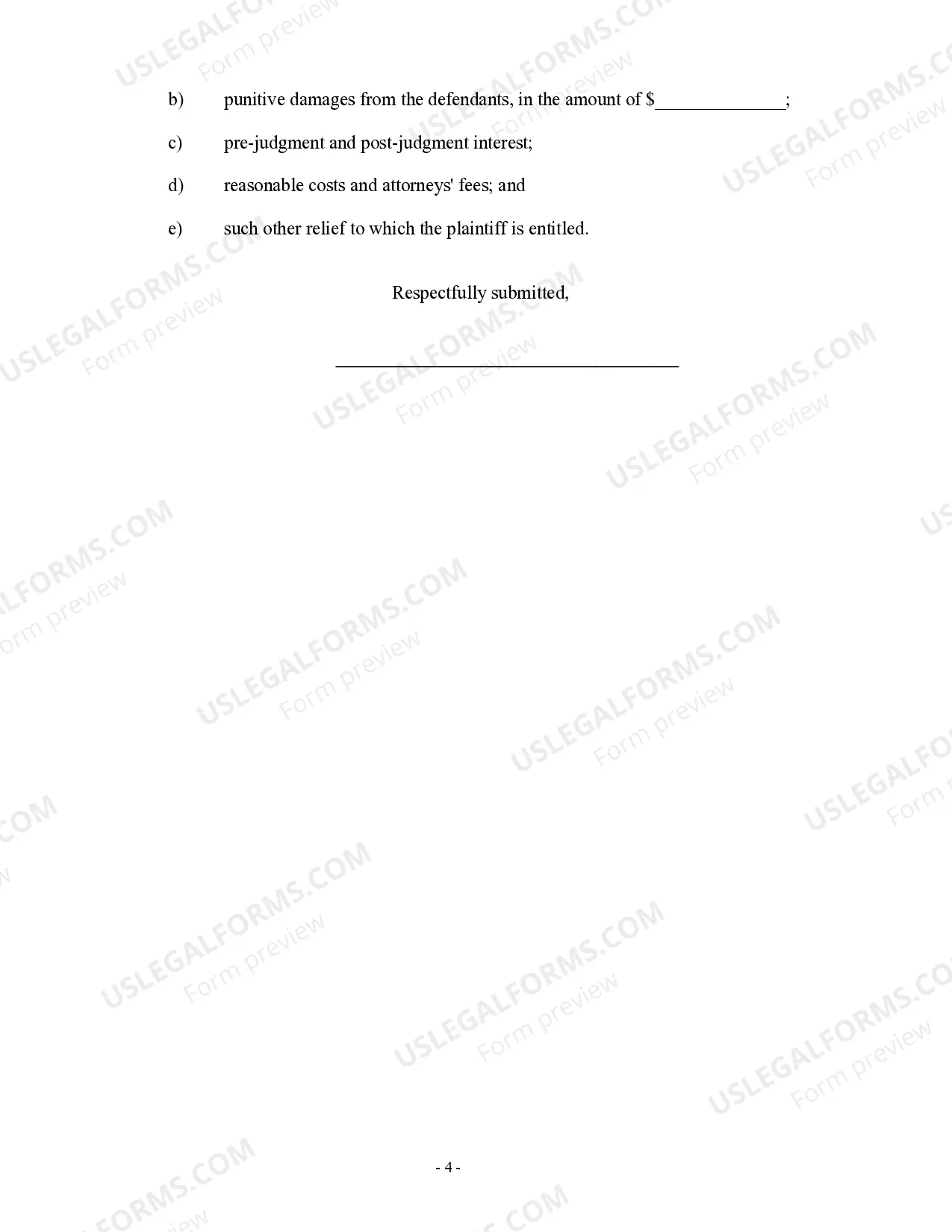
This form is a Complaint. This action was filed by the plaintiff due to a strip search which was conducted upon his/her person after an arrest. The plaintiff requests that he/she be awarded compensatory damages and punitive damages for the alleged violation of his/her constitutional rights.
Amendment Forbidding Search And Seizure In Wake
State:
Multi-State
Category:
County:
Wake
Control #:
US-000282
Format:
Word;
Rich Text
81 downloads
Description
Free preview




Get your form ready online
Our built-in tools help you complete, sign, share, and store your documents in one place.
Built-in online Word editor
Make edits, fill in missing information, and update formatting in US Legal Forms—just like you would in MS Word.
Export easily
Download a copy, print it, send it by email, or mail it via USPS—whatever works best for your next step.
E-sign your document
Sign and collect signatures with our SignNow integration. Send to multiple recipients, set reminders, and more. Go Premium to unlock E-Sign.
Notarize online 24/7
If this form requires notarization, complete it online through a secure video call—no need to meet a notary in person or wait for an appointment.
Store your document securely
We protect your documents and personal data by following strict security and privacy standards.

Make edits, fill in missing information, and update formatting in US Legal Forms—just like you would in MS Word.

Download a copy, print it, send it by email, or mail it via USPS—whatever works best for your next step.

Sign and collect signatures with our SignNow integration. Send to multiple recipients, set reminders, and more. Go Premium to unlock E-Sign.

If this form requires notarization, complete it online through a secure video call—no need to meet a notary in person or wait for an appointment.

We protect your documents and personal data by following strict security and privacy standards.
Looking for another form?








Form popularity
FAQ
Both controversies led to the famous notion that a person's home is their castle, not easily invaded by the government. Today the Fourth Amendment is understood as placing restraints on the government any time it detains (seizes) or searches a person or property.
United States, 275 U.S. 192, 194 (1927) ( It has long been settled that the Fifth Amendment protects every person against incrimination by the use of evidence obtained through search or seizure made in violation of his rights under the Fourth Amendment. ).
Third Amendment: restricts housing soldiers in private homes. Fourth Amendment: protects against unreasonable search and seizure. Fifth Amendment: protects against self-testimony, being tried twice for the same crime, and the seizure of property under eminent domain.
The Constitution, through the Fourth Amendment, protects people from unreasonable searches and seizures by the government.
Further, warrantless seizure of abandoned property, or of properties on an open field do not violate Fourth Amendment, because it is considered that having expectation of privacy right to an abandoned property or to properties on an open field is not reasonable.
The right of the people to be secure in their persons, houses, papers, and effects, against unreasonable searches and seizures, shall not be violated, and no Warrants shall issue, but upon probable cause, supported by Oath or affirmation, and particularly describing the place to be searched, and the persons or things ...
For practical purposes, a traffic stop is essentially the same as a Terry stop; for the duration of a stop, driver and passengers are "seized" within the meaning of the Fourth Amendment.
For example, a sudden search of a driver's motor vehicle after a speeding ticket stop may constitute an illegal search and seizure if the law enforcement officer did not have probable cause to believe that the driver had committed another crime.
The Constitution, through the Fourth Amendment, protects people from unreasonable searches and seizures by the government. The Fourth Amendment, however, is not a guarantee against all searches and seizures, but only those that are deemed unreasonable under the law.