Patent Infringement In India In Phoenix
Description

Get your form ready online
Our built-in tools help you complete, sign, share, and store your documents in one place.
Make edits, fill in missing information, and update formatting in US Legal Forms—just like you would in MS Word.
Download a copy, print it, send it by email, or mail it via USPS—whatever works best for your next step.
Sign and collect signatures with our SignNow integration. Send to multiple recipients, set reminders, and more. Go Premium to unlock E-Sign.
If this form requires notarization, complete it online through a secure video call—no need to meet a notary in person or wait for an appointment.
We protect your documents and personal data by following strict security and privacy standards.

Make edits, fill in missing information, and update formatting in US Legal Forms—just like you would in MS Word.

Download a copy, print it, send it by email, or mail it via USPS—whatever works best for your next step.

Sign and collect signatures with our SignNow integration. Send to multiple recipients, set reminders, and more. Go Premium to unlock E-Sign.

If this form requires notarization, complete it online through a secure video call—no need to meet a notary in person or wait for an appointment.

We protect your documents and personal data by following strict security and privacy standards.
Looking for another form?








Form popularity
FAQ
If the patent is a US patent and you have reason to believe that the patent is invalid and never should have been issued (based on your knowledge of the industry and/or the results of a prior art search), you may be able to challenge the patent's validity using a United States Patent and Trademark Office (USPTO) ...
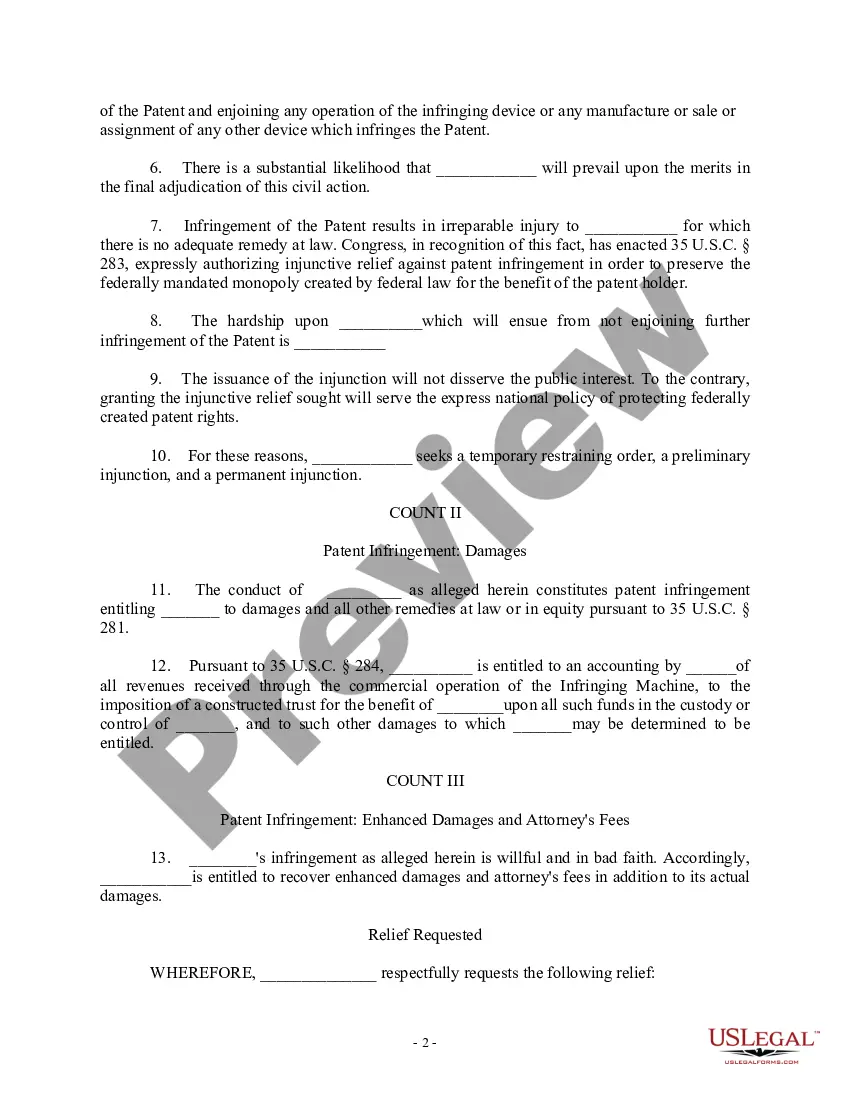
In India, the process of patent infringement involves filing an infringement suit in court, presenting evidence of infringement, and attending hearings to argue the case. The court assesses the evidence, including expert testimony, and delivers a judgement based on the merits of the case.
Any third party may challenge a pending patent application by filing a third party preissuance submission that includes prior art. The goal is to cause the examiner to reject the claims in the utility patent application or at least prevent the applicant from obtaining broader claims.
The Patents Act of 19701 serves as the cornerstone of patent law in India, establishing the framework for the protection and enforcement of patent rights.
Interested parties, or the government, can also file a petition for revocation of a patent at any time during the life of the patent. Such petitions must be lodged with the Intellectual Property Appellate Board (IPAB) or at High Court level.
This probably will require hiring a patent attorney. You should make sure to find an attorney who has handled patent infringement cases previously and who is familiar with your industry. Your attorney will file a formal complaint in federal court, explaining how the defendant has infringed on your patent.
The remedies include temporary injunction, permanent injunction, damages or account of profits.
Patent infringement in India can lead to civil remedies such as injunctions, damages, or an account of profits. Criminal penalties are generally not applied, but financial liability can be substantial.
The IPR Center encourages victims to visit its website at .IPRCenter to obtain more information about the IPR Center and to report violations of intellectual property rights online or by emailing IPRCenter@dhs. You can also report IP crime by clicking on The IRP Center's “Report IP Theft” button.
If a patent holder believes that another party has infringed upon their patent and chooses to litigate, they will file a civil lawsuit in a U.S. district court.