Replevin Foreclosure In Houston
Description


Get your form ready online
Our built-in tools help you complete, sign, share, and store your documents in one place.
Make edits, fill in missing information, and update formatting in US Legal Forms—just like you would in MS Word.
Download a copy, print it, send it by email, or mail it via USPS—whatever works best for your next step.
Sign and collect signatures with our SignNow integration. Send to multiple recipients, set reminders, and more. Go Premium to unlock E-Sign.
If this form requires notarization, complete it online through a secure video call—no need to meet a notary in person or wait for an appointment.
We protect your documents and personal data by following strict security and privacy standards.

Make edits, fill in missing information, and update formatting in US Legal Forms—just like you would in MS Word.

Download a copy, print it, send it by email, or mail it via USPS—whatever works best for your next step.

Sign and collect signatures with our SignNow integration. Send to multiple recipients, set reminders, and more. Go Premium to unlock E-Sign.

If this form requires notarization, complete it online through a secure video call—no need to meet a notary in person or wait for an appointment.

We protect your documents and personal data by following strict security and privacy standards.
Looking for another form?









Form popularity
FAQ
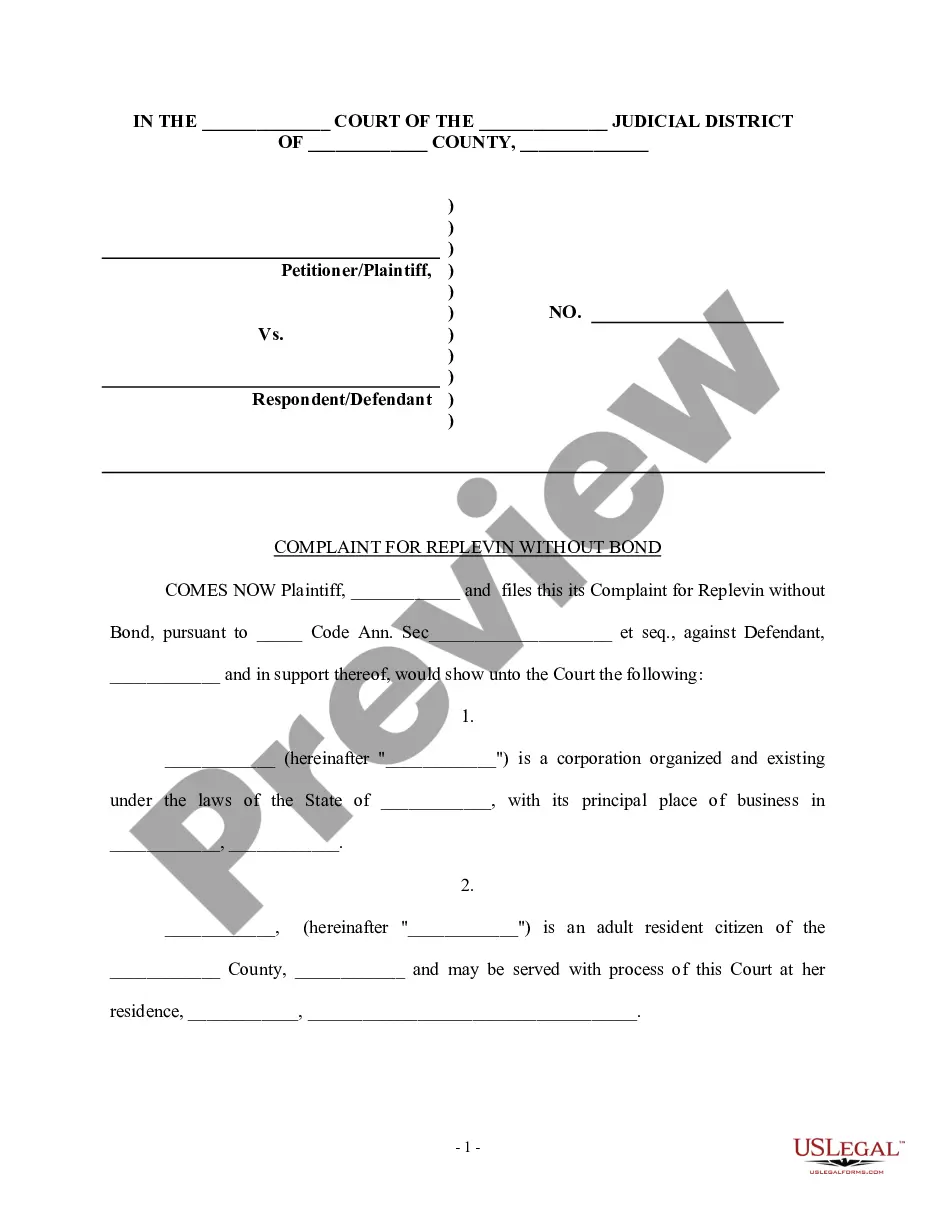
The process of starting a replevin action usually begins with filing a complaint. It also requires filing an affidavit in the county or district court where the property is. The affidavit: States that the plaintiff claims rightful ownership or entitlement to possession of the property.
Procedure for Obtaining, in Court, a Writ of Replevin The filing of a complaint begins a replevin action. As in other civil actions, the defendant is brought into Court by the service of the summons and the complaint. If the plaintiff establishes the cause of action, the Court must enter an Order granting possession.
The replevin remedy is quick. The hearing on the writ will typically take place within 50 days of filing the lawsuit. The writ should be to the sheriff within 10 days after the hearing. The writ itself is good for 60 days, and the sheriff generally makes more than one attempt at recovery.
When filing a replevin suit, the plaintiff must provide evidence that they are the rightful owner of the property in question and that it was taken without justification or consent.
In Texas, the types of foreclosure include expedited, judicial, and non-judicial. Most foreclosures are non-judicial types. This means court approval isn't required and speeds up the process. Many Texas foreclosures take 160 days.
In Texas, there are three ways in which a lienholder can foreclose on a property: Judicial Foreclosure. A judicial foreclosure requires the lienholder to file a civil lawsuit against the homeowner. Non-Judicial Foreclosure. Expedited Foreclosure. Court Rules.
Many lenders prefer to use non-judicial foreclosure because it is often faster and less expensive than judicial foreclosure. Non-judicial foreclosure has an expedited time compared to judicial foreclosure.
The process of starting a replevin action usually begins with filing a complaint. It also requires filing an affidavit in the county or district court where the property is. The affidavit: States that the plaintiff claims rightful ownership or entitlement to possession of the property.
In Texas, there are three ways in which a lienholder can foreclose on a property: Judicial Foreclosure. A judicial foreclosure requires the lienholder to file a civil lawsuit against the homeowner. Non-Judicial Foreclosure. Expedited Foreclosure. Court Rules.
The process involves: Filing a Complaint: The plaintiff must file a detailed complaint, specifying the property and asserting their ownership or right to possession. Notice and Hearing: The defendant is given notice, and a hearing is scheduled. The plaintiff must prove their claim to the property.
