Complaint Waived File For Divorce In Salt Lake
Description




Get your form ready online
Our built-in tools help you complete, sign, share, and store your documents in one place.
Make edits, fill in missing information, and update formatting in US Legal Forms—just like you would in MS Word.
Download a copy, print it, send it by email, or mail it via USPS—whatever works best for your next step.
Sign and collect signatures with our SignNow integration. Send to multiple recipients, set reminders, and more. Go Premium to unlock E-Sign.
If this form requires notarization, complete it online through a secure video call—no need to meet a notary in person or wait for an appointment.
We protect your documents and personal data by following strict security and privacy standards.

Make edits, fill in missing information, and update formatting in US Legal Forms—just like you would in MS Word.

Download a copy, print it, send it by email, or mail it via USPS—whatever works best for your next step.

Sign and collect signatures with our SignNow integration. Send to multiple recipients, set reminders, and more. Go Premium to unlock E-Sign.

If this form requires notarization, complete it online through a secure video call—no need to meet a notary in person or wait for an appointment.

We protect your documents and personal data by following strict security and privacy standards.
Looking for another form?




Form popularity
FAQ
If the respondent does NOT answer If the respondent misses the deadline to file an answer, you can ask for a default judgment. This means you get what you asked for in the divorce petition.
An absolute divorce, also known as a final divorce, is the complete and permanent termination of a marital union.
It cannot be waived, no. The court can enter a judgment making the marriage automatically terminate once the 90 days is up, but the 90 days must pass before the marriage dissolves. There is no way to sugar coat that.
Either party can ask the court to bifurcate the case by filing a Motion to Grant Divorce and Decide Other Issues Later. Utah Rule of Civil Procedure 42.
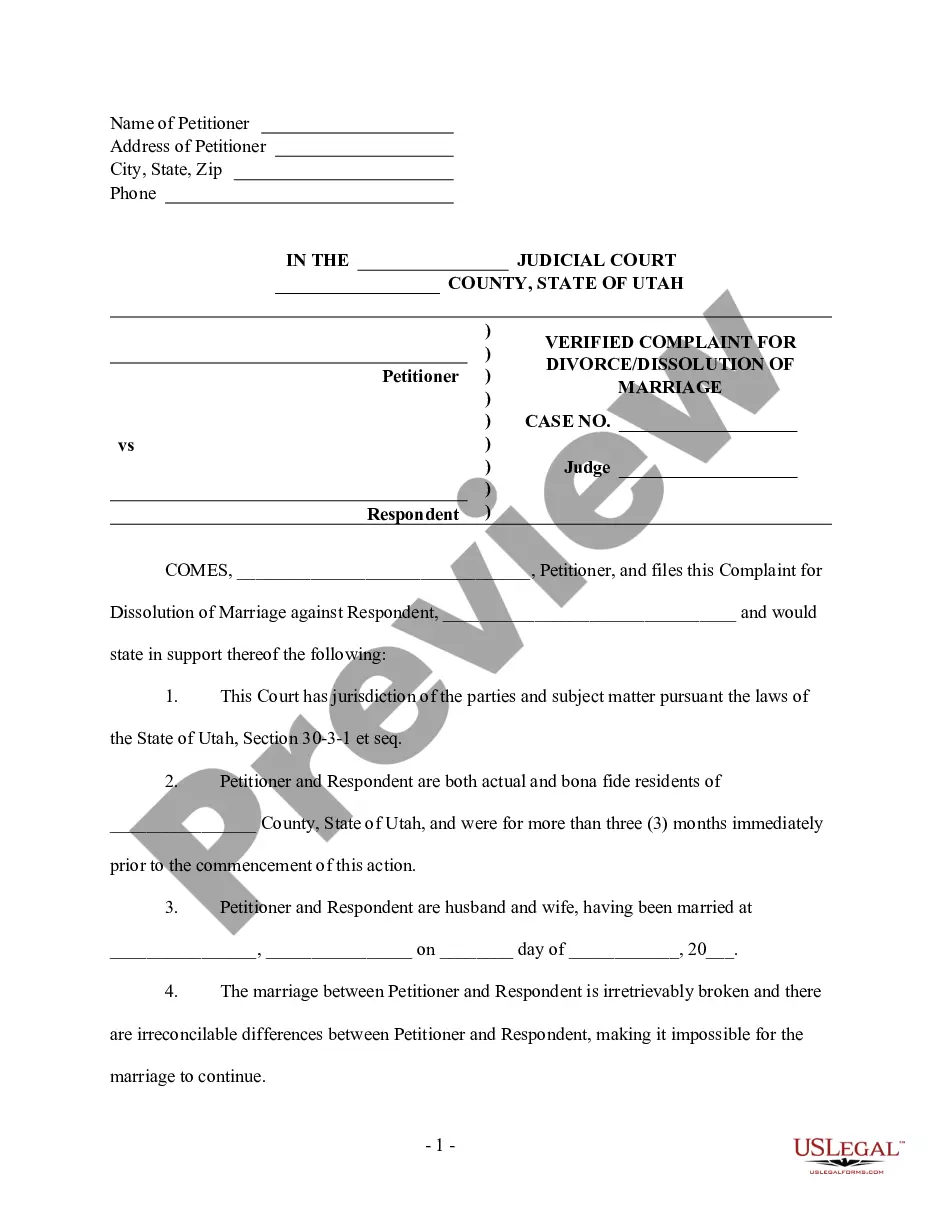
A Complaint for Divorce or Filing for Divorce is the formalized process of filing paperwork such that legal and factual issues maybe set forth and later addressed at trial, if necessary.
A divorce or legal separation case begins when the plaintiff the party who starts the court case files a formal complaint at the courthouse. The defendant, the other party, may answer within 28 days. If an answer is filed, the case is contested. If the defendant does not file an answer, the case is uncontested.
If your spouse doesn't file a response within 30 days of being served, you can ask the court for a default. This means asking the court to decide the case without your spouse's input. In a divorce by default, the court will make decisions based on the information you file and what the law says.
In many legal systems, both parties don't necessarily have to agree to get divorced. One spouse can file for divorce even if the other disagrees, although the specific requirements and processes can vary by jurisdiction.
Contested Divorce Ultimately, the parties either reach a settlement or the trial concludes with a final judgment from the court. The whole process can take 9 months or even longer in more complex cases, for example, those involving hidden assets, domestic violence, or other serious complications.
