Types Of Torts In Law In Suffolk
Description










Form popularity
FAQ
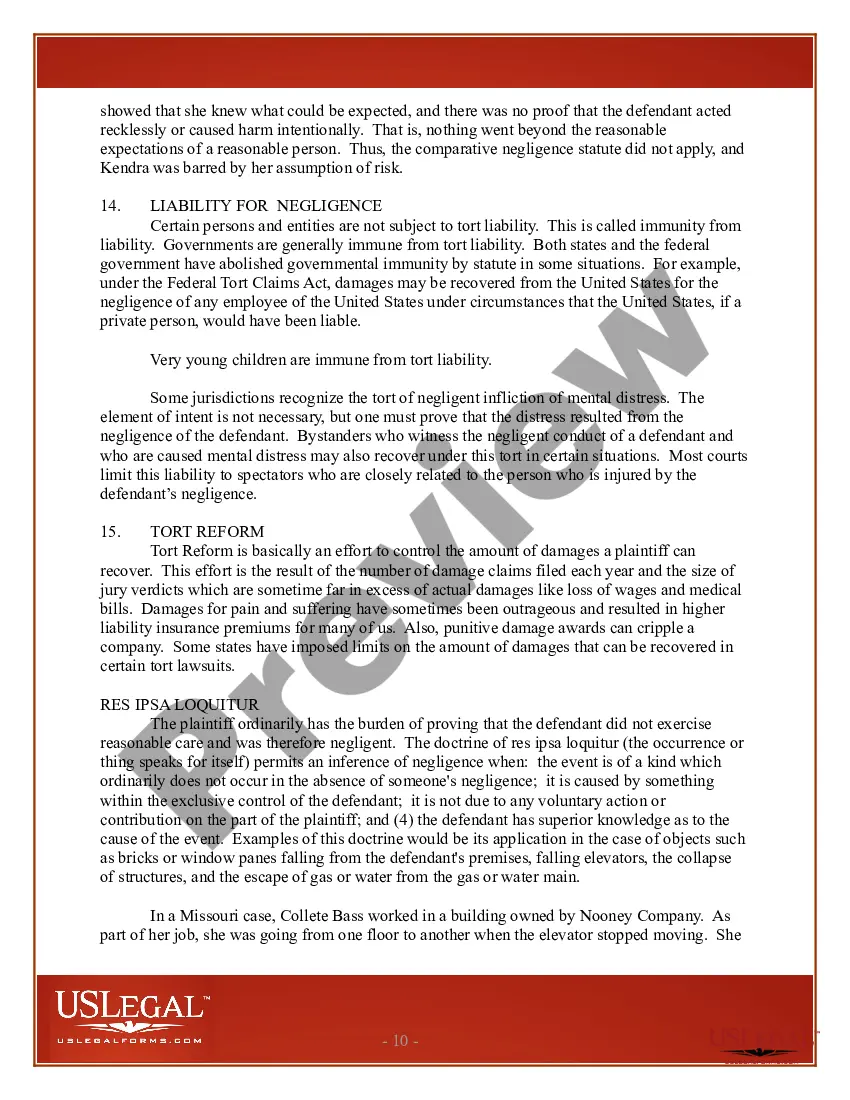
Torts fall into three general categories: Intentional torts (e.g., intentionally hitting a person); Negligent torts (e.g., causing an accident by failing to obey traffic rules); and. Strict liability torts (e.g., liability for making and selling defective products - see Products Liability).
This course focuses on personal injury law, as it has developed within the Anglo-American legal tradition. In particular, the concept of negligence and the refinements of negligence law will be extensively considered.
Some of the hardest classes in law school, ing to current and former students, are: Constitutional Law. Civil Procedure. Contracts. Federal Courts. Federal Income Tax. Administrative Law. Partnership Tax.
Law MSLL students must be enrolled in at least 12 credits per academic period to be considered full-time, between 9 - 11 credits per academic period to be considered three-quarter time, and at least 6 credits per academic period to be considered half-time.
The most common kind of tort that occurs in the public school context is negligence. More specifically, the most common kind of tort claim brought against schools seeks recovery of damages for personal injuries. Preventing injury is not only an ethical responsibility, but also a legal obligation.
Law of tort and law of torts, the difference lays in the concepts. The former has a broader scope where all the wrongful acts backed by legal justification can be brought into action, whereas the other one has a limited scope which restricts the actions to be brought under certain specified torts to seek remedy.
This course focuses on personal injury law, as it has developed within the Anglo-American legal tradition. In particular, the concept of negligence and the refinements of negligence law will be extensively considered.
A tort is an act or omission that causes legally cognizable harm to persons or property. Tort law, in turn, is the body of rules concerned with remedying harms caused by a person's wrongful or injurious actions.
Suffolk Law School Admissions Suffolk Law School is considered a Somewhat Competitive law school, which accepts only 70% of its applicants.