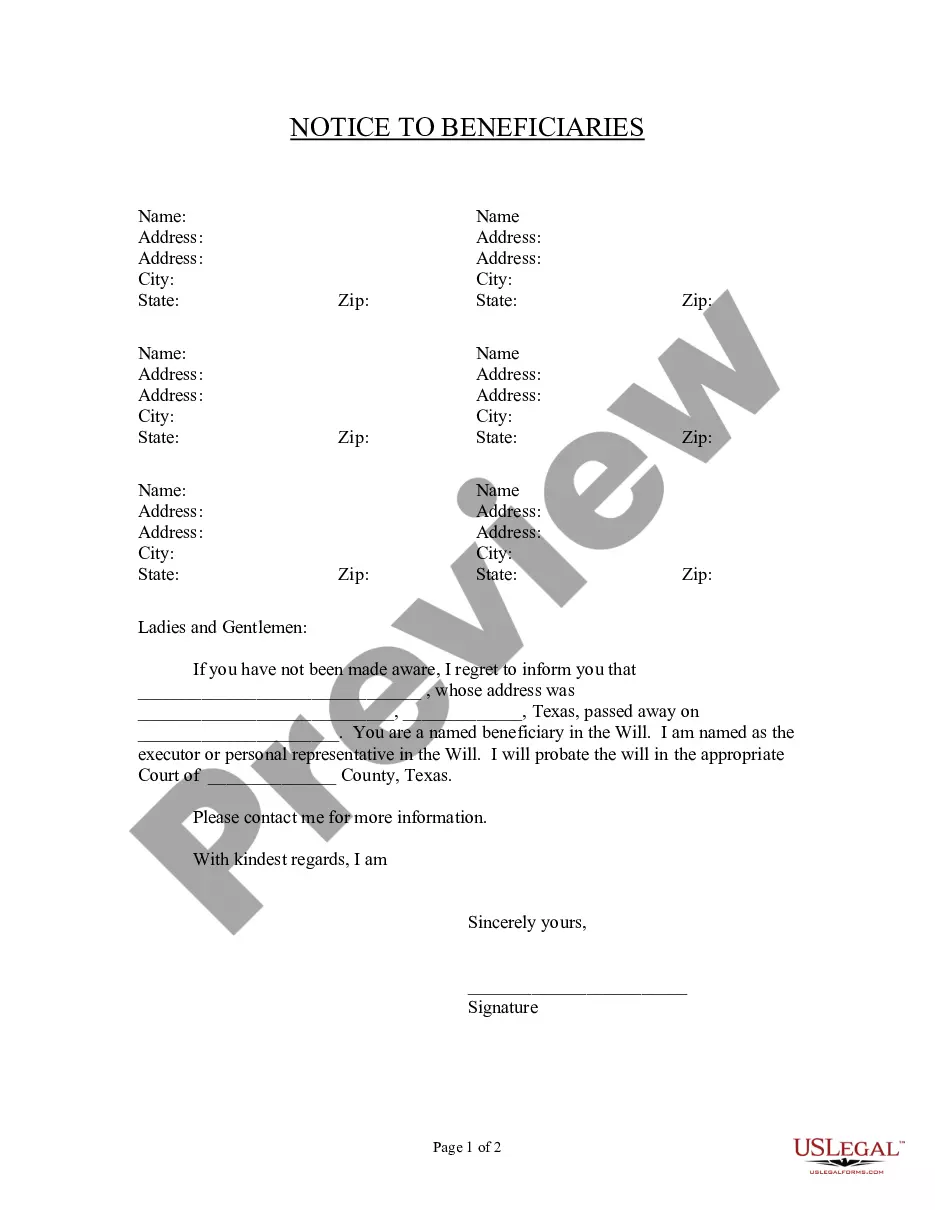
Notice Beneficiary Form For Bank Accounts
Description
Get your form ready online
Our built-in tools help you complete, sign, share, and store your documents in one place.
Make edits, fill in missing information, and update formatting in US Legal Forms—just like you would in MS Word.
Download a copy, print it, send it by email, or mail it via USPS—whatever works best for your next step.
Sign and collect signatures with our SignNow integration. Send to multiple recipients, set reminders, and more. Go Premium to unlock E-Sign.
If this form requires notarization, complete it online through a secure video call—no need to meet a notary in person or wait for an appointment.
We protect your documents and personal data by following strict security and privacy standards.

Make edits, fill in missing information, and update formatting in US Legal Forms—just like you would in MS Word.

Download a copy, print it, send it by email, or mail it via USPS—whatever works best for your next step.

Sign and collect signatures with our SignNow integration. Send to multiple recipients, set reminders, and more. Go Premium to unlock E-Sign.

If this form requires notarization, complete it online through a secure video call—no need to meet a notary in person or wait for an appointment.

We protect your documents and personal data by following strict security and privacy standards.
Looking for another form?

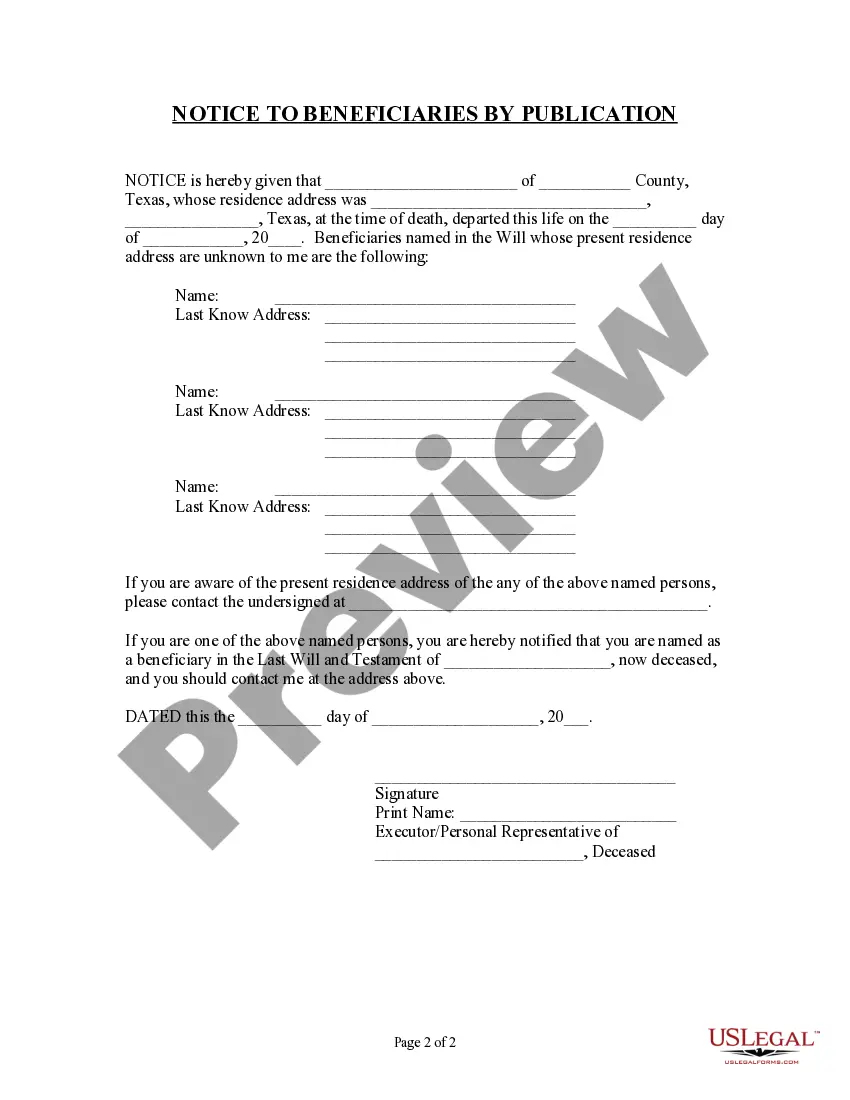
How to fill out Texas Notice To Beneficiaries Of Being Named In Will?
Handling legal documents can be exasperating, even for the most experienced professionals.
When you are looking for a Notice Beneficiary Form For Bank Accounts and lack the time to spend searching for the correct and current version, the processes can be overwhelming.
US Legal Forms addresses all your requirements, from personal to corporate paperwork, all in one location.
Utilize sophisticated tools to complete and oversee your Notice Beneficiary Form For Bank Accounts.
Here are the steps to follow after downloading the form you require: Confirm that this is the correct form by previewing it and reviewing its description. Ensure that the template is recognized in your state or county. Click Buy Now when you are prepared. Choose a subscription plan. Select your preferred file format, and Download, complete, eSign, print, and submit your document. Benefit from the US Legal Forms online library, supported by 25 years of experience and reliability. Transform your daily document management into a straightforward and user-friendly process today.
- Access a database of articles, guides, and resources pertinent to your circumstances and requirements.
- Save time and energy searching for the documents you need, and leverage US Legal Forms’ advanced search and Review tool to locate the Notice Beneficiary Form For Bank Accounts and obtain it.
- If you have a subscription, Log In to your US Legal Forms account, search for the form, and obtain it.
- Check your My documents tab to see the documents you have previously saved and manage your folders as you wish.
- If it's your first experience with US Legal Forms, create a free account and enjoy unlimited access to all the library’s benefits.
- A comprehensive online form repository can be transformative for anyone aiming to navigate these situations efficiently.
- US Legal Forms is a frontrunner in the realm of online legal documents, featuring over 85,000 state-specific legal forms available to you at any time.
- With US Legal Forms, you can access state- or county-specific legal and business documents.
Form popularity
FAQ
Bank account beneficiary rules usually allow payable-on-death beneficiaries to withdraw the entirety of a decedent's bank account immediately following their death, so long as they present the bank with the proper documentation to prove that the account holder has died and to confirm their own identity.
The beneficiary is not entitled to money in the account while the owner is alive, but automatically becomes the owner of the account upon the original owner's death. In these cases, simply visit the bank with a valid ID and a certified copy of the death certificate.
Most beneficiary designations will require you to provide a person's full legal name and their relationship to you (spouse, child, mother, etc.). Some beneficiary designations also include information like mailing address, email, phone number, date of birth and Social Security number.
Generally, beneficiaries do not pay income tax on money or property that they inherit, but there are exceptions for retirement accounts, life insurance proceeds, and savings bond interest. Money inherited from a 401(k), 403(b), or IRA is taxable if that money was tax deductible when it was contributed.
If the account is already open, it's usually easy to go to the bank in person and add one or more beneficiaries to the existing account. Make sure you have your photo ID and the beneficiary's information. Finally, you should not name a minor as a beneficiary for any bank account.