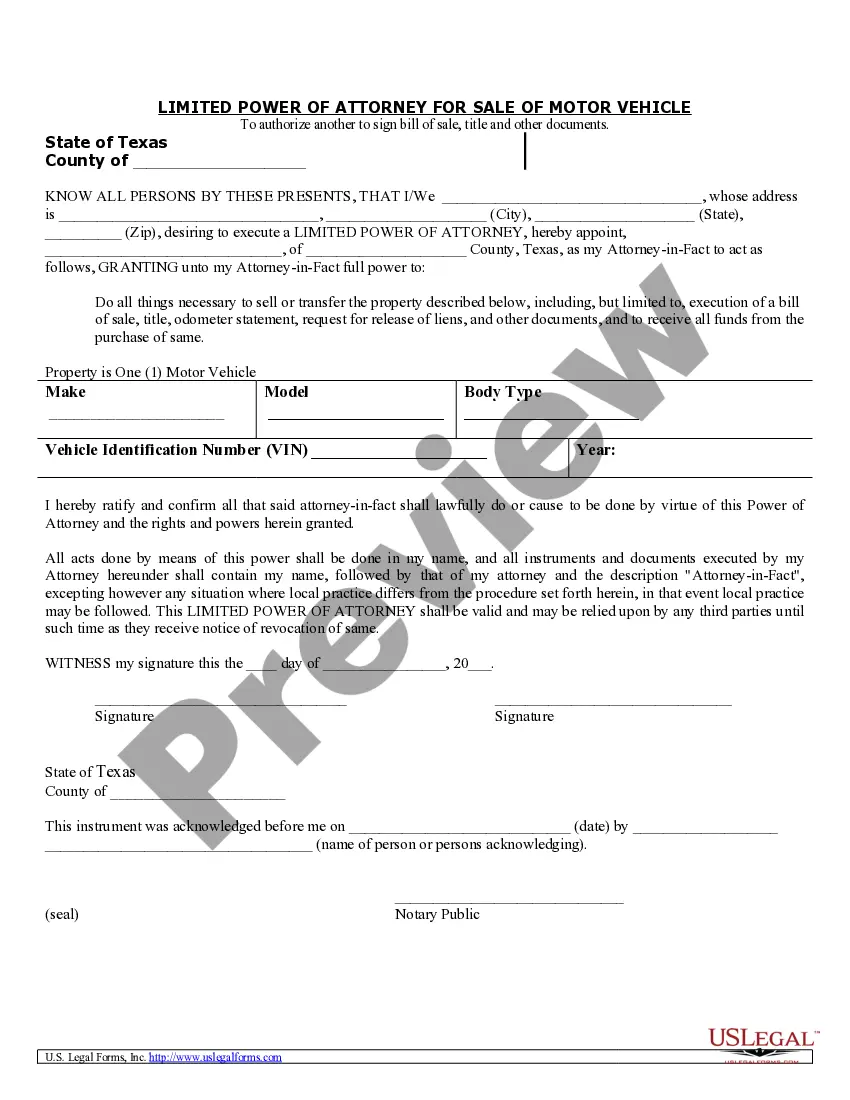
Poa Motor Vehicle Texas With Lienholder
Description
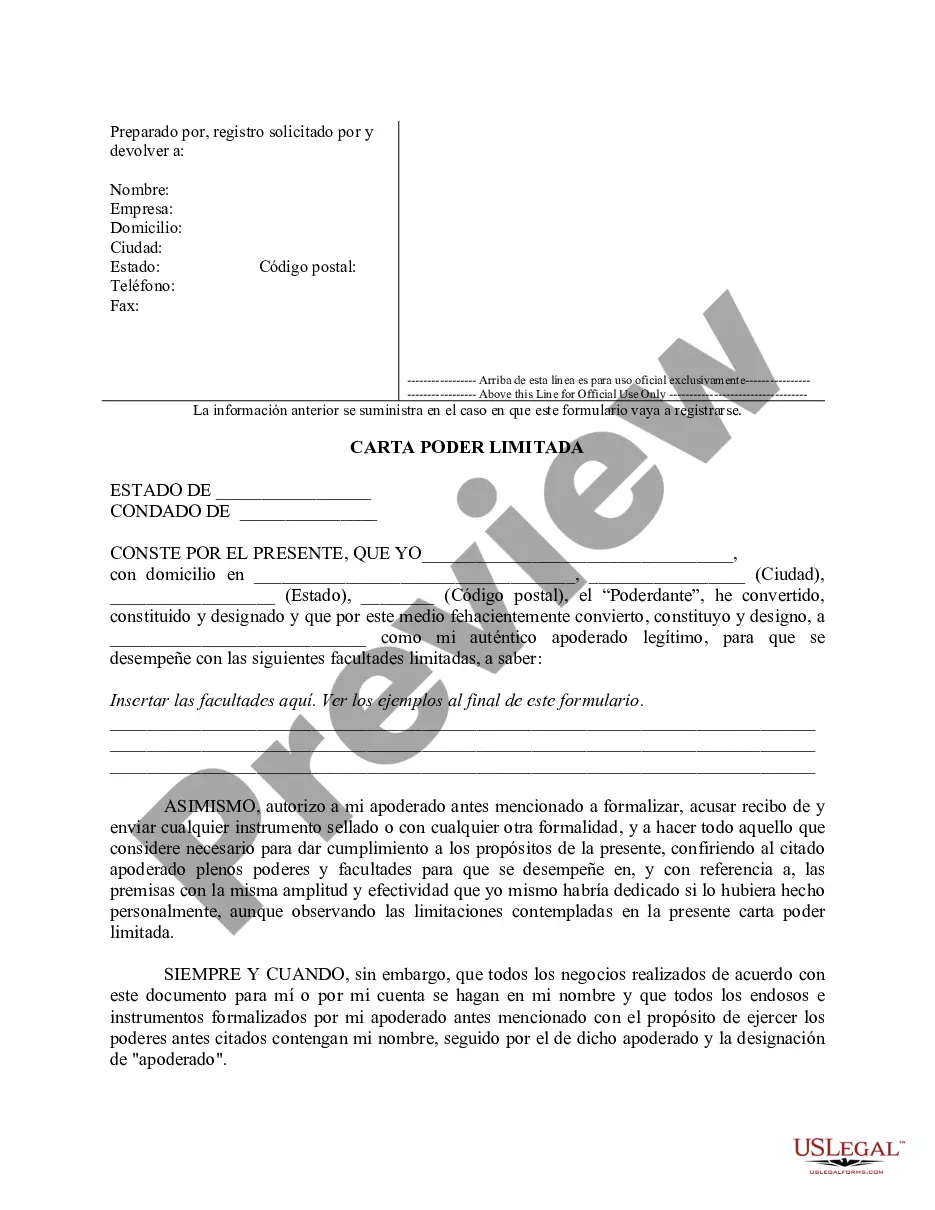
Get your form ready online
Our built-in tools help you complete, sign, share, and store your documents in one place.
Make edits, fill in missing information, and update formatting in US Legal Forms—just like you would in MS Word.
Download a copy, print it, send it by email, or mail it via USPS—whatever works best for your next step.
Sign and collect signatures with our SignNow integration. Send to multiple recipients, set reminders, and more. Go Premium to unlock E-Sign.
If this form requires notarization, complete it online through a secure video call—no need to meet a notary in person or wait for an appointment.
We protect your documents and personal data by following strict security and privacy standards.

Make edits, fill in missing information, and update formatting in US Legal Forms—just like you would in MS Word.

Download a copy, print it, send it by email, or mail it via USPS—whatever works best for your next step.

Sign and collect signatures with our SignNow integration. Send to multiple recipients, set reminders, and more. Go Premium to unlock E-Sign.

If this form requires notarization, complete it online through a secure video call—no need to meet a notary in person or wait for an appointment.

We protect your documents and personal data by following strict security and privacy standards.
Looking for another form?

Form popularity
FAQ
To transfer a car title from two owners to one in Texas, you must complete Form 130-U and indicate the change in ownership. Both owners need to sign the title, and if one owner cannot be present, a power of attorney may be required. In scenarios involving PoA motor vehicle Texas with lienholder, ensure all lienholder details are accurately recorded. Seeking out assistance through platforms like USLegalForms can be beneficial, providing clarity and guidance on the process.
Writing a power of attorney for a car requires specific information to make it valid. Start with the names of the principal and the agent, and include detailed vehicle information along with any lienholder details if applicable. In the case of PoA motor vehicle Texas with lienholder, make sure to state the purpose clearly in the document. Optionally, using templates from platforms like USLegalForms can ensure you cover every necessary detail.
A vehicle power of attorney in Texas allows someone to act on behalf of an owner for vehicle-related matters. This is especially useful when dealing with transactions such as selling or registering a car. In situations involving PoA motor vehicle Texas with lienholder, this document becomes crucial, as it grants authority to the agent to handle necessary paperwork with the lienholder. Utilizing a trusted platform like USLegalForms can simplify the process even further.
Form 130-U is a Texas application for a title and/or registration of a motor vehicle. This form is essential for transferring ownership or registering a vehicle. When you're dealing with PoA motor vehicle Texas with lienholder situations, completing Form 130-U accurately can help streamline the process of title transfer. Be sure to have your lienholder's details handy when filling it out.
Filling out a motor vehicle power of attorney in Texas involves several key steps. First, you need to download the appropriate form, ensuring it relates to PoA motor vehicle Texas with lienholder. Next, input the necessary details, such as the names of both the principal and the agent, as well as specific vehicle information. Finally, sign the document in front of a notary public to ensure its validity.
Yes, you can register your car even if there is a lien on it. The lienholder maintains a legal claim on the vehicle, so it's essential to include them in the registration process. When registering, ensure you provide all necessary paperwork that indicates the lienholder’s information. Using UsLegalForms makes it easier to navigate these requirements.
Registering a financed car in Texas requires you to complete a title application through the Texas Department of Motor Vehicles. You must indicate the lienholder on the application since the lender has a financial interest in the vehicle. Be sure to provide necessary documents like proof of identity, the vehicle identification number, and payment for fees. UsLegalForms can assist you in gathering the required documents for a smooth registration.
Obtaining a power of attorney for a car title is straightforward. You need to fill out a specific form that grants someone authority to act on your behalf regarding the title. Ensure the form is signed and notarized to meet legal requirements. UsLegalForms offers templates to simplify this process, ensuring you have the correct documentation for your situation.
To sell a car with a Power of Attorney, first ensure the POA document includes authority for vehicle transactions. Gather all required documents, including the title, and potentially a lien release if applicable. Using a POA motor vehicle in Texas with a lienholder can help streamline this process, ensuring compliance with state requirements for a successful sale.
Yes, you can sell a car on behalf of someone else in Texas if you have a valid Power of Attorney that explicitly includes vehicle transactions. It’s important to follow the required legal steps and ensure all necessary documentation is completed. A POA motor vehicle in Texas with a lienholder simplifies this process, ensuring all parties are protected.