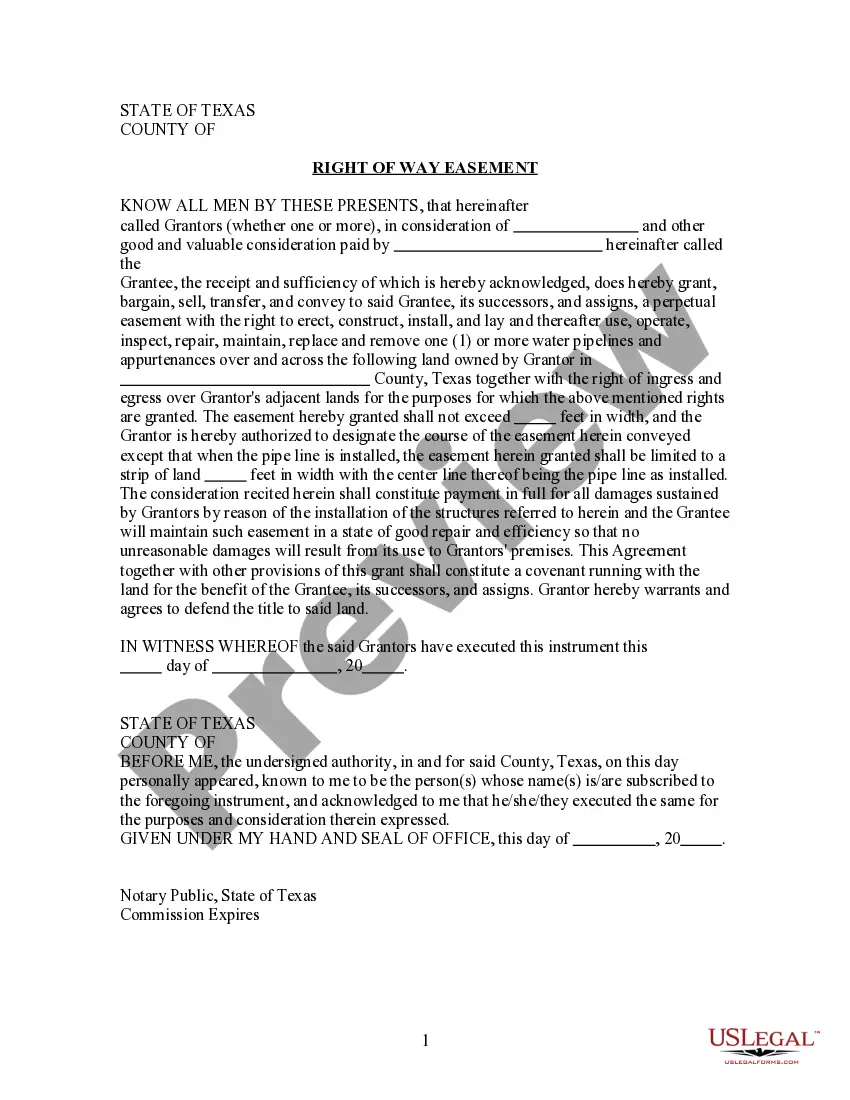
Water Line Easement Rights Within City Limits
Description
Get your form ready online
Our built-in tools help you complete, sign, share, and store your documents in one place.
Make edits, fill in missing information, and update formatting in US Legal Forms—just like you would in MS Word.
Download a copy, print it, send it by email, or mail it via USPS—whatever works best for your next step.
Sign and collect signatures with our SignNow integration. Send to multiple recipients, set reminders, and more. Go Premium to unlock E-Sign.
If this form requires notarization, complete it online through a secure video call—no need to meet a notary in person or wait for an appointment.
We protect your documents and personal data by following strict security and privacy standards.

Make edits, fill in missing information, and update formatting in US Legal Forms—just like you would in MS Word.

Download a copy, print it, send it by email, or mail it via USPS—whatever works best for your next step.

Sign and collect signatures with our SignNow integration. Send to multiple recipients, set reminders, and more. Go Premium to unlock E-Sign.

If this form requires notarization, complete it online through a secure video call—no need to meet a notary in person or wait for an appointment.

We protect your documents and personal data by following strict security and privacy standards.
Looking for another form?


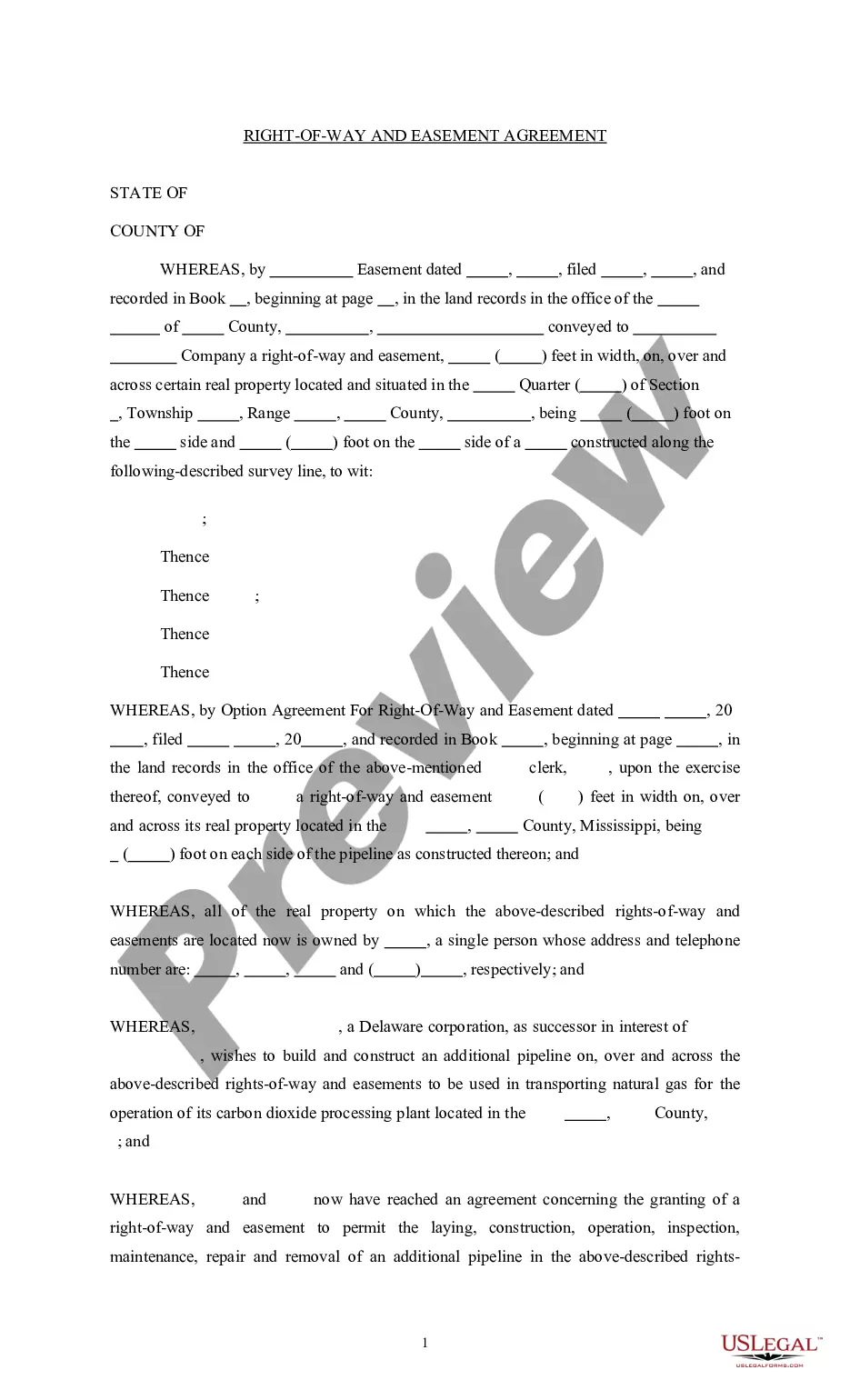
How to fill out Texas Right Of Way Easement For Water Pipeline Or Pipelines?
Whether for commercial reasons or personal matters, everyone must confront legal issues at some point in their lives.
Completing legal documents requires meticulous attention, starting with selecting the appropriate form template.
With an extensive US Legal Forms library available, you won’t have to waste time searching for the appropriate template online. Utilize the catalog’s user-friendly navigation to find the right sample for any situation.
- Acquire the template you require by using the search bar or catalog browsing.
- Review the form’s description to ensure it aligns with your circumstances, state, and county.
- Click on the form’s preview to inspect it.
- If it’s the incorrect form, return to the search tool to find the Water Line Easement Rights Within City Limits template you need.
- Obtain the document if it meets your criteria.
- If you already possess a US Legal Forms account, click Log in to access documents saved in My documents.
- If you don’t have an account yet, you can acquire the form by clicking Buy now.
- Choose the correct pricing plan.
- Complete the account registration form.
- Select your payment option: use a credit card or PayPal account.
- Pick the document format you prefer and download the Water Line Easement Rights Within City Limits.
- Once downloaded, you can fill out the form using editing software or print it and complete it by hand.
Form popularity
FAQ
Refusing a utility easement may not be straightforward, as local laws often grant utilities the right to access your property for essential services. However, you can negotiate terms that may protect your interests while ensuring service continuity. Understanding your water line easement rights within city limits can empower you to advocate for fair conditions, and platforms like US Legal Forms can provide guidance on your options.
Typically, a water line easement may range from 5 to 15 feet in width, depending on local regulations and the specific needs of the utility provider. This distance allows enough space for installation, maintenance, and emergency access. Familiarizing yourself with your water line easement rights within city limits can help you plan your property layout effectively.
A water line easement is a legal agreement that permits a utility company to use a portion of your property for water line installation and maintenance. This easement ensures that water services remain uninterrupted for the community. Knowing your water line easement rights within city limits helps you navigate any potential conflicts with your property plans.
An easement for water lines allows utility companies to install and maintain water pipes on private property. This easement grants access to the utility for necessary repairs and upgrades. Understanding your water line easement rights within city limits is crucial, as these rights may affect your property use and design.
In Georgia, easement laws are defined by state statutes and common law principles. These laws outline the rights and responsibilities associated with water line easement rights within city limits. Engaging with a legal expert or using platforms like USLegalForms can simplify the process of understanding and managing your easement rights in Georgia.
Easements come with specific rules that govern their creation, use, and termination. For water line easement rights within city limits, these rules often dictate how utility companies can access and maintain their lines. Being aware of these regulations helps you protect your property while ensuring necessary utilities function properly.
The 20-year rule refers to a legal concept where an easement may become permanent if it has been continuously used for that period. In the context of water line easement rights within city limits, if a water line has been in consistent use on your property for 20 years, it may solidify the easement. Understanding this rule helps property owners recognize the potential permanence of certain easements.
Property line easement law governs the rights of property owners regarding the use of land for specific purposes, including utilities like water lines. Generally, these laws define how easements can be established, used, and maintained. To fully understand your water line easement rights within city limits, consulting local regulations or legal experts can provide clarity.
When you hold an easement on your property, you have specific rights to use a portion of that land for a designated purpose, such as accessing a water line. These water line easement rights within city limits typically allow you to maintain and repair necessary infrastructure. However, it is important to understand that your rights may be limited by the terms of the easement agreement and local laws.
The three main types of easements include easement by grant, easement by necessity, and easement by prescription. An easement by grant is established through a legal agreement, while an easement by necessity arises when access to a property is crucial. Finally, an easement by prescription is gained through continuous usage over time. When considering water line easement rights within city limits, recognizing these distinctions can guide your property decisions.