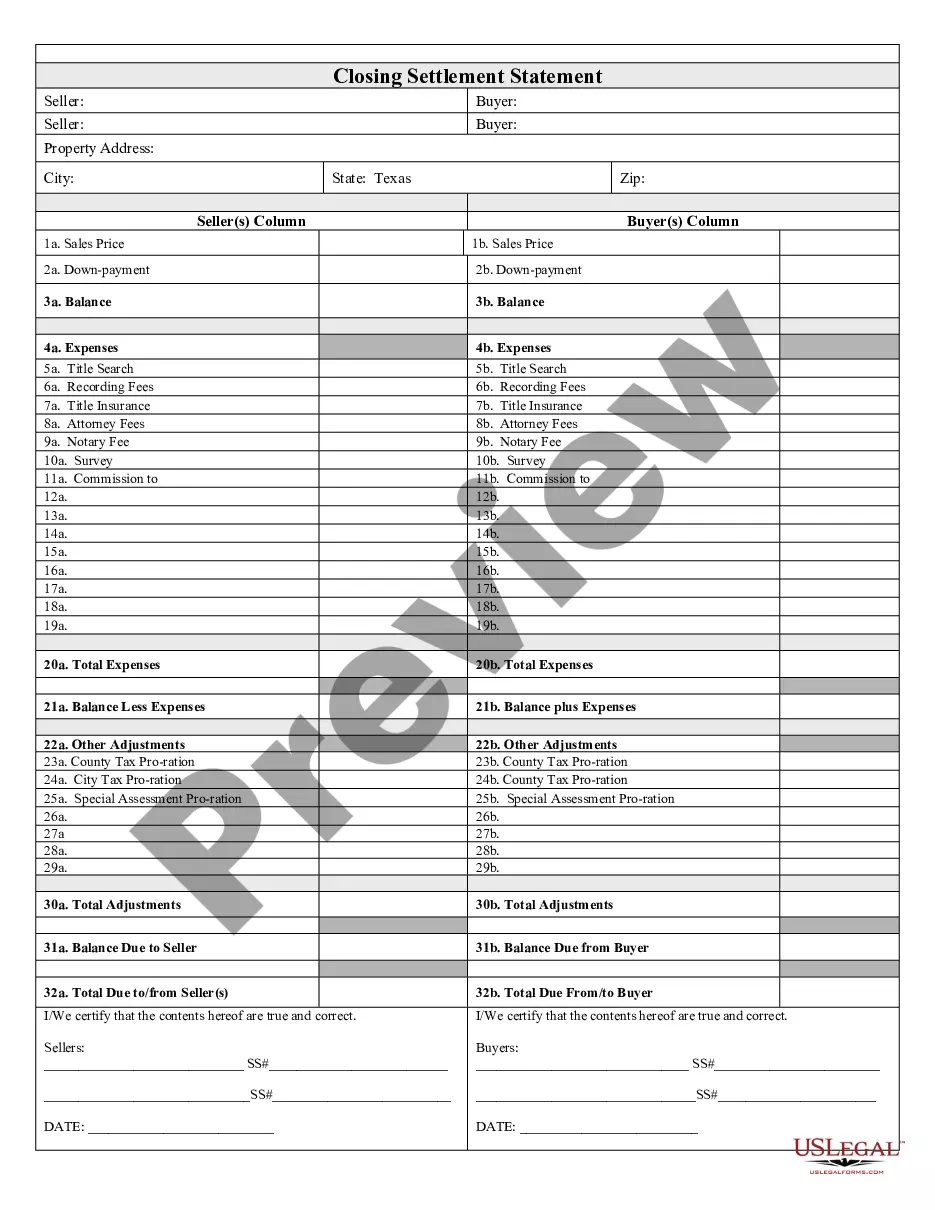
House Closing Statement For Taxes
Description

Get your form ready online
Our built-in tools help you complete, sign, share, and store your documents in one place.
Make edits, fill in missing information, and update formatting in US Legal Forms—just like you would in MS Word.
Download a copy, print it, send it by email, or mail it via USPS—whatever works best for your next step.
Sign and collect signatures with our SignNow integration. Send to multiple recipients, set reminders, and more. Go Premium to unlock E-Sign.
If this form requires notarization, complete it online through a secure video call—no need to meet a notary in person or wait for an appointment.
We protect your documents and personal data by following strict security and privacy standards.

Make edits, fill in missing information, and update formatting in US Legal Forms—just like you would in MS Word.

Download a copy, print it, send it by email, or mail it via USPS—whatever works best for your next step.

Sign and collect signatures with our SignNow integration. Send to multiple recipients, set reminders, and more. Go Premium to unlock E-Sign.

If this form requires notarization, complete it online through a secure video call—no need to meet a notary in person or wait for an appointment.

We protect your documents and personal data by following strict security and privacy standards.
Looking for another form?



How to fill out Texas Closing Statement?
The House Closing Statement For Taxes displayed on this site is a versatile formal template created by expert attorneys adhering to federal and local regulations.
For over 25 years, US Legal Forms has offered individuals, businesses, and legal professionals more than 85,000 verified, state-specific documents for every business and personal situation.
Register with US Legal Forms to access verified legal templates for all of life's circumstances.
- Search for the document you require and review it.
- Browse the file you searched and preview it or read the form description to ensure it meets your needs. If it does not, utilize the search bar to locate the correct one. Click Buy Now once you've identified the template you need.
- Register and Log In.
- Choose the pricing plan that best fits you and set up an account. Utilize PayPal or a credit card to make a quick payment. If you already possess an account, Log In and review your subscription to proceed.
- Download the editable template.
- Select the format you prefer for your House Closing Statement For Taxes (PDF, DOCX, RTF) and save the sample to your device.
- Fill out and sign the document.
- Print the template for manual completion. Alternatively, use an online multi-functional PDF editor to swiftly and accurately fill out and sign your form with an electronic signature.
- Re-download your documents as needed.
- Utilize the same document again whenever required. Access the My documents section in your profile to redownload any previously saved documents.
Form popularity
FAQ
A taxpayer may bring you a document known as a closing disclosure or settlement statement (Form HUD-1, ALTA Settlement Statement, or similar), providing information about the property they have purchased and, if applicable, the mortgage loan they took out.
Prepaid Interest But that month isn't interest-free! You'll have to pay what's called prepaid interest. This interest is tax-deductible, and so is the rest of the mortgage interest you pay throughout the year. The mortgage interest deduction is usually a big one for homeowners who itemize.
The mortgage interest deduction is a tax deduction for mortgage interest paid on the first $750,000 of mortgage debt. Homeowners who bought houses before December 16, 2017, can deduct interest on the first $1 million of the mortgage. Claiming the mortgage interest deduction requires itemizing on your tax return.
Who prepares the settlement statement? Whoever is facilitating the closing ? whether it be a title company, escrow firm, or real estate attorney ? will be responsible for preparing the settlement statement.
Now the loan limit is $750,000. That means for the 2022 tax year, married couples filing jointly, single filers and heads of households could deduct the interest on mortgages up to $750,000. Married taxpayers filing separately could deduct up to $375,000 each.