Texas Grantors Resident With A Child
Description
Get your form ready online
Our built-in tools help you complete, sign, share, and store your documents in one place.
Make edits, fill in missing information, and update formatting in US Legal Forms—just like you would in MS Word.
Download a copy, print it, send it by email, or mail it via USPS—whatever works best for your next step.
Sign and collect signatures with our SignNow integration. Send to multiple recipients, set reminders, and more. Go Premium to unlock E-Sign.
If this form requires notarization, complete it online through a secure video call—no need to meet a notary in person or wait for an appointment.
We protect your documents and personal data by following strict security and privacy standards.

Make edits, fill in missing information, and update formatting in US Legal Forms—just like you would in MS Word.

Download a copy, print it, send it by email, or mail it via USPS—whatever works best for your next step.

Sign and collect signatures with our SignNow integration. Send to multiple recipients, set reminders, and more. Go Premium to unlock E-Sign.

If this form requires notarization, complete it online through a secure video call—no need to meet a notary in person or wait for an appointment.

We protect your documents and personal data by following strict security and privacy standards.
Looking for another form?









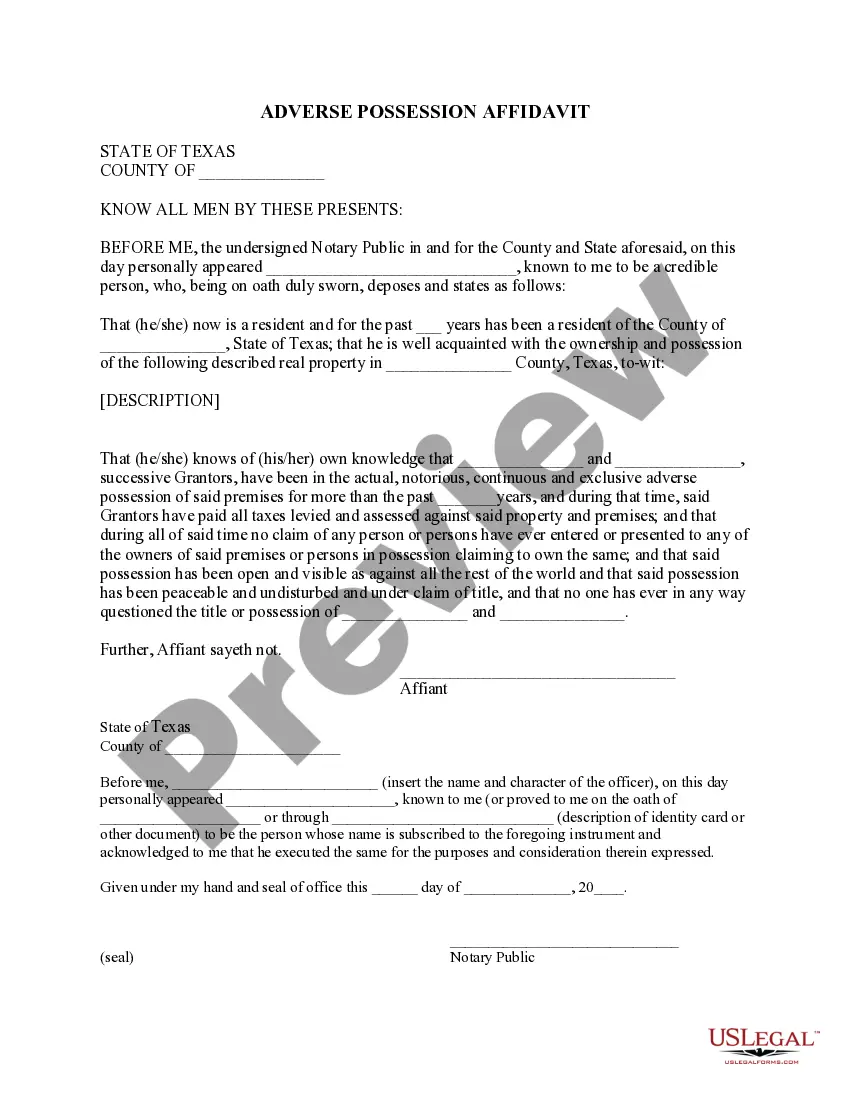
How to fill out Texas Adverse Possession Affidavit - Squatters Rights?
- Log in to your US Legal Forms account if you're a returning user. Ensure that your subscription is active to facilitate easy downloads.
- For first-time users, start by previewing available forms. Carefully read the descriptions to ensure they align with your local jurisdiction requirements.
- Need another form? Use the Search tab to locate the correct template that suits your needs.
- Once you find the right document, click the Buy Now button and select a suitable subscription plan. Registration is necessary for full access.
- Complete your purchase by entering payment details using your credit card or PayPal.
- After the payment is processed, download your chosen form. You can find it later in the My Forms section of your profile.
US Legal Forms not only provides an extensive collection of forms but also offers access to premium experts who can assist in ensuring your documents are completed accurately and comply with legal standards.
Take the next step toward simplified legal documentation today and explore the benefits of US Legal Forms!
Form popularity
FAQ
The best way to transfer your house to your son is by completing a quitclaim deed, which transfers any interest you have in the property to him. This deed should be executed properly and recorded with your county. If you are a Texas grantor resident with a child, you might want to consult legal documents or services like US Legal Forms to ensure a smooth transfer process.
Yes, a parent can indeed gift a house to a child in Texas. The key step is to create a deed that effectively transfers the ownership without receiving compensation. For Texas grantors residents with a child, it’s important to be aware of the tax implications related to such a gift. Platforms such as US Legal Forms provide the necessary documents to simplify this gift process.
To transfer your house title from parent to child in Texas, you must draft a new deed that clearly states the intention to transfer ownership. This deed must be executed and recorded with your local county clerk's office. As a Texas grantor resident with a child, it’s essential to ensure that all legal requirements are met during this transfer. Consulting resources like US Legal Forms can simplify the process.
Yes, you can gift your house to your son in Texas. This process typically involves completing a deed that transfers ownership from you as the grantor to your son as the grantee. However, it is important to note the potential tax implications of such a gift, especially for Texas grantors residents with a child. Utilizing platforms like US Legal Forms can guide you through the necessary paperwork efficiently.
To add a family member to your property title in Texas, you must complete a new deed that reflects the changes. This deed should be executed and signed by the current owner, and then filed with your county clerk's office. If you are a Texas grantor resident with a child, this process can be straightforward. Consider using online legal services, like US Legal Forms, to ensure that you follow all the requirements properly.
A child typically becomes a Texas resident by living in the state with a parent or guardian for a specified period, usually 12 months before enrolling in college. Additionally, demonstrating intent to remain in Texas, like obtaining a Texas driver’s license, can strengthen residency claims. This status is important for Texas grantors resident with a child seeking educational funding.
If you are not receiving grants from FAFSA, it could be due to factors like incomplete applications or not meeting the eligibility criteria. Additionally, your financial situation may not demonstrate enough need. Consider consulting experts like uslegalforms, who can guide you through the FAFSA process to help clarify your options.
Not everyone qualifies for the Texas grant, as it is based on specific eligibility criteria and available funding. Only applicants who meet all the requirements, including residency and financial need, may receive the grant. It is vital to stay informed about the application process and deadlines to maximize your chances.
Eligibility for the Texas grant program primarily includes Texas grantors resident with a child who are enrolling in college or university for the first time. Students must exhibit financial need and demonstrate academic readiness. Additionally, they must complete the FAFSA to be considered for the grant.
Not receiving a Texas grant could result from insufficient financial need, incomplete applications, or missed deadlines. It is important to review the criteria and ensure all required documentation is submitted accurately. If you need assistance, resources like uslegalforms can help clarify the application process.