Adverse Possession Texas For Landlords
Description
Get your form ready online
Our built-in tools help you complete, sign, share, and store your documents in one place.
Make edits, fill in missing information, and update formatting in US Legal Forms—just like you would in MS Word.
Download a copy, print it, send it by email, or mail it via USPS—whatever works best for your next step.
Sign and collect signatures with our SignNow integration. Send to multiple recipients, set reminders, and more. Go Premium to unlock E-Sign.
If this form requires notarization, complete it online through a secure video call—no need to meet a notary in person or wait for an appointment.
We protect your documents and personal data by following strict security and privacy standards.

Make edits, fill in missing information, and update formatting in US Legal Forms—just like you would in MS Word.

Download a copy, print it, send it by email, or mail it via USPS—whatever works best for your next step.

Sign and collect signatures with our SignNow integration. Send to multiple recipients, set reminders, and more. Go Premium to unlock E-Sign.

If this form requires notarization, complete it online through a secure video call—no need to meet a notary in person or wait for an appointment.

We protect your documents and personal data by following strict security and privacy standards.
Looking for another form?






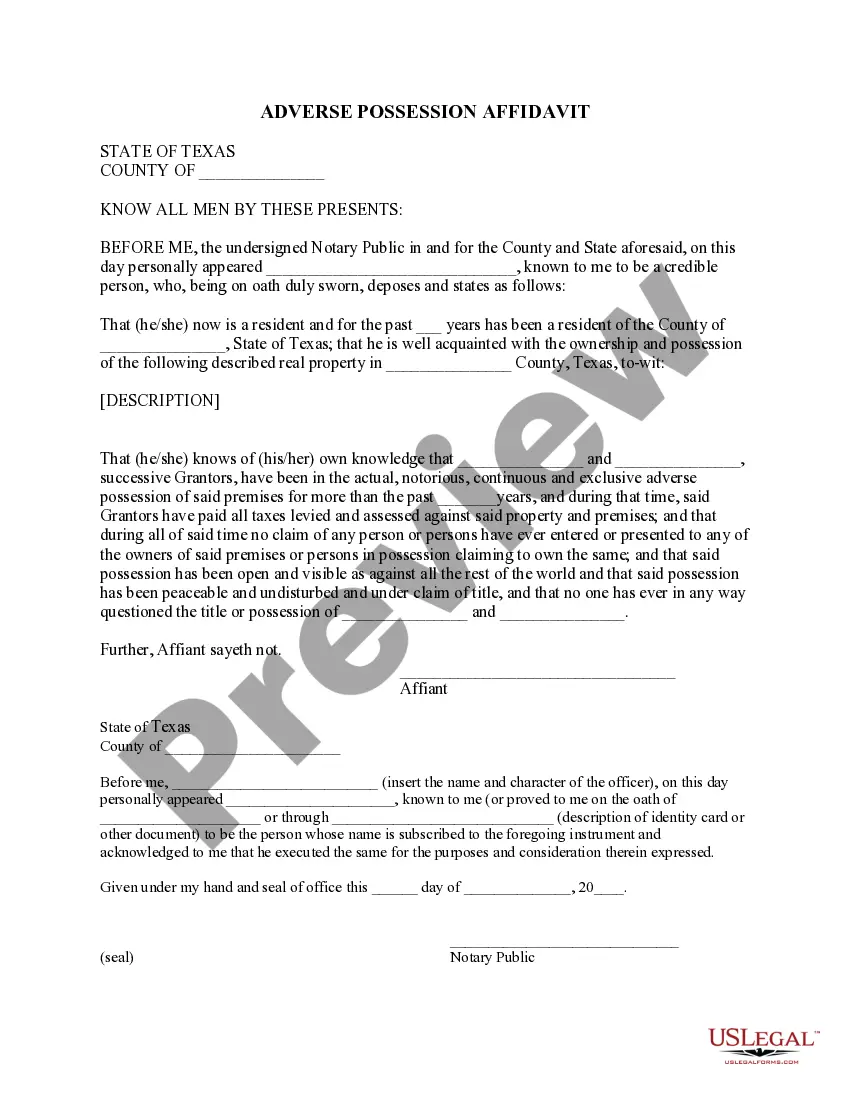
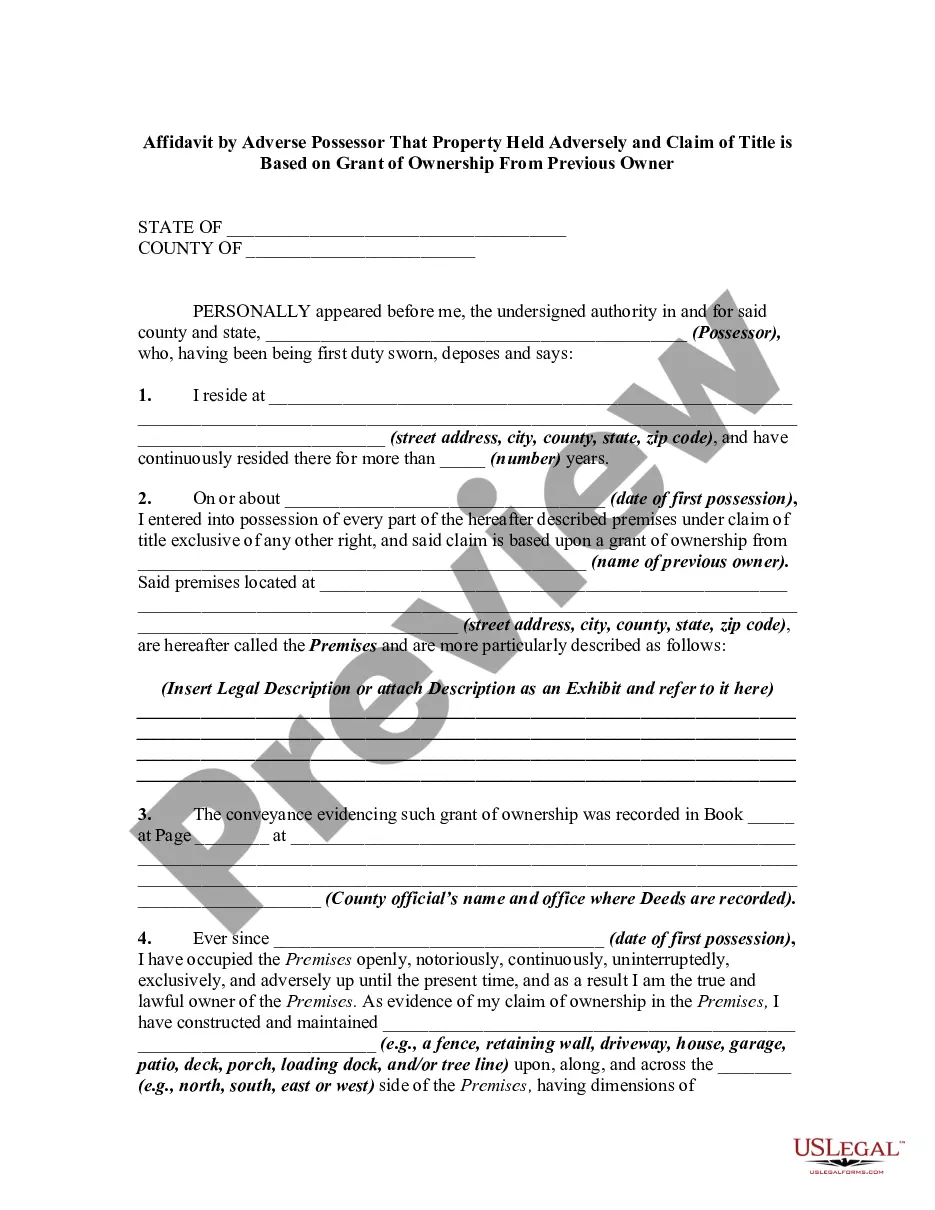
How to fill out Texas Adverse Possession Affidavit - Squatters Rights?
- Log in to your US Legal Forms account if you're an existing user. Ensure your subscription is active; if it's expired, renew it as per your payment plan.
- If you're new to US Legal Forms, start by previewing the available document options. Check their descriptions to find the appropriate form tailored to your situation.
- Utilize the search bar if you need additional templates. Should anything seem amiss, don’t hesitate to seek alternative documents that suit your needs.
- Purchase your selected document by clicking the 'Buy Now' button. Choose a subscription plan that fits your requirements, and if necessary, create an account.
- Complete your transaction by entering your payment information, either via credit card or through your PayPal account.
- Download your completed form to your device, allowing you to fill it out at your convenience. You can also revisit it anytime in the 'My Forms' section of your profile.
Utilizing US Legal Forms offers numerous benefits, such as access to a vast library of over 85,000 legal documents which are easily editable. Additionally, you have the opportunity to consult premium experts who can guide you in completing your forms accurately.
In conclusion, US Legal Forms simplifies the document preparation process for landlords facing adverse possession issues. Take advantage of their extensive resources today and ensure your legal documents are accurate and compliant.
Form popularity
FAQ
Adverse possession refers to a legal doctrine that allows a person to claim ownership of land under certain conditions, particularly after occupying it for a specific period without the owner’s consent. The possession must be continuous, open, and adverse, providing the occupant a path to potentially gain legal title. This definition is particularly important for landlords to comprehend, as it emphasizes the protections available to property owners against unwarranted claims.
To claim a piece of property through adverse possession in Texas, you must prove your continuous and actual possession for at least ten years. Additionally, you must demonstrate that your use of the property was open and notorious, showcasing your occupancy to all. Your possession must also be adverse, meaning without the permission of the legal owner. Understanding these proof requirements is essential for landlords who might face complications from adverse possession.
Acquiring property by adverse possession in Texas involves several specific requirements that include actual and exclusive possession, as well as continuous use for ten years. In addition, the possession must be open, meaning it is clear and visible to anyone, including the true owner. Furthermore, the use must be adverse or hostile to the interests of the owner, without their consent. Familiarizing yourself with these requirements can aid landlords in defending against potential adverse claims on their property.
A required element for acquiring ownership through adverse possession is that the possession must be exclusive. This means that the occupant cannot share possession with the true owner or the public. Exclusive possession reinforces the idea that the occupant is asserting control over the property. For landlords, recognizing this element can help in identifying threats to their property from adverse possession claims in Texas.
To establish an adverse possession claim in Texas, the claimant must meet several key requirements. First, the possession must be actual, meaning the person physically occupies the land. Second, the possession must be open and notorious, which means that it is visible and not secretive. Lastly, the possession needs to be continuous for a period of at least ten years, and it must be adverse, meaning without permission from the owner. Understanding these requirements is crucial for landlords dealing with potential adverse possession claims.
To defeat an adverse possession claim, you need to provide evidence that counteracts the claimant's assertions. Gather documentation, such as property surveys, tax records, and any communications regarding ownership. A proactive approach, including maintaining rights through active use and demonstrating lack of consent, strengthens your case. For landlords facing such challenges, consulting with US Legal Forms can provide essential legal documents to fortify your defenses.
To avoid adverse possession in Texas, it's essential to periodically inspect and maintain your property. Regularly asserting your ownership through activities such as paying property taxes and ensuring visible upkeep can help deter claims. Additionally, clearly communicate with nearby property owners to establish boundaries and expectations. Using US Legal Forms' resources can help solidify your legal stance and prevent misunderstandings.
In Texas, the finders keepers law does not grant you ownership just because you found something. Adverse possession laws govern real property, meaning simply occupying a space does not equate to owning it. To claim land through adverse possession, specific legal requirements must be met, including continuous possession and intent to claim ownership. Understanding these laws is crucial for landlords concerned about adverse possession in Texas.
To protect yourself from adverse possession in Texas, regularly visit your property and ensure it remains in your possession. Clearly mark your boundaries with fencing or signage that indicates private property. Engaging a legal expert familiar with adverse possession laws can further safeguard your interests, especially if you face potential claims. Utilize resources like US Legal Forms to draft necessary documents and reinforce your ownership.
The five requirements for adverse possession in Texas include actual possession, open and notorious use, exclusive possession, adverse use, and continuous possession for ten years. Each requirement is crucial for a successful claim and highlights the importance of maintaining awareness of land use. For landlords, familiarizing yourself with these requirements can help prevent future disputes over property. Utilizing resources like uslegalforms can enhance your understanding of these legalities.