Estate For Life Meaning
Description

Get your form ready online
Our built-in tools help you complete, sign, share, and store your documents in one place.
Make edits, fill in missing information, and update formatting in US Legal Forms—just like you would in MS Word.
Download a copy, print it, send it by email, or mail it via USPS—whatever works best for your next step.
Sign and collect signatures with our SignNow integration. Send to multiple recipients, set reminders, and more. Go Premium to unlock E-Sign.
If this form requires notarization, complete it online through a secure video call—no need to meet a notary in person or wait for an appointment.
We protect your documents and personal data by following strict security and privacy standards.

Make edits, fill in missing information, and update formatting in US Legal Forms—just like you would in MS Word.

Download a copy, print it, send it by email, or mail it via USPS—whatever works best for your next step.

Sign and collect signatures with our SignNow integration. Send to multiple recipients, set reminders, and more. Go Premium to unlock E-Sign.

If this form requires notarization, complete it online through a secure video call—no need to meet a notary in person or wait for an appointment.

We protect your documents and personal data by following strict security and privacy standards.
Looking for another form?




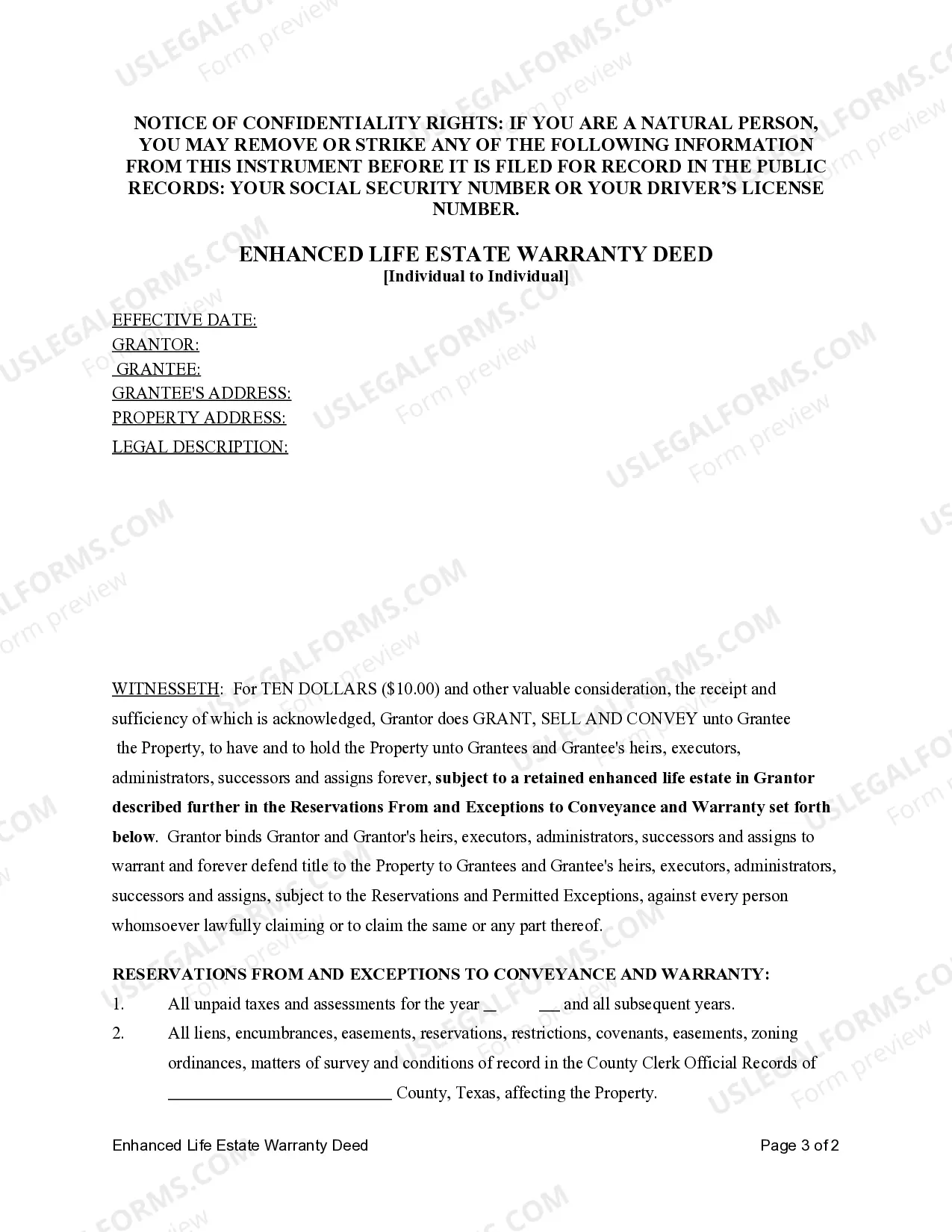
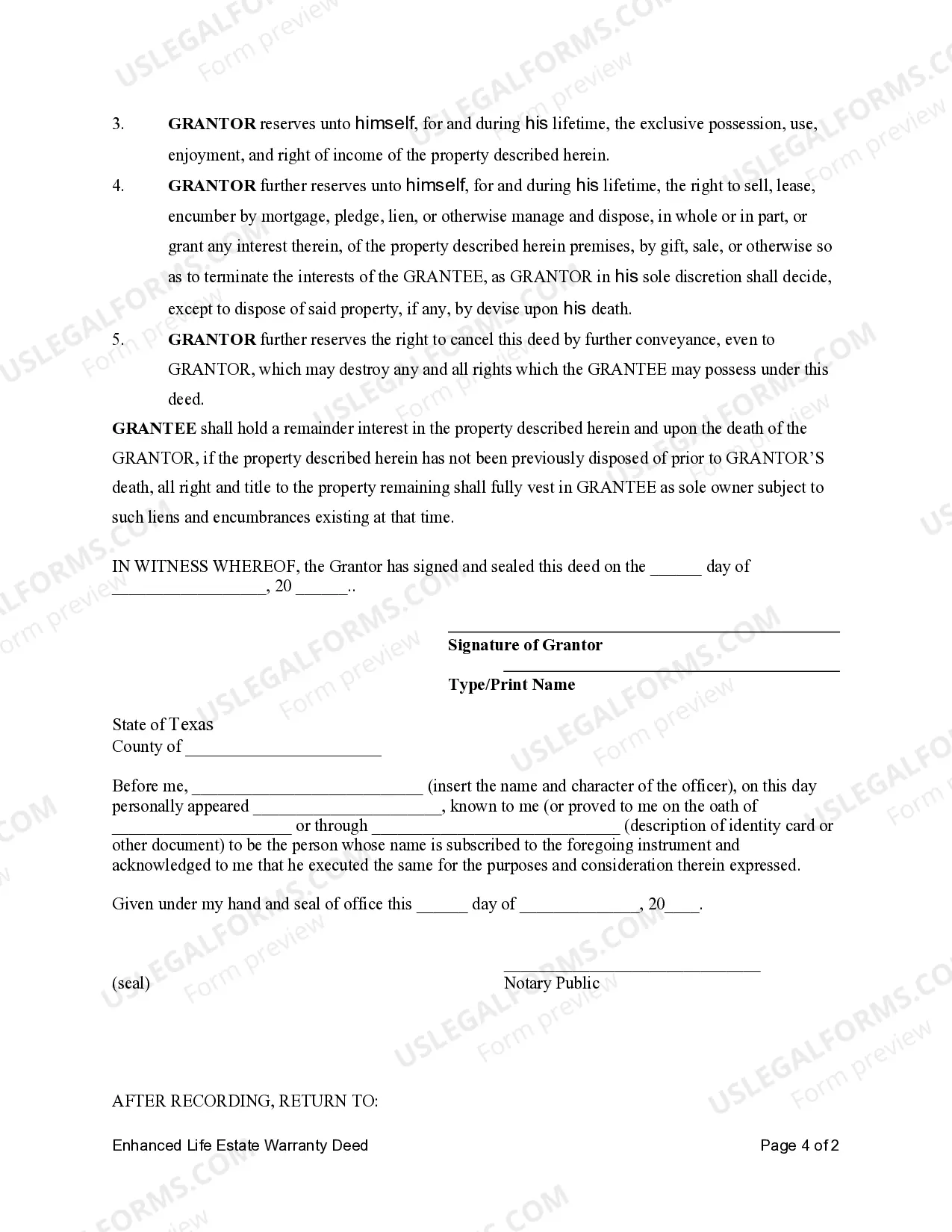
How to fill out Texas Lady Bird Or Enhanced Life Estate Warranty Deed - Individual To Individual?
- If you're a returning user, log in to your account, check your subscription status, and click the Download button to retrieve your form.
- If you're new to our service, start by assessing the Preview mode and reading the form description to confirm it meets your needs and is compatible with your local laws.
- Should you find discrepancies, utilize the Search tab at the top to locate the correct template.
- Once you've identified the appropriate document, hit the Buy Now button and select your preferred subscription plan. Registration for an account is required to access our library.
- Proceed to make your payment by entering your credit card information or using your PayPal account.
- Finally, download your form and save it to your device. You can also access it anytime from the My Forms section of your profile.
US Legal Forms empowers users with a vast selection of over 85,000 editable legal documents, making it a superior choice in the legal form space.
In conclusion, navigating legal documents related to real estate does not have to be daunting. Start using US Legal Forms today to simplify your document needs!
Form popularity
FAQ
The primary difference between a life estate and a will lies in their functions and timings. A life estate allows you to use the property during your lifetime, while a will comes into effect only after your death. Understanding the estate for life meaning also highlights how a life estate provides ongoing rights to the property, and a will outlines your wishes for distribution after you're gone. Exploring both options ensures that you have a comprehensive plan for your assets, and uslegalforms can help you navigate these choices.
A life estate can technically be sold, but it is complex and requires careful consideration. The life tenant must provide full disclosure of their limited rights in the property to any potential buyer. Therefore, understanding the estate for life meaning becomes vital, as selling such an estate may not yield the same financial return as selling full ownership. It is often wise to consult with a legal advisor to navigate these transactions effectively.
Choosing between a will and establishing an estate depends on your specific needs and goals. A will directs how your assets should be distributed after your death, while a life estate allows you to retain certain rights to property during your lifetime. Understanding the estate for life meaning can clarify how both options serve different purposes and can be part of comprehensive estate planning. Consulting with a legal expert can help you make the best decision for your situation.
A primary disadvantage of a life estate is that the owner, known as the life tenant, cannot freely sell or transfer the property without the consent of the remainderman, who holds the future interest. This limitation can hinder financial flexibility, and the life tenant may face challenges when trying to access the value of the estate. Additionally, the estate for life meaning implies that upon the life tenant's death, the property automatically transfers to the remainderman, potentially leaving the life tenant with limited control over their property.
An estate for life refers to a legal arrangement where an individual holds property for the duration of their life. For example, consider a situation where a parent gives their child the right to live in the family home until the parent's death. This arrangement highlights the estate for life meaning: the child enjoys the property rights, but ownership will revert to the parent’s heirs after the child's passing. Such legal concepts clarify property rights and help individuals understand how estates function within the law.
The terms of a life estate typically define the duration of the life tenant's rights, responsibilities for property maintenance, and what occurs upon their death. The life tenant can live in the property but cannot damage it or diminish its value. Understanding these terms ensures compliance and helps in estate planning. Exploring the estate for life meaning reveals significant legal implications surrounding these terms.
Having a life estate means you can live in and use the property for your lifetime, but cannot transfer full ownership. When the life tenant passes away, the property transfers to the remainderman. This arrangement helps with estate planning by allowing individuals to maintain property control while ensuring its future use. Familiarity with the estate for life meaning clarifies your responsibilities and rights.
Life estates are generally created by a deed or a will, specifying the rights of the life tenant and the remainderman. This legal structure provides clarity on who can use the property during the life tenant's existence. Additionally, understanding the estate for life meaning helps individuals grasp the consequences of such arrangements in estate planning.
To get out of a life estate, you must transfer your interest in the property, which can be done through a deed. You can sell your life estate or gift it to someone else. Alternatively, you may also consider seeking legal advice to discuss options like termination through mutual agreement with the remainderman. Understanding the estate for life meaning helps clarify your rights and avenues.