Bird Edits
Description


Get your form ready online
Our built-in tools help you complete, sign, share, and store your documents in one place.
Make edits, fill in missing information, and update formatting in US Legal Forms—just like you would in MS Word.
Download a copy, print it, send it by email, or mail it via USPS—whatever works best for your next step.
Sign and collect signatures with our SignNow integration. Send to multiple recipients, set reminders, and more. Go Premium to unlock E-Sign.
If this form requires notarization, complete it online through a secure video call—no need to meet a notary in person or wait for an appointment.
We protect your documents and personal data by following strict security and privacy standards.

Make edits, fill in missing information, and update formatting in US Legal Forms—just like you would in MS Word.

Download a copy, print it, send it by email, or mail it via USPS—whatever works best for your next step.

Sign and collect signatures with our SignNow integration. Send to multiple recipients, set reminders, and more. Go Premium to unlock E-Sign.

If this form requires notarization, complete it online through a secure video call—no need to meet a notary in person or wait for an appointment.

We protect your documents and personal data by following strict security and privacy standards.
Looking for another form?



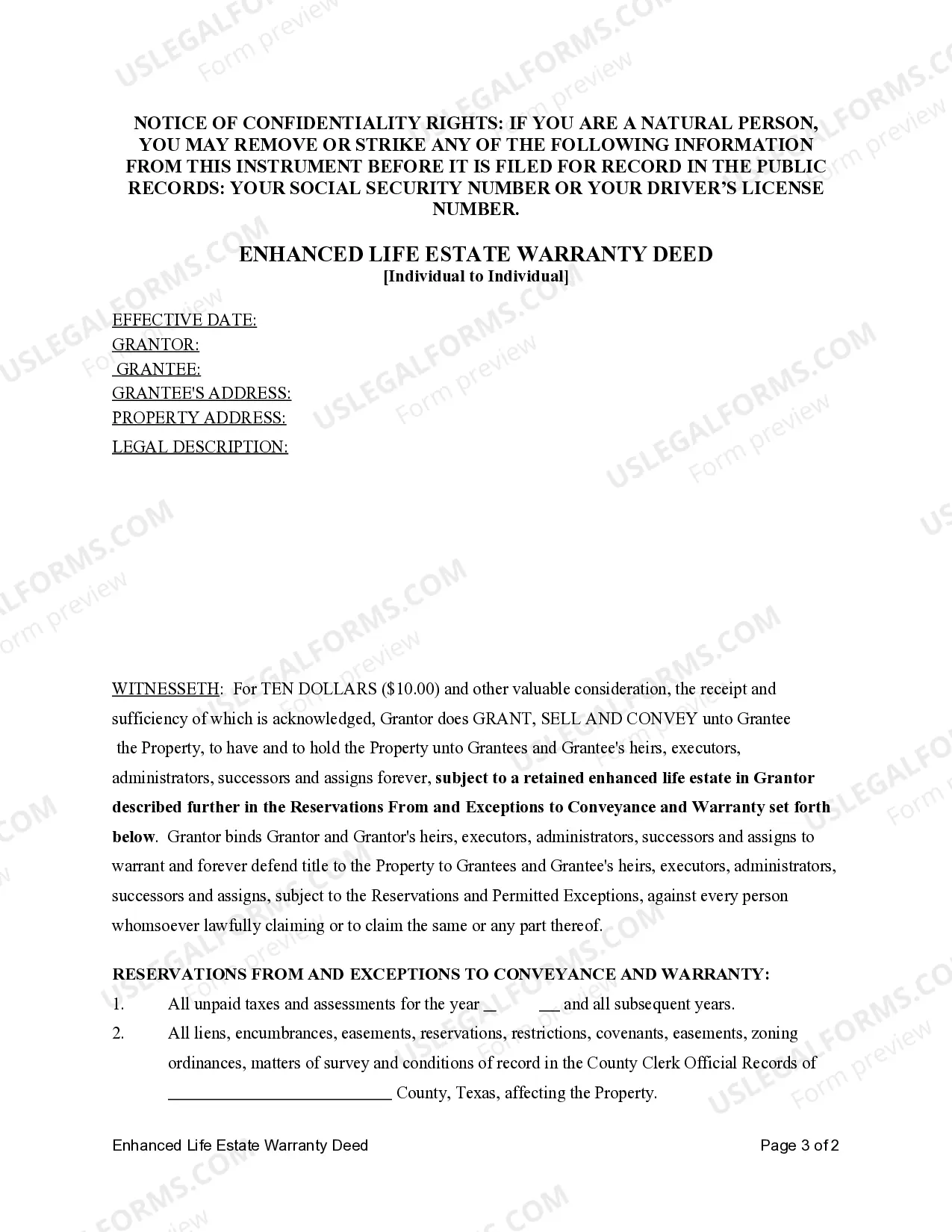
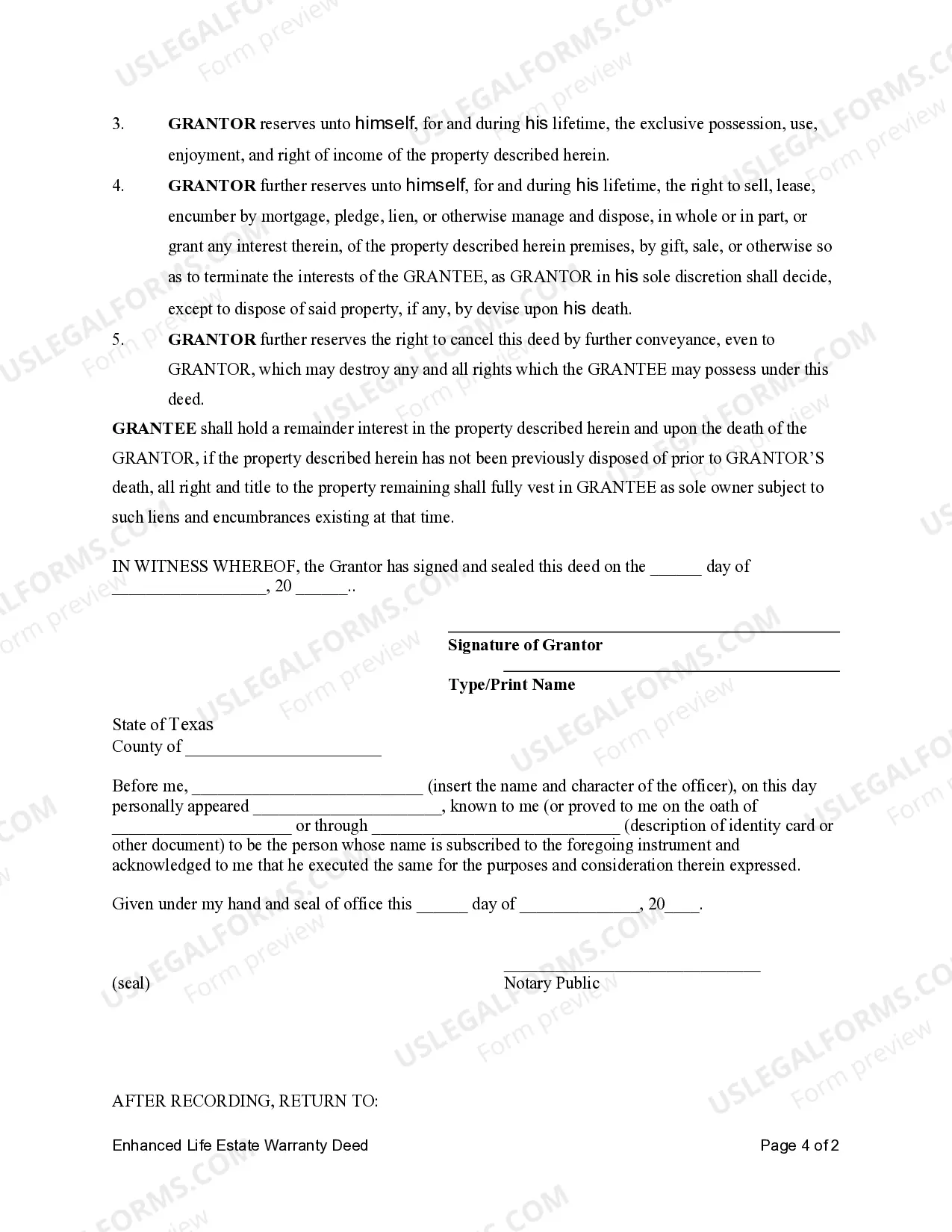
How to fill out Texas Lady Bird Or Enhanced Life Estate Warranty Deed - Individual To Individual?
- Log in to your account at US Legal Forms. Ensure your subscription is active; renew it if necessary.
- Browse the library and select the form you need. Use the Preview mode and form description to verify its relevance.
- If you can’t find the right document, utilize the Search function at the top of the page to refine your options.
- Once you find the correct template, click on the 'Buy Now' button and select your preferred subscription plan.
- Complete your purchase using a credit card or PayPal account for payment.
- Download your finalized document onto your device and access it later from the 'My Forms' section in your account.
By following these steps, you'll harness the full power of US Legal Forms to obtain legal documents quickly and efficiently. The vast library and expert support set this service apart, making it an invaluable resource.
Don't hesitate to start your legal journey—visit US Legal Forms today and unlock the benefits of easy document acquisition!
Form popularity
FAQ
Getting a bird to land on your finger involves building a trusting relationship first. Spend time near them and use treats to encourage their approach. Place your finger near them, allowing time for your bird to feel comfortable. Consistency and patience will lead to your feathered friend confidently stepping onto your finger, making bird edits easier in the long run.
To help your budgie step onto your finger, start by establishing trust with treats and gentle interaction. Position your finger near their perch for them to explore at their own pace. Allow your budgie to feel comfortable and gradually encourage them to hop on. When they do, reward them with praise and a treat to reinforce this positive behavior, assisting you with bird edits in the future.
Encouraging your bird to step onto your finger can take time and patience. Start by placing your finger close to their perch, ensuring they feel secure. Use treats to motivate them, reinforcing the behavior when they make an effort to step up. With practice, your bird will become more comfortable with the idea of perching on your finger.
To attract birds, create a calm environment that draws them in. Use treats to lure them closer while keeping your movements smooth and gentle. Spend time each day sitting near your bird’s favorite areas. This consistent presence helps them feel safe and encourages them to approach you.
To gain your bird's trust, spend time near them without forcing interaction. Use treats to entice your bird to come closer while keeping your hand still. Allow your bird to approach at their own pace. When they show interest, they will feel more comfortable interacting with your hand, paving the way for easier bird edits in the future.
Birds may hesitate to go on your finger due to fear or lack of trust. Building a bond starts with patience and understanding their body language. Gradually offer your finger as a perch while providing treats to encourage them. This way, your bird will associate your hand with positive experiences, making it easier for them to come to you.
The rule of thirds in bird photography is about composing your images to make them more captivating. Positioning your bird along the grid lines or at intersections captures the viewer's attention while allowing for dynamic backgrounds. This not only emphasizes the bird but also enhances the storytelling aspect of your photos. After capturing your images, bird edits can further refine this composition for maximum impact.
The 20-60-20 rule suggests that you allocate 20% of your image to the foreground, 60% to the subject, and 20% to the background. This approach creates balance and draws attention to the primary subject, enhancing viewer engagement. In bird photography, this rule helps ensure that both the bird and its environment are captured effectively. You can apply this concept while using bird edits to perfect your final image.
The rule of thirds is a composition technique where you divide your frame into a grid of nine equal parts using two horizontal and two vertical lines. By placing your subject along these lines or at their intersections, you create a more balanced and engaging image. This technique works particularly well in bird photography, where positioning can greatly affect the mood. After taking your shots, consider using bird edits to fine-tune your composition.
For bird photography, using Continuous Autofocus (AF-C) mode is recommended. This setting continuously adjusts focus as the bird moves, ensuring sharp images. Many cameras also offer tracking modes specifically designed for wildlife, allowing you to capture those fleeting moments. Combine this with bird edits for stunning results.