Oregon Temporary Custody Forms For Parents
Description
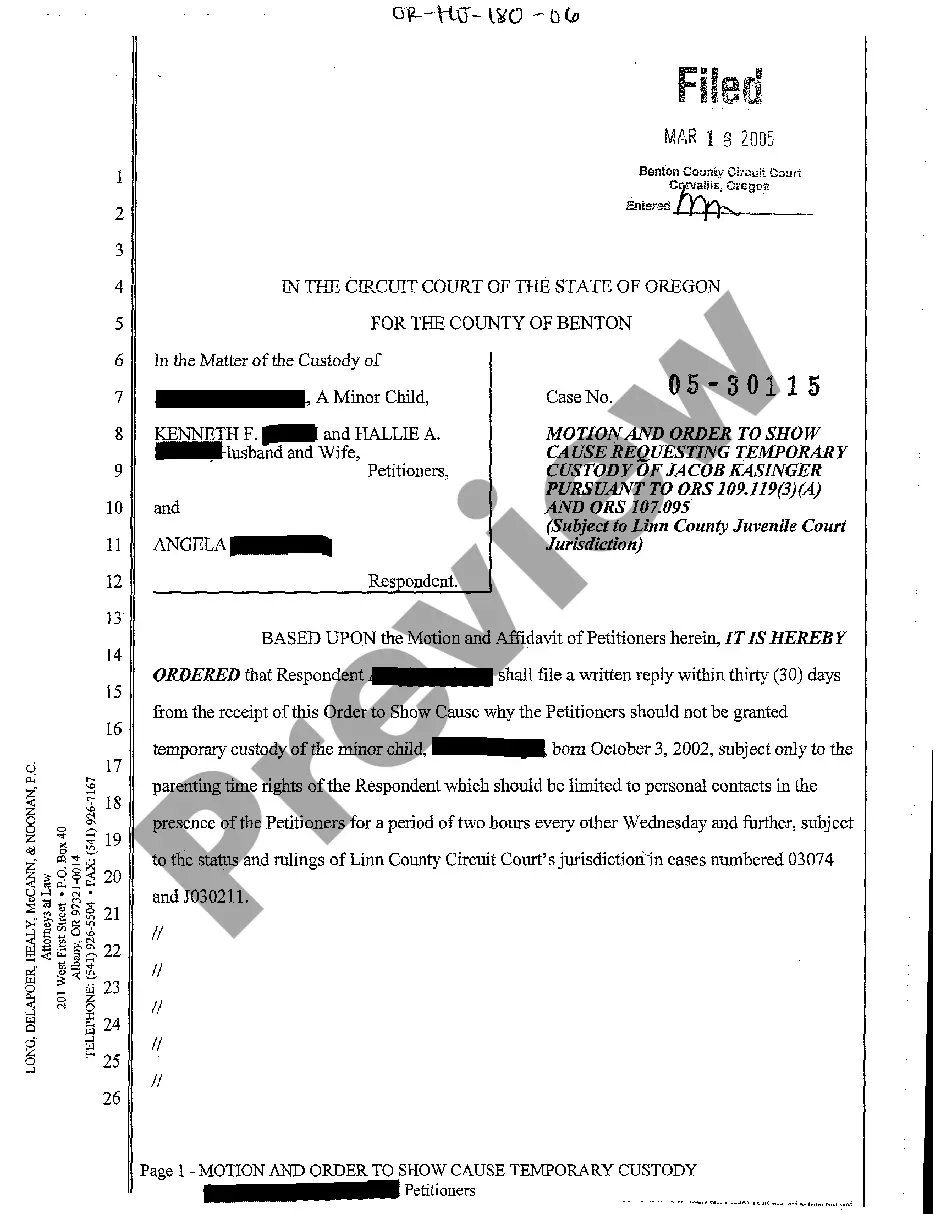
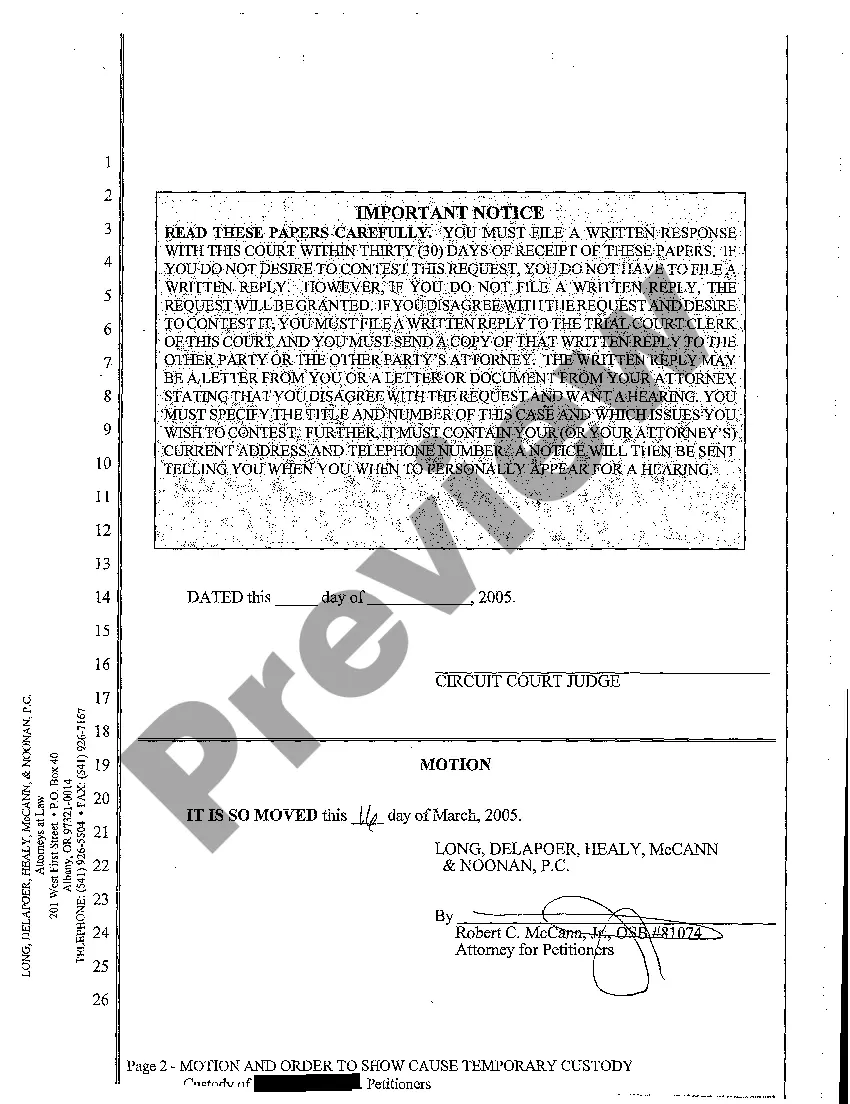

How to fill out Oregon Motion And Order To Show Cause Requesting Temporary Custody Pursuant To ORS 109.119(3)(A) And ORS 107.095?
Dealing with legal documents and procedures can be a lengthy addition to your routine. Oregon Temporary Custody Forms For Parents and similar forms often necessitate searching for them and comprehending how to fill them out correctly.
Therefore, whether you are managing financial, legal, or personal issues, utilizing a comprehensive and user-friendly online library of forms at your disposal will be incredibly beneficial.
US Legal Forms is the leading online resource for legal templates, providing over 85,000 state-specific forms along with various tools to help you complete your documents effortlessly.
Browse the collection of relevant documents available with just a single click.
Then, follow the steps below to finalize your form: Ensure you have the correct form using the Preview feature and reviewing the form details. Select Buy Now when ready, and choose the monthly subscription plan that suits your requirements. Click Download and then fill out, sign, and print the form. US Legal Forms has 25 years of experience assisting clients with their legal documents. Get the form you need today and streamline any process without hassle.
- US Legal Forms supplies you with state- and county-specific forms available at any time for download.
- Enhance your document management processes with a reliable service that lets you prepare any form in a matter of minutes without additional or hidden fees.
- Simply Log In to your account, find Oregon Temporary Custody Forms For Parents, and obtain it directly from the My documents section.
- You can also access forms that have been downloaded previously.
- Is this your first time using US Legal Forms? Register and create your account in a few minutes to gain access to the form library and Oregon Temporary Custody Forms For Parents.
Form popularity
FAQ
To get an Immediate Danger temporary order, you must file a form called an Ex Parte Motion for Order of Immediate Danger & Temporary Custody and Parenting Time & Declaration in Support.
Oregon law provides that a parent or guardian of a minor child can sign a Power of Attorney to temporarily give another person the right to act as parent to that child (Oregon Revised Statutes 109.056). This is called "delegating" your rights and powers as a parent.
When the child turns 18, the court no longer has the jurisdiction (power) to require custody or visitation with either parent.
Under Oregon law, a delegation of parental/guardian rights is effective for a maximum of six months. You can limit this time period to as little as you want, but you cannot extend it beyond six months.
In both Washington and Oregon, a child can only choose which parent they'd like to live with when they turn 18 or are otherwise emancipated. Minor children are not considered capable of making such decisions for themselves and are not permitted to ?choose? living with one parent over another.