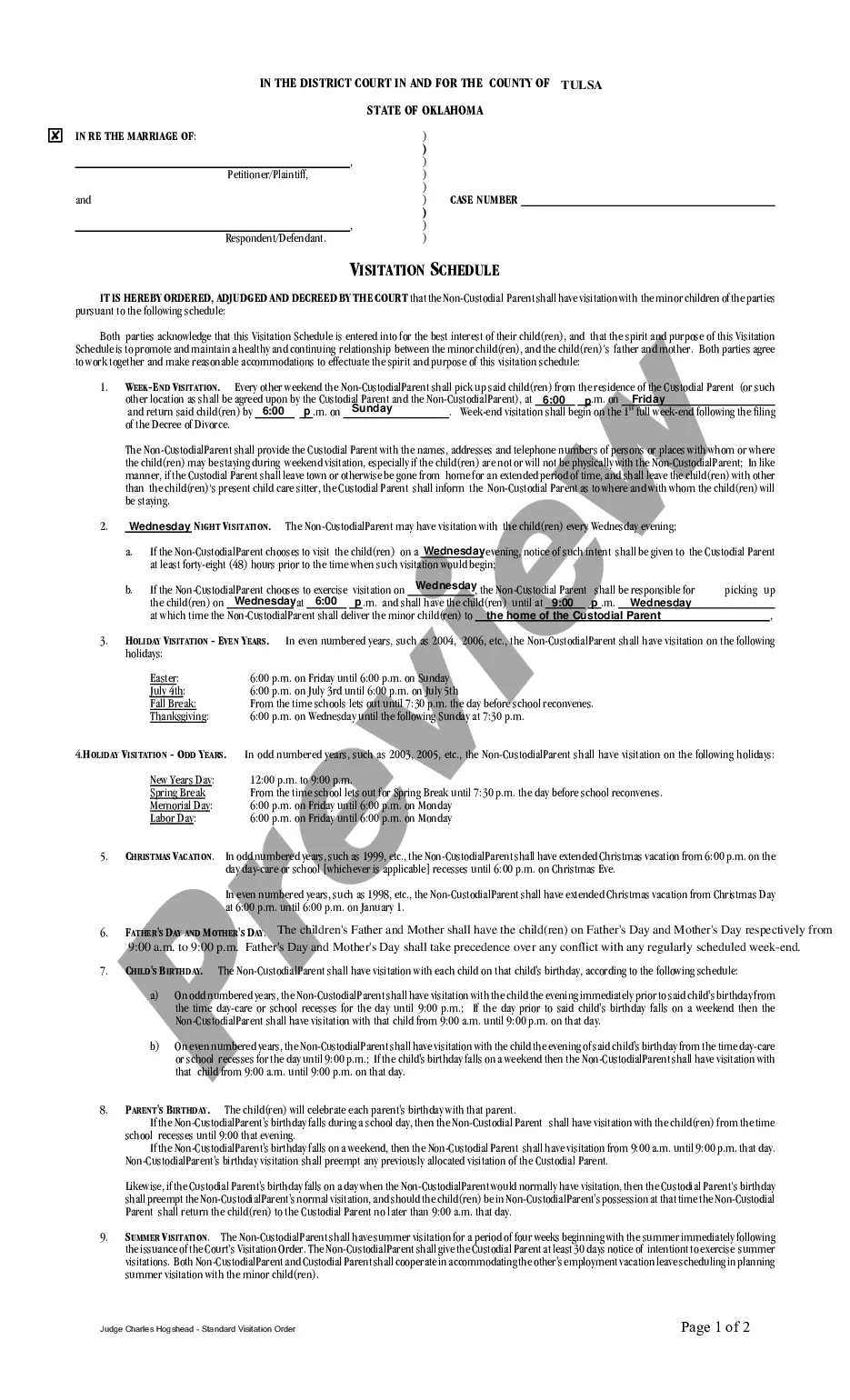
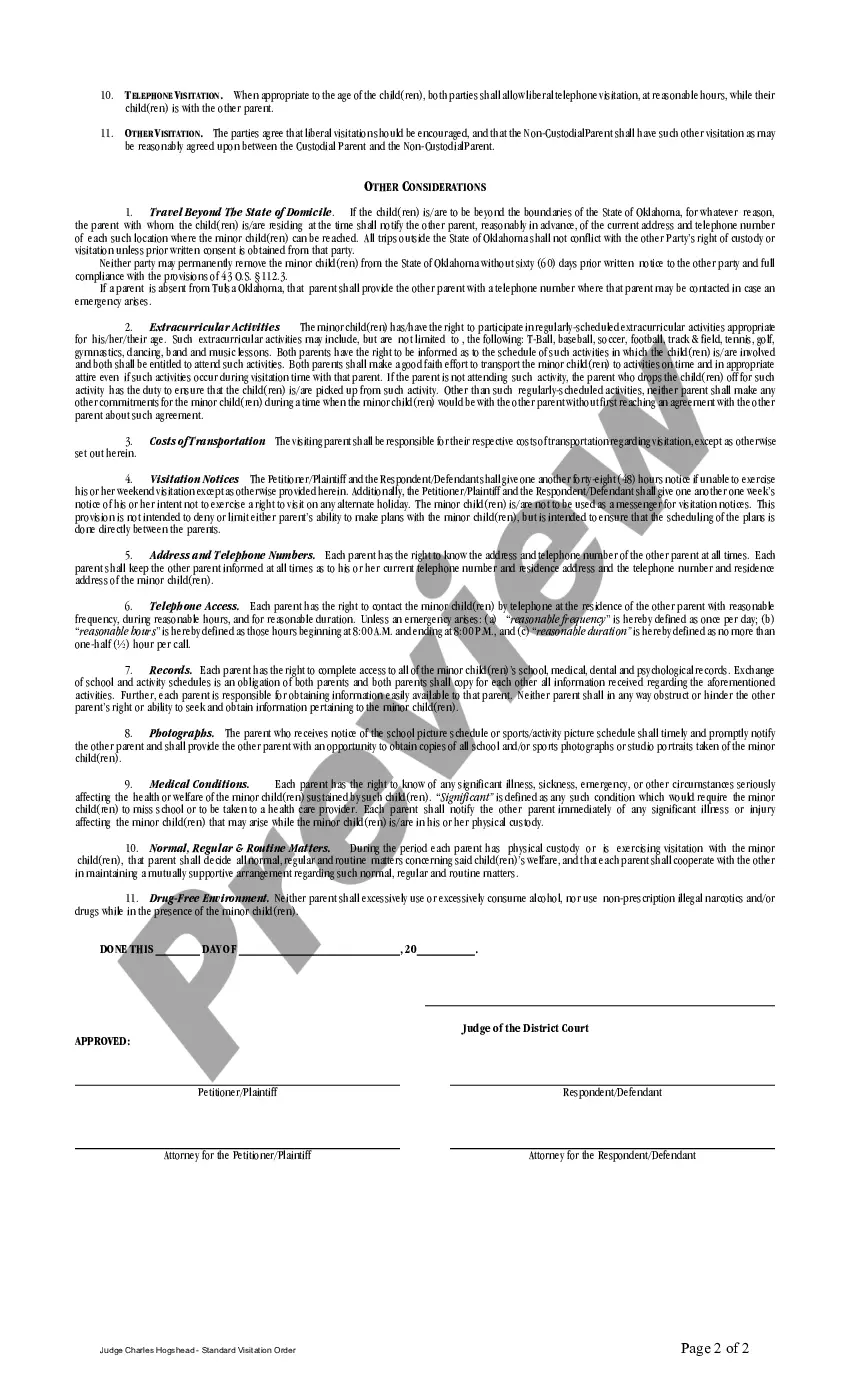
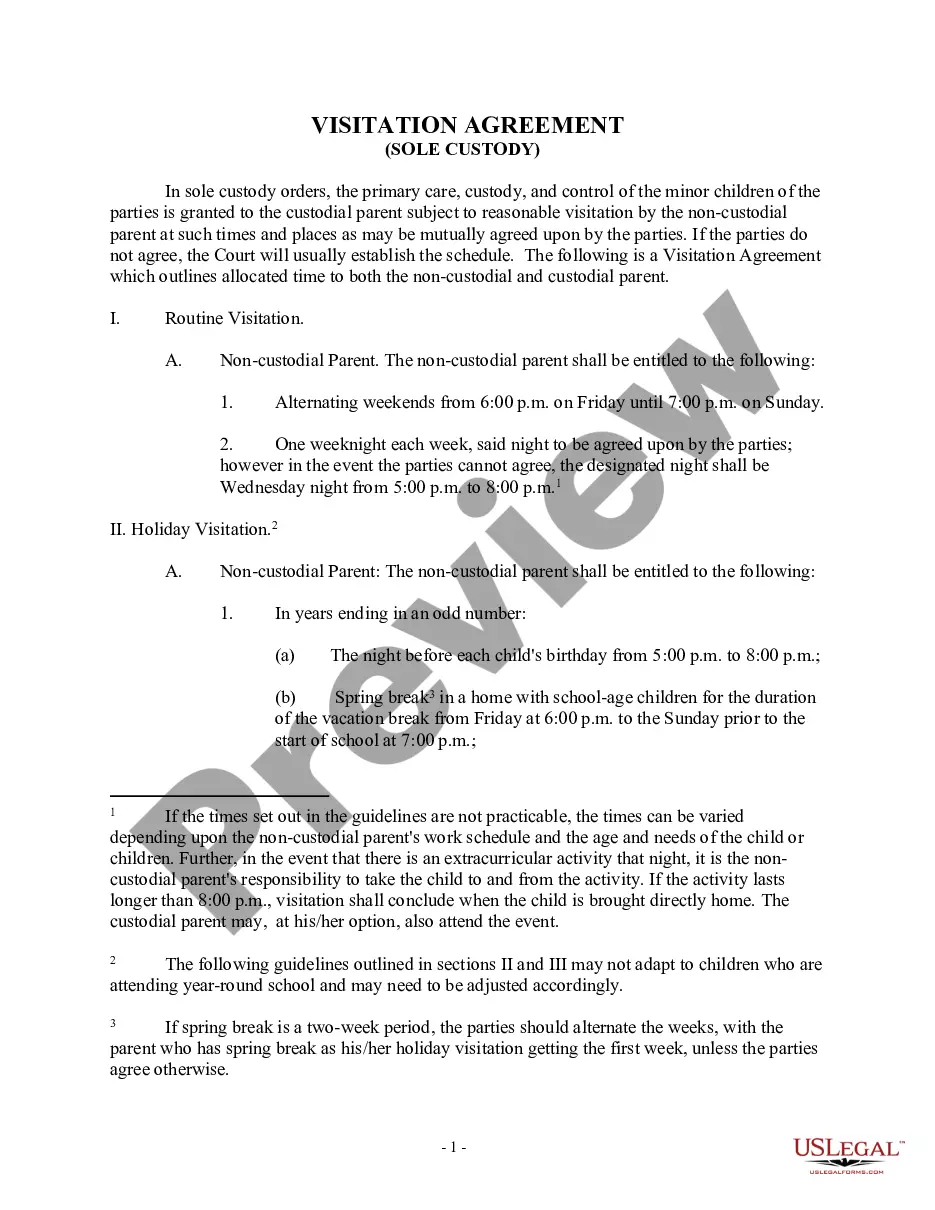
Oklahoma Standard Visitation Holiday Schedule For Divorced Parents
Description
Get your form ready online
Our built-in tools help you complete, sign, share, and store your documents in one place.
Make edits, fill in missing information, and update formatting in US Legal Forms—just like you would in MS Word.
Download a copy, print it, send it by email, or mail it via USPS—whatever works best for your next step.
Sign and collect signatures with our SignNow integration. Send to multiple recipients, set reminders, and more. Go Premium to unlock E-Sign.
If this form requires notarization, complete it online through a secure video call—no need to meet a notary in person or wait for an appointment.
We protect your documents and personal data by following strict security and privacy standards.

Make edits, fill in missing information, and update formatting in US Legal Forms—just like you would in MS Word.

Download a copy, print it, send it by email, or mail it via USPS—whatever works best for your next step.

Sign and collect signatures with our SignNow integration. Send to multiple recipients, set reminders, and more. Go Premium to unlock E-Sign.

If this form requires notarization, complete it online through a secure video call—no need to meet a notary in person or wait for an appointment.

We protect your documents and personal data by following strict security and privacy standards.
Looking for another form?
How to fill out Oklahoma Standard Visitation Schedule - Order?
Identifying a trusted location to acquire the most up-to-date and suitable legal templates is a significant part of navigating bureaucracy.
Finding the correct legal documents demands accuracy and careful consideration, which is why it is important to obtain samples of the Oklahoma Standard Visitation Holiday Schedule For Divorced Parents exclusively from trustworthy sources, such as US Legal Forms. An incorrect template can squander your time and prolong your current situation.
Eliminate the stress associated with your legal documentation. Explore the extensive US Legal Forms collection to discover legal templates, evaluate their relevance to your needs, and download them immediately.
- Make use of the library navigation or search bar to locate your template.
- Check the form’s details to confirm its compliance with the regulations of your state and locality.
- Examine the form preview, if available, to ensure the template aligns with your interests.
- Continue the search and identify the correct document if the Oklahoma Standard Visitation Holiday Schedule For Divorced Parents does not meet your specifications.
- If you are confident about the form’s applicability, download it.
- As an authorized user, click Log in to verify and access your chosen templates in My documents.
- If you haven't created an account, click Buy now to obtain the form.
- Choose the pricing option that best fits your needs.
- Proceed with the registration to finalize your transaction.
- Conclude your purchase by selecting a payment method (credit card or PayPal).
- Choose the file format for downloading the Oklahoma Standard Visitation Holiday Schedule For Divorced Parents.
- Once the form is on your device, you can modify it using an editor or print it out and fill it in manually.
Form popularity
FAQ
Can a Parent Deny Visitation in Oklahoma? In almost all situations, it is illegal for a parent to deny visitation to a child without a court order. If you believe the child is in immediate danger, denying visitation may be permitted, but only with sufficient evidence to prove so.
The standard visitation schedule The standard schedules are considered the minimum amount of visitation that a noncustodial parent should have and they are all very similar to this schedule. The parents alternate major, school, and religious holidays. The parents each get 6 weeks with the child during summer break.
The non-custodial parent shall have visitation with all minor children of the parties as follows: REGULAR VISITATION: a) The non-custodial parent shall have visitation every other weekend from Friday after school or day care until Monday morning when non-custodial parent returns child(ren) to school or day care.
Standard visitation generally means that the non-custodial parent or the secondary custodial parent has every other weekend and alternating holidays. And that every other weekend is typically from Friday after school and then returning sometime Sunday evening every other weekend.
Legally, the custodial parent must follow the visitation schedule. A child must comply until 18 years of age or is emancipated. From a practical standpoint, it can be challenging to follow the visitation schedule if the minor child clearly expresses disinterest and refuses to travel to see the other parent.