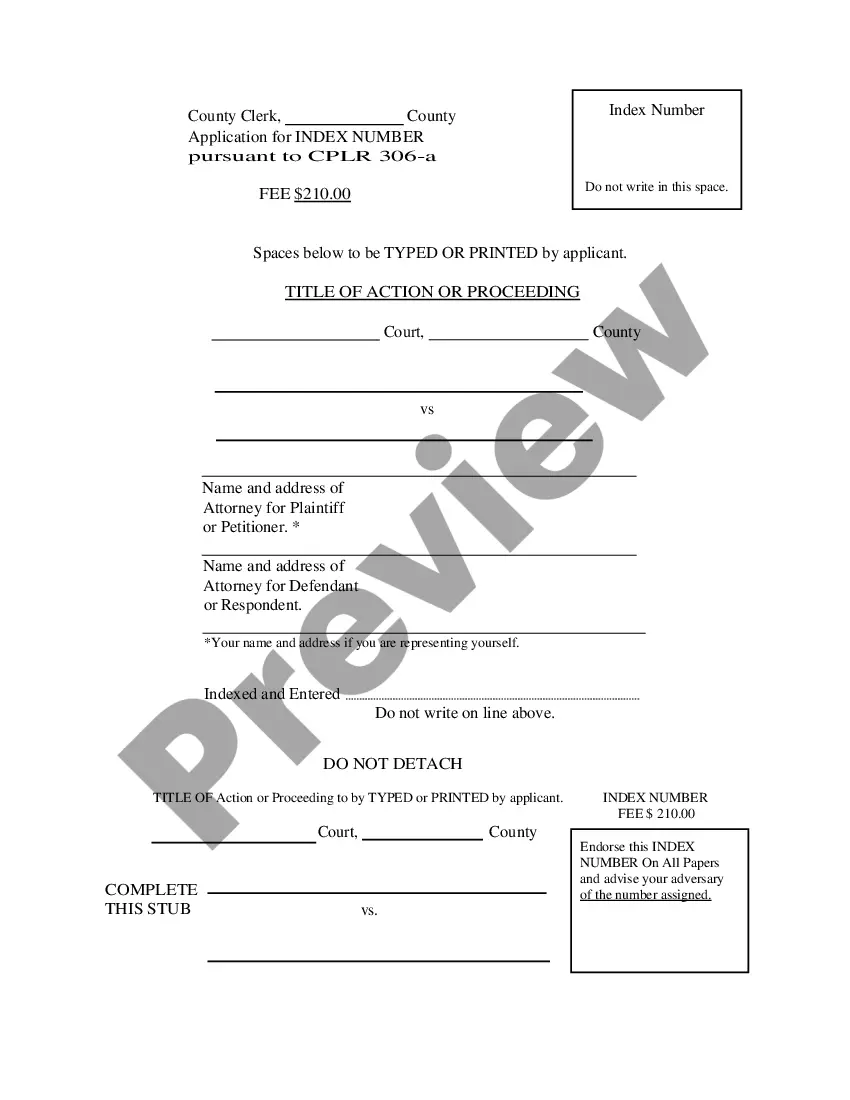
Official New York form used for obtaining index number assignments.
Cplr 306 A With Motion
Instant download
This website is not affiliated with any governmental entity
Public form
Description
Get your form ready online
Our built-in tools help you complete, sign, share, and store your documents in one place.
Built-in online Word editor
Make edits, fill in missing information, and update formatting in US Legal Forms—just like you would in MS Word.
Export easily
Download a copy, print it, send it by email, or mail it via USPS—whatever works best for your next step.
E-sign your document
Sign and collect signatures with our SignNow integration. Send to multiple recipients, set reminders, and more. Go Premium to unlock E-Sign.
Notarize online 24/7
If this form requires notarization, complete it online through a secure video call—no need to meet a notary in person or wait for an appointment.
Store your document securely
We protect your documents and personal data by following strict security and privacy standards.

Make edits, fill in missing information, and update formatting in US Legal Forms—just like you would in MS Word.

Download a copy, print it, send it by email, or mail it via USPS—whatever works best for your next step.

Sign and collect signatures with our SignNow integration. Send to multiple recipients, set reminders, and more. Go Premium to unlock E-Sign.

If this form requires notarization, complete it online through a secure video call—no need to meet a notary in person or wait for an appointment.

We protect your documents and personal data by following strict security and privacy standards.
Looking for another form?









How to fill out New York Application For Index Number?
Securing a reliable source for obtaining the latest and most pertinent legal templates is a significant part of navigating bureaucracy.
Locating the correct legal documents requires precision and meticulousness, which underscores the necessity to obtain samples of Cplr 306 A With Motion exclusively from reputable entities, such as US Legal Forms. An incorrect template can lead to wasted time and prolong your current situation. With US Legal Forms, you can feel assured. You can access and review all relevant details concerning the document's applicability and importance for your specific situation and location.
Eliminate the hassle associated with your legal paperwork. Explore the extensive US Legal Forms library where you can discover legal templates, assess their relevance to your situation, and download them instantly.
- Utilize the library navigation or search bar to find your template.
- Examine the form’s details to verify if it meets the criteria for your location.
- Preview the form, if available, to confirm it is indeed the version you need.
- If the Cplr 306 A With Motion does not fulfill your requirements, return to the search to find the suitable document.
- Once you are certain about the form's applicability, download it.
- If you are an authorized user, click Log in to verify and access your selected forms in My documents.
- If you do not have an account yet, click Buy now to acquire the template.
- Choose the pricing plan that aligns with your needs.
- Proceed with registration to complete your purchase.
- Complete your transaction by selecting a payment option (credit card or PayPal).
- Choose the file format for downloading Cplr 306 A With Motion.
- Once you have the document on your device, you can edit it using the editor or print it and complete it manually.
Form popularity
FAQ
Yes, you can file a motion in court without a lawyer. Many individuals choose to represent themselves and successfully navigate the legal system. Understanding the procedures, especially those outlined in CPLR 306 a with motion, is vital for your success. Utilizing resources like US Legal Forms can provide valuable templates and guidance to streamline your process.
Writing a motion letter to a judge requires clarity and professionalism. Begin with a proper heading that includes the case name and number. Clearly state your request and provide supporting arguments, using CPLR 306 a with motion for guidance. Be respectful and concise, as judges appreciate straightforward communication.
To file a motion on your own, start by understanding the specific requirements of your case. Gather all necessary documents and draft your motion clearly, referencing CPLR 306 a with motion where applicable. Once completed, submit your motion to the court clerk along with any required fees. Keeping organized records throughout this process will help you manage your case effectively.
A motion to compel in New York's CPLR is a request made to the court to force a party to comply with discovery obligations. This motion is often used to ensure that evidence or information is provided as required. When filing such a motion, referencing CPLR 306 a with motion can clarify your demands and strengthen your argument. Properly presenting your case can lead to a favorable outcome.
Yes, many individuals have successfully won cases without hiring a lawyer. While it can be challenging, understanding the legal process and effectively utilizing resources like CPLR 306 a with motion can aid your efforts. Many self-represented litigants have succeeded by being diligent and well-prepared. Researching your case and following proper procedures is crucial.
A motion to preclude under CPLR refers to a request asking the court to prevent a party from introducing evidence that is deemed inadmissible. This motion aims to protect your case from irrelevant or unfairly prejudicial material. Understanding CPLR 306 a with motion is essential when preparing such a request. A well-prepared motion can strengthen your position in court.
Yes, you can file your own motion in court, commonly known as pro se representation. This means you represent yourself without an attorney. To ensure your motion complies with the necessary legal standards, familiarize yourself with Cplr 306 a with motion. Resources like UsLegalForms can provide templates and guidance to help you navigate the process effectively.
To file a motion in New York, you must prepare your motion papers, which include a notice of motion, an affidavit, and any supporting documents. Ensure you adhere to the New York Civil Practice Law and Rules, particularly Cplr 306 a with motion for the correct format and content. Once your documents are ready, file them with the court clerk and serve copies to all parties involved in your case.
Yes, you can file a motion yourself even if you have an attorney. However, it is important to communicate with your attorney about your intentions to ensure that your filing aligns with your overall legal strategy. If you choose to proceed on your own, refer to Cplr 306 a with motion for guidance on the filing process. This way, you can maintain consistency in your legal approach.
To start a motion, you should begin with a clear and concise introduction. State the title of your motion and identify the parties involved in the case. It is also helpful to outline the specific relief you are requesting. Using Cplr 306 a with motion can guide you in drafting an effective opening statement to ensure clarity and precision.