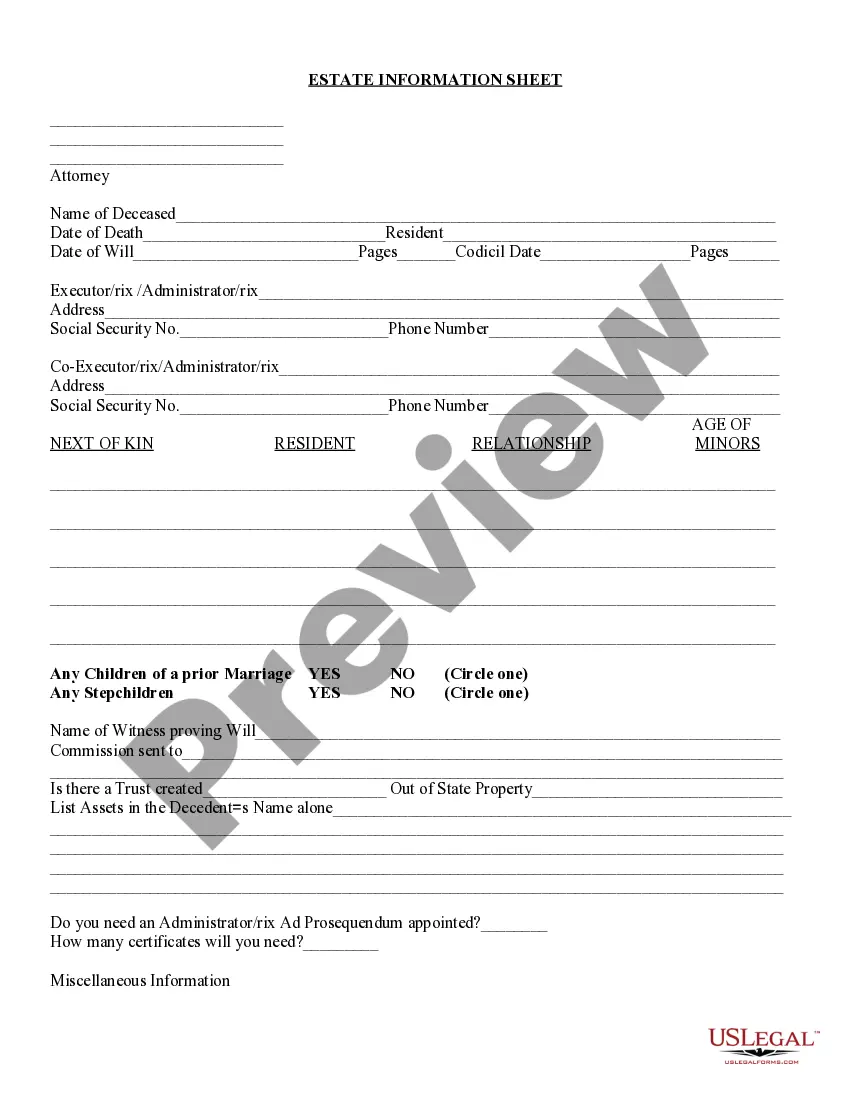
Ocean County Surrogate Estate Information Sheet For Parents
Description
Get your form ready online
Our built-in tools help you complete, sign, share, and store your documents in one place.
Make edits, fill in missing information, and update formatting in US Legal Forms—just like you would in MS Word.
Download a copy, print it, send it by email, or mail it via USPS—whatever works best for your next step.
Sign and collect signatures with our SignNow integration. Send to multiple recipients, set reminders, and more. Go Premium to unlock E-Sign.
If this form requires notarization, complete it online through a secure video call—no need to meet a notary in person or wait for an appointment.
We protect your documents and personal data by following strict security and privacy standards.

Make edits, fill in missing information, and update formatting in US Legal Forms—just like you would in MS Word.

Download a copy, print it, send it by email, or mail it via USPS—whatever works best for your next step.

Sign and collect signatures with our SignNow integration. Send to multiple recipients, set reminders, and more. Go Premium to unlock E-Sign.

If this form requires notarization, complete it online through a secure video call—no need to meet a notary in person or wait for an appointment.

We protect your documents and personal data by following strict security and privacy standards.
Looking for another form?
Form popularity
FAQ
In New Jersey, you generally have nine months to file for probate after a person’s death. It's important to begin this process promptly to ensure that you handle any estate matters with the required legal oversight. The Ocean county surrogate estate information sheet for parents can provide guidance on the necessary steps involved. Utilizing platforms like USLegalForms can simplify the process by offering the essential forms and information needed to navigate probate efficiently.
Probate court and surrogate court serve similar functions, but they are not precisely the same. While probate court handles various estate matters, surrogate court specifically addresses issues related to the administration of estates and guardianship cases. It’s important to know the distinctions so you can effectively utilize resources like the Ocean County surrogate estate information sheet for parents, which details procedures in your local surrogate court.
In court terms, a surrogate refers to a judge who oversees probate matters, including the validation of wills and the administration of estates. This role is crucial for ensuring that the wishes of the deceased are honored according to state law. Understanding the role of a surrogate can help you better navigate the legal process, especially when using resources like the Ocean County surrogate estate information sheet for parents to guide you through.
There are several reasons why someone might choose not to probate a will. For example, if the estate’s assets are below a certain value, it may not be necessary. Additionally, if the deceased had overlapping transfer of assets, such as joint ownership or payable-on-death accounts, probate may be avoided. It is essential to consult the Ocean County surrogate estate information sheet for parents to navigate these decisions effectively.
In most states, you generally need to probate the will within a specific time frame after death, often around four to six months. This process allows the estate to be settled and assets to be distributed according to the wishes outlined in the will. If you need to understand specific deadlines and procedures, the Ocean County surrogate estate information sheet for parents can provide useful guidance. Always check with your local probate court for the exact timelines applicable to your situation.
A Surrogate's certificate in New Jersey serves as official proof that the Will has been duly probated and that the executor has the right to act on behalf of the estate. This certificate is essential for managing estate assets, including accessing bank accounts and transferring property titles. To find more information on obtaining a Surrogate's certificate, refer to the Ocean County surrogate estate information sheet for parents.
While a lawyer is not strictly required to probate a Will in New Jersey, it can be highly beneficial. Navigating the probate process can be complicated, and a lawyer can help ensure that all documents are correctly submitted and that you comply with legal requirements. Additionally, they can assist with any disputes that may arise. Consider consulting the Ocean County surrogate estate information sheet for parents for more insights on when legal help might be necessary.
Probate court specifically handles cases related to the administration of deceased persons' estates, while surrogate court oversees issues such as contested wills and guardianships. In Ocean County, the surrogate court is also responsible for the appointment of personal representatives to manage estates. Understanding this distinction is crucial, especially when you refer to the Ocean County surrogate estate information sheet for parents, which can help clarify these processes.
To probate a Will in Ocean County, NJ, you need to file the Will with the Surrogate's Court in the county where the deceased resided. Begin by submitting the original Will along with a probate application and paying the required fees. After filing, the court will verify the validity of the Will and issue a Letter of Testamentary, which gives you the authority to manage the estate. For detailed guidance, you might want to refer to the Ocean County surrogate estate information sheet for parents.
To initiate probate in New Jersey, you generally require the original will, a certified death certificate, and a completed Ocean County surrogate estate information sheet for parents. Other necessary documents might include identification of the executor and supporting financial records. Having these documents ready can enhance the efficiency of the probate process.