Closing Statement Examples
Description

Get your form ready online
Our built-in tools help you complete, sign, share, and store your documents in one place.
Make edits, fill in missing information, and update formatting in US Legal Forms—just like you would in MS Word.
Download a copy, print it, send it by email, or mail it via USPS—whatever works best for your next step.
Sign and collect signatures with our SignNow integration. Send to multiple recipients, set reminders, and more. Go Premium to unlock E-Sign.
If this form requires notarization, complete it online through a secure video call—no need to meet a notary in person or wait for an appointment.
We protect your documents and personal data by following strict security and privacy standards.

Make edits, fill in missing information, and update formatting in US Legal Forms—just like you would in MS Word.

Download a copy, print it, send it by email, or mail it via USPS—whatever works best for your next step.

Sign and collect signatures with our SignNow integration. Send to multiple recipients, set reminders, and more. Go Premium to unlock E-Sign.

If this form requires notarization, complete it online through a secure video call—no need to meet a notary in person or wait for an appointment.

We protect your documents and personal data by following strict security and privacy standards.
Looking for another form?
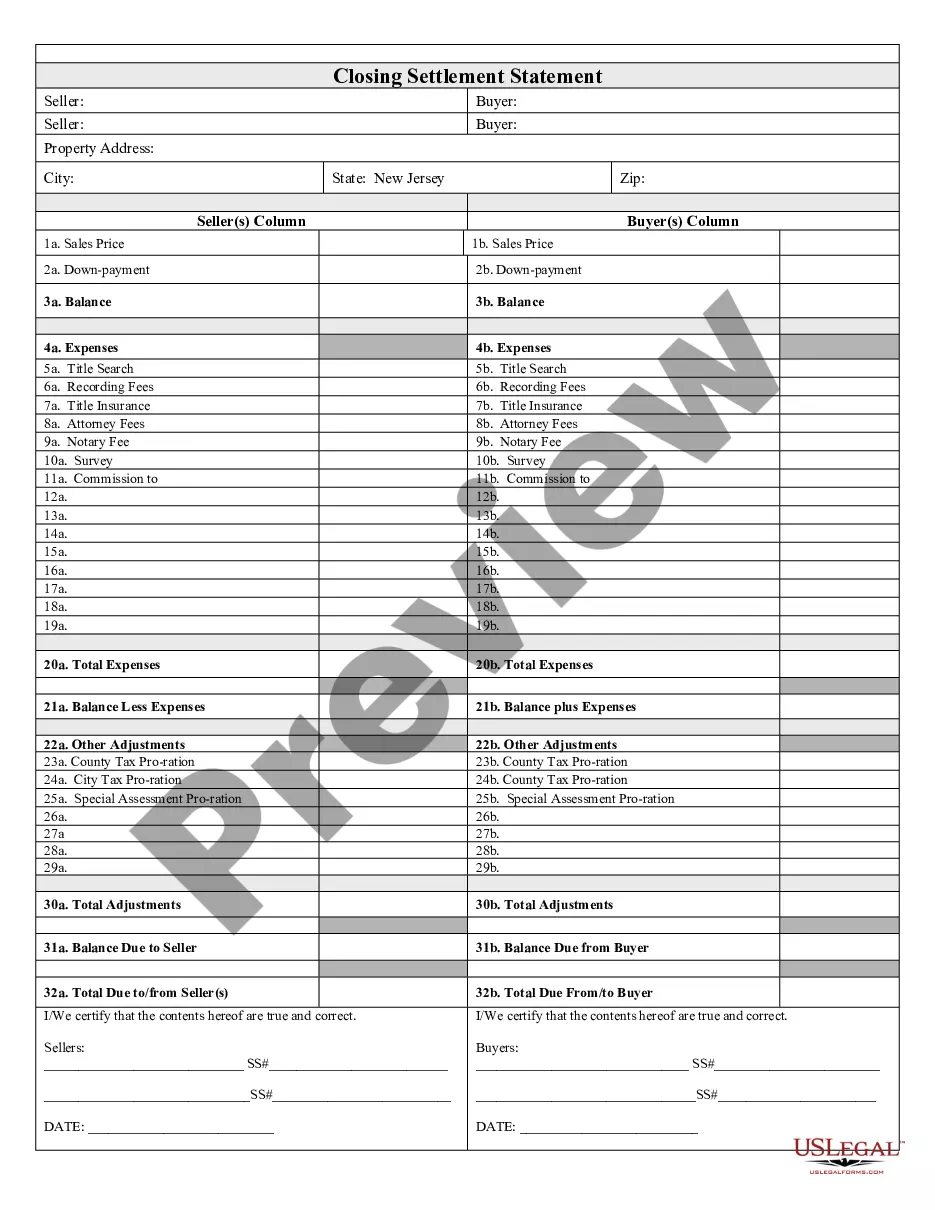
How to fill out New Jersey Closing Statement?
- Visit the US Legal Forms website and log into your account if you’re a returning user.
- If you’re new, navigate to the form database and use the search function to find closing statement examples that fit your needs.
- Ensure you review the descriptions and preview mode to confirm the form meets your jurisdiction's requirements.
- Select your desired document and click on the 'Buy Now' button to choose a suitable subscription plan.
- Complete your purchase by entering your payment details or using PayPal.
- Download your form and save it on your device for easy access and future reference in the 'My Forms' section of your profile.
Following these steps will simplify the process of obtaining closing statement examples tailored to your specific needs.
Don’t hesitate to utilize US Legal Forms for your legal documentation needs—unlock a world of resources today!
Form popularity
FAQ
A good closing speech integrates emotion with factual evidence, appealing to the jury’s sense of justice. It should connect the dots between the evidence and the desired verdict, leaving a lasting impression. To create an impactful closing speech, explore various closing statement examples that demonstrate successful language and structure, thus enhancing your ability to persuade the jury.
A brief closing statement succinctly summarizes the essential points of a case without elaborating on unnecessary details. It conveys the core message effectively, making it easier for the jury to grasp the main arguments. You can find various closing statement examples online to help you create a compelling and concise summary that fits the context of your case.
A typical closing statement outlines the facts of the case, reviews the evidence presented, and reiterates the main arguments of each side. It often includes a call to action, encouraging the jury to return a specific verdict based on the information shared. For better clarity, consider using closing statement examples that demonstrate how to structure your message effectively and keep the jury engaged.
A good closing statement clearly summarizes the main points of your case and reinforces your key arguments. It should resonate with the jury, highlighting the evidence that supports your position. By providing strong closing statement examples, you can effectively persuade the jury to understand your perspective and make a favorable decision.
Examples of closing statements vary widely depending on the case type and court setting. They can range from straightforward summaries of evidence to dramatic appeals to emotion. By exploring a variety of closing statement examples, you can find effective techniques and styles that resonate with different audiences, ultimately enhancing your ability as a legal representative.
Powerful closing statements often evoke emotions while logically summarizing the evidence presented in a case. By integrating personal anecdotes, vivid imagery, and strong assertions, these statements can leave a profound impact. To create your own powerful closing statement, reviewing successful closing statement examples can provide valuable insights and inspiration, helping you craft an engaging final argument.
A closing statement example provides a clear template or guideline for legal professionals to follow when finalizing their arguments. It represents a powerful opportunity to encapsulate the essence of the case and persuade the decision-maker. By studying various closing statement examples, you can learn how to effectively articulate your case, ensuring your final words leave a meaningful impression.
Effective closing statements summarize the key points of a case and leave a lasting impact on the jury or judge. They highlight the main arguments made throughout the trial while reinforcing the desired outcome. By utilizing closing statement examples, legal professionals can craft compelling narratives that resonate with their audience and persuade them towards a favorable decision.
You should structure your closing statement with a clear introduction, main body, and a powerful conclusion. Begin by restating the purpose of your statement, then summarize the crucial evidence and points supporting your position. Finally, conclude with a strong statement that reinforces your argument and encourages action. For examples and structuring tips, look no further than USLegalForms for reliable resources.
When writing your closing statement, start by summarizing the key points developed throughout your argument. Clearly state your main objective and reinforce your rationale. A strong closing statement takes into account the audience and aims to persuade them effectively. USLegalForms provides templates and closing statement examples to help streamline your writing process.