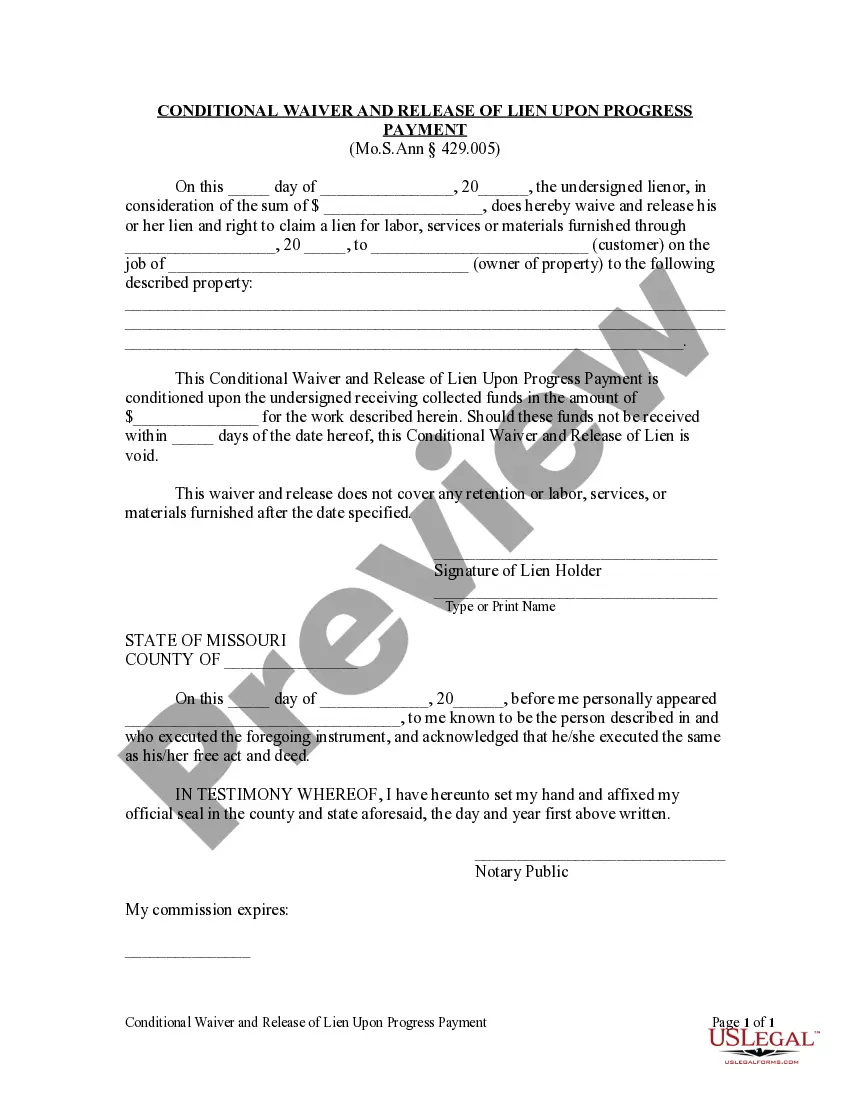
Conditional Lien Waiver For Partial Payment
Description
Get your form ready online
Our built-in tools help you complete, sign, share, and store your documents in one place.
Make edits, fill in missing information, and update formatting in US Legal Forms—just like you would in MS Word.
Download a copy, print it, send it by email, or mail it via USPS—whatever works best for your next step.
Sign and collect signatures with our SignNow integration. Send to multiple recipients, set reminders, and more. Go Premium to unlock E-Sign.
If this form requires notarization, complete it online through a secure video call—no need to meet a notary in person or wait for an appointment.
We protect your documents and personal data by following strict security and privacy standards.

Make edits, fill in missing information, and update formatting in US Legal Forms—just like you would in MS Word.

Download a copy, print it, send it by email, or mail it via USPS—whatever works best for your next step.

Sign and collect signatures with our SignNow integration. Send to multiple recipients, set reminders, and more. Go Premium to unlock E-Sign.

If this form requires notarization, complete it online through a secure video call—no need to meet a notary in person or wait for an appointment.

We protect your documents and personal data by following strict security and privacy standards.
Looking for another form?



How to fill out Missouri Conditional Waiver And Release Of Lien Upon Progress Payment?
Whether for commercial reasons or for private issues, everyone must deal with legal circumstances at some time in their life.
Completing legal documents necessitates meticulous attention, beginning with selecting the appropriate form template.
With an extensive US Legal Forms catalog available, you don't need to waste time searching for the correct template online. Utilize the library’s straightforward navigation to find the appropriate template for any circumstance.
- Acquire the template you require by utilizing the search bar or catalog browsing.
- Review the form’s details to ensure it corresponds to your situation, jurisdiction, and area.
- Click on the form’s preview to examine it.
- If it is the incorrect form, return to the search function to find the Conditional Lien Waiver For Partial Payment template you need.
- Obtain the template once it satisfies your requirements.
- If you already possess a US Legal Forms account, click Log in to access previously saved templates in My documents.
- In case you haven’t created an account yet, you can acquire the form by clicking Buy now.
- Select the appropriate pricing option.
- Fill out the profile registration form.
- Select your payment method: you can use a credit card or a PayPal account.
- Choose the file format you desire and download the Conditional Lien Waiver For Partial Payment.
- After it is downloaded, you can fill out the form using editing software or print it and complete it by hand.
Form popularity
FAQ
A lien is a legal right or interest that a lender has in a borrower's property, granted until the debt obligation is satisfied. In contrast, a non-lien does not assert any claim against the property. With a conditional lien waiver for partial payment, the distinction becomes clearer as it shows that while some claims are relinquished, others may still exist. Knowing this difference is crucial for anyone dealing with property or finances.
The summons and petition (or joint petition) for divorce or legal separation and confidential petition addendum must be filed and a fee paid to the Clerk of Circuit Court. (Note: There is a mandatory 120-day waiting period before the court can hear the final hearing.)
Confidential Petition Addendum - a document to provide information to the court concerning social security numbers in a confidential manner.
How do I do this? A "discretionary change of venue" (Wisconsin Statute 801.52) changes "the venue to any county in the interest of justice or for the convenience of the parties or witnesses..." To seek this, you would first need to file a motion for change of venue in your current county.
The purpose of the notice of retainer is to indicate to the court who you are representing. The court may already know who you are representing, and can add you as the attorney of record for the appropriate party before you opt in.
To file for a divorce in Dane County, Wisconsin, you need the correct forms. To file it in person, you go to the clerk of courts office on Hamilton Street in Madison. After filing, you can get a temporary order that outlines short-term solutions for things like property division, child custody, and child support.