Transfer Death Beneficiary For Ira
Description


Get your form ready online
Our built-in tools help you complete, sign, share, and store your documents in one place.
Make edits, fill in missing information, and update formatting in US Legal Forms—just like you would in MS Word.
Download a copy, print it, send it by email, or mail it via USPS—whatever works best for your next step.
Sign and collect signatures with our SignNow integration. Send to multiple recipients, set reminders, and more. Go Premium to unlock E-Sign.
If this form requires notarization, complete it online through a secure video call—no need to meet a notary in person or wait for an appointment.
We protect your documents and personal data by following strict security and privacy standards.

Make edits, fill in missing information, and update formatting in US Legal Forms—just like you would in MS Word.

Download a copy, print it, send it by email, or mail it via USPS—whatever works best for your next step.

Sign and collect signatures with our SignNow integration. Send to multiple recipients, set reminders, and more. Go Premium to unlock E-Sign.

If this form requires notarization, complete it online through a secure video call—no need to meet a notary in person or wait for an appointment.

We protect your documents and personal data by following strict security and privacy standards.
Looking for another form?









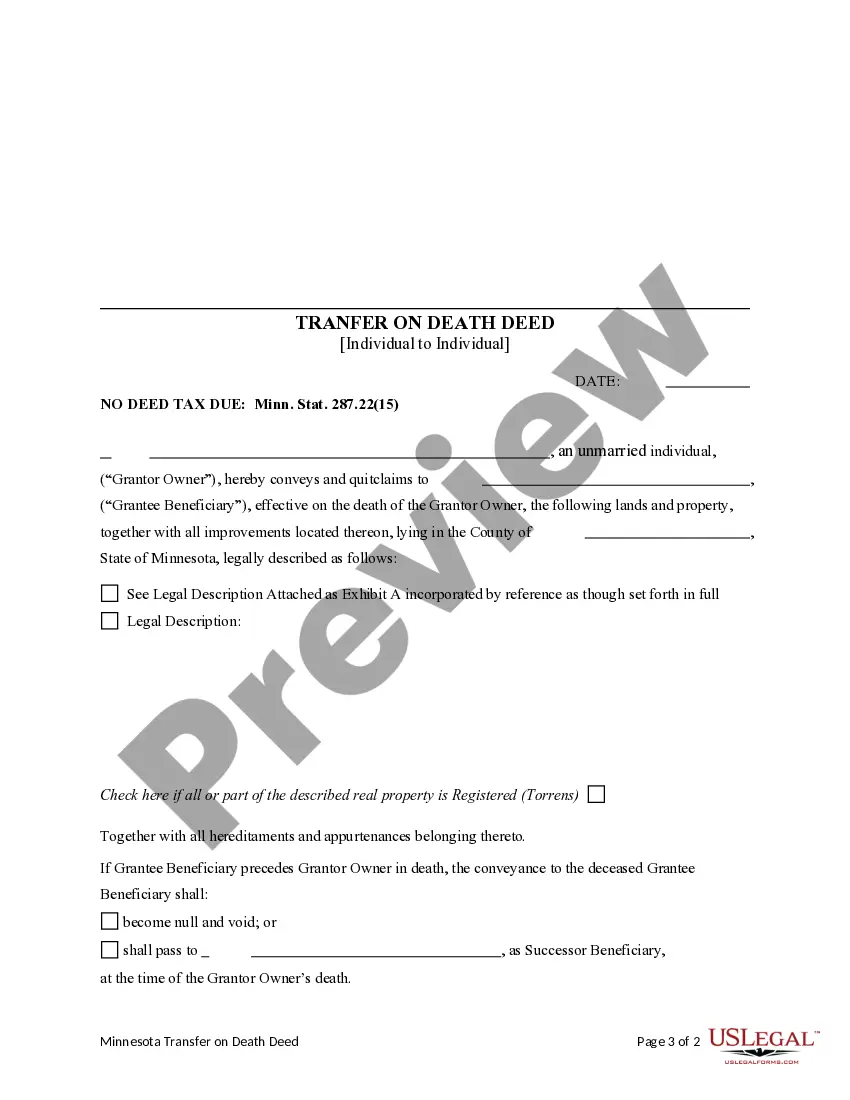
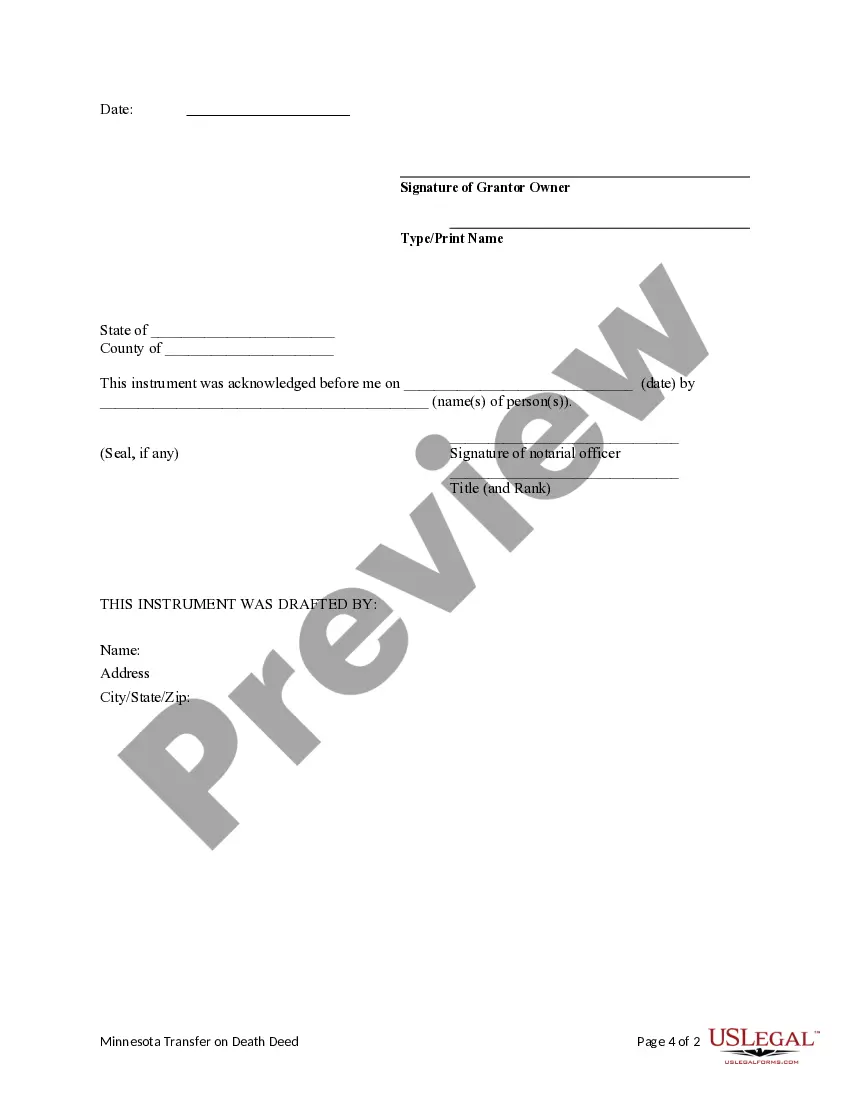
How to fill out Minnesota Transfer On Death Deed - Individual To Individual?
- Log in to your US Legal Forms account. If you're a returning user, ensure your subscription is active. If not, simply renew it.
- In the form library, preview the necessary document related to the beneficiary transfer. Make sure it aligns with your local regulations.
- If you don't find the correct form, use the search feature to look for suitable alternatives. Select the one that meets all your criteria.
- Select your preferred subscription plan and click on the 'Buy Now' button. You will need to create an account if you do not have one.
- Enter your payment details, either through credit card or PayPal, and confirm your purchase.
- Once the payment is processed, download the necessary form directly to your device for easy access.
By following these steps, you can ensure the accurate transfer of your IRA beneficiary designations.
Don't hesitate to reach out to US Legal Forms' premium experts for any assistance in completing your documents correctly. Simplify your legal processes today!
Form popularity
FAQ
To effectively transfer an inherited IRA, beneficiaries should first consult with a tax professional to understand the tax implications involved. Generally, establishing a beneficiary IRA and following the rules set by the IRS is crucial. Utilizing services such as US Legal Forms can help ensure that all necessary documents are filed correctly. This ensures a smooth transfer process and allows you to make the best decisions regarding your transfer death beneficiary for IRA.
In the event that a primary beneficiary passes away, the next steps depend on whether there is a contingent beneficiary designated. The IRA may then go to the contingent beneficiary, or, if none exists, it could revert to the owner's estate. This scenario can complicate the transfer process. To simplify this, always designate multiple beneficiaries when planning for your transfer death beneficiary for IRA.
If a beneficiary of an IRA dies before the original account holder, the financial institution will look at the account's beneficiary designations. Generally, an IRA may pass to secondary beneficiaries if they were named. If no secondary beneficiary exists, the IRA may become part of the deceased beneficiary's estate. This situation emphasizes the importance of regularly reviewing and updating your transfer death beneficiary for IRA designations.
When the account owner of an IRA passes away, the process of transferring the account to the designated beneficiaries begins. The IRA issuer will typically require a death certificate along with a beneficiary claim form. Beneficiaries need to understand that they will receive the transfer death beneficiary for IRA based on the specific instructions provided by the account holder. It's important to keep records updated to avoid complications.
To distribute an IRA after the primary beneficiary has died, you must first notify the financial institution holding the IRA. Gather necessary documentation, including the death certificate and relevant beneficiary designation forms. The goal is to transfer the death beneficiary for IRA efficiently while following the institution's procedures. You may want to seek legal advice to navigate any complex aspects and ensure proper distribution.
When an individual with an inherited IRA passes away, the account needs to be managed according to the new beneficiary designations. The transfer of the death beneficiary for IRA scenarios often involves naming new beneficiaries or possibly transferring the account to another eligible heir. The new beneficiaries must decide how to distribute the account funds, taking into account the tax rules that apply. Consulting an expert can help ensure the process aligns with your financial goals.
Distributing an inherited IRA can be simplified by transferring the death beneficiary for IRA purposes correctly. Beneficiaries often have several options such as taking a lump sum distribution, stretching the distributions over their lifetime, or moving the funds into their own IRA. Each option has differing tax implications, so consider your financial situation carefully. It's wise to consult with an expert to ensure that you choose the most beneficial route.
When the primary beneficiary of an IRA passes away, you must determine who the successor beneficiaries are. If no successor is named, the IRA usually goes to the deceased account holder's estate. To effectively transfer the death beneficiary for IRA purposes, you should contact the IRA custodian to start the process. They will provide necessary forms and guidance on how to distribute the funds according to the existing legal framework.
Filling out an IRA beneficiary form requires providing detailed information such as your name, address, and the beneficiaries' details. Ensure you include names, relationships, and Social Security numbers of the beneficiaries. By accurately completing this form, you streamline the process to transfer death beneficiary for IRA, ensuring your wishes are followed without delays.
To avoid taxes on a beneficiary's IRA, consider transferring the IRA into an Inherited IRA. This transition allows the beneficiary to stretch distributions over their life expectancy, reducing immediate tax impacts. Utilizing this strategy is essential when discussing how to transfer a death beneficiary for IRA while minimizing tax liabilities.