Minnesota Transfer Deed Withholding Tax
Description

Get your form ready online
Our built-in tools help you complete, sign, share, and store your documents in one place.
Make edits, fill in missing information, and update formatting in US Legal Forms—just like you would in MS Word.
Download a copy, print it, send it by email, or mail it via USPS—whatever works best for your next step.
Sign and collect signatures with our SignNow integration. Send to multiple recipients, set reminders, and more. Go Premium to unlock E-Sign.
If this form requires notarization, complete it online through a secure video call—no need to meet a notary in person or wait for an appointment.
We protect your documents and personal data by following strict security and privacy standards.

Make edits, fill in missing information, and update formatting in US Legal Forms—just like you would in MS Word.

Download a copy, print it, send it by email, or mail it via USPS—whatever works best for your next step.

Sign and collect signatures with our SignNow integration. Send to multiple recipients, set reminders, and more. Go Premium to unlock E-Sign.

If this form requires notarization, complete it online through a secure video call—no need to meet a notary in person or wait for an appointment.

We protect your documents and personal data by following strict security and privacy standards.
Looking for another form?
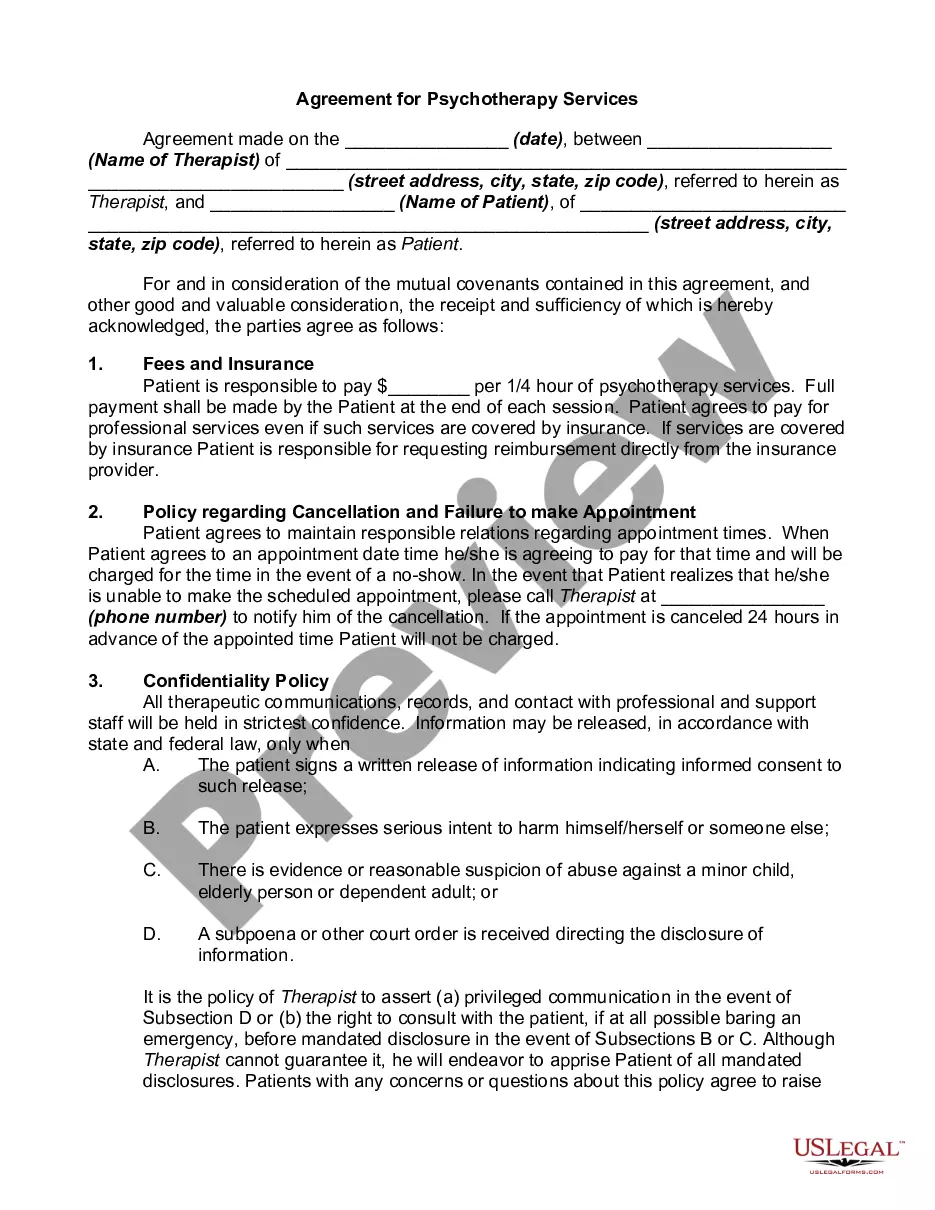




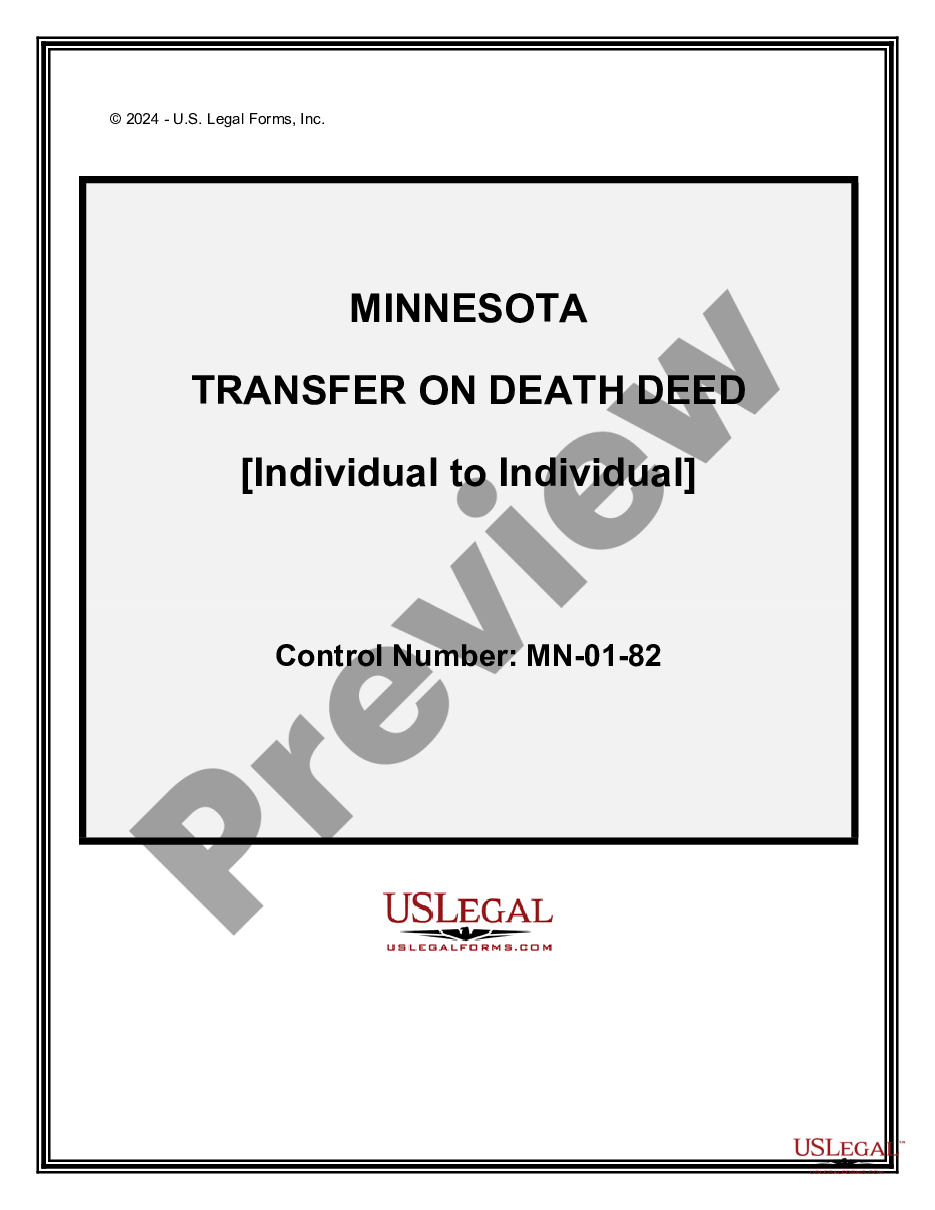
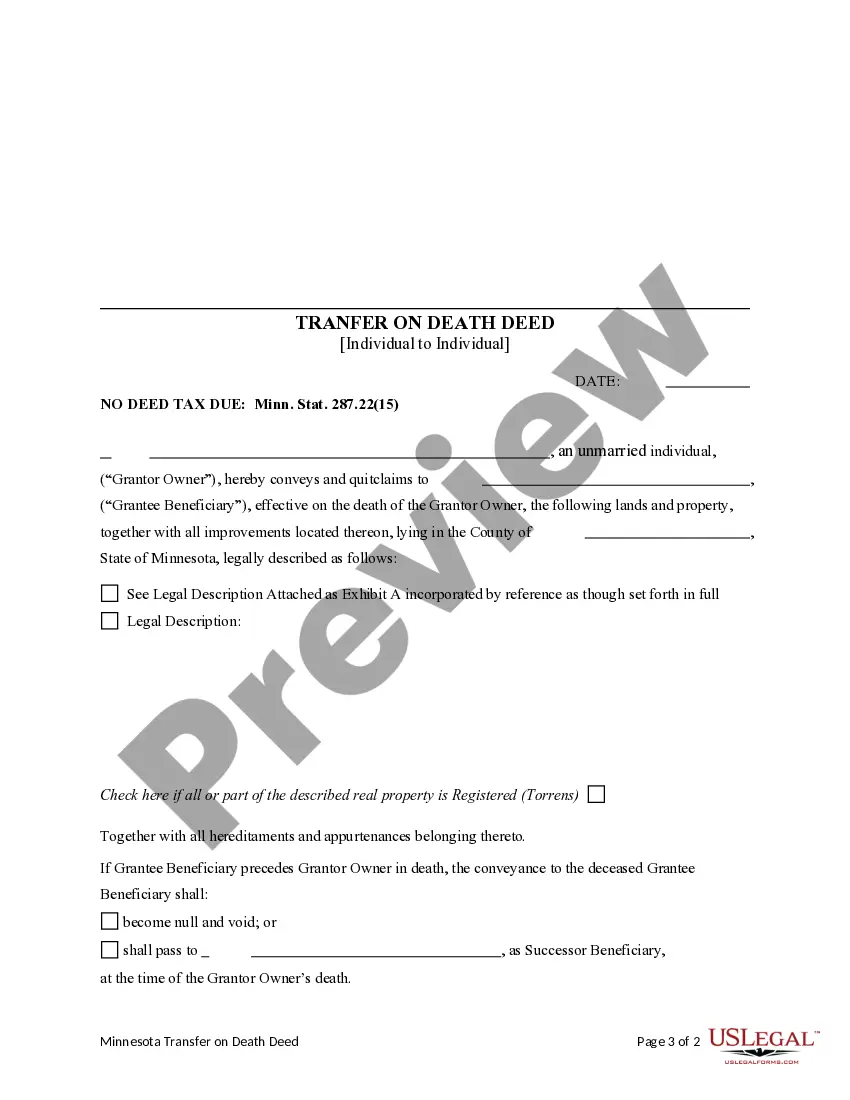
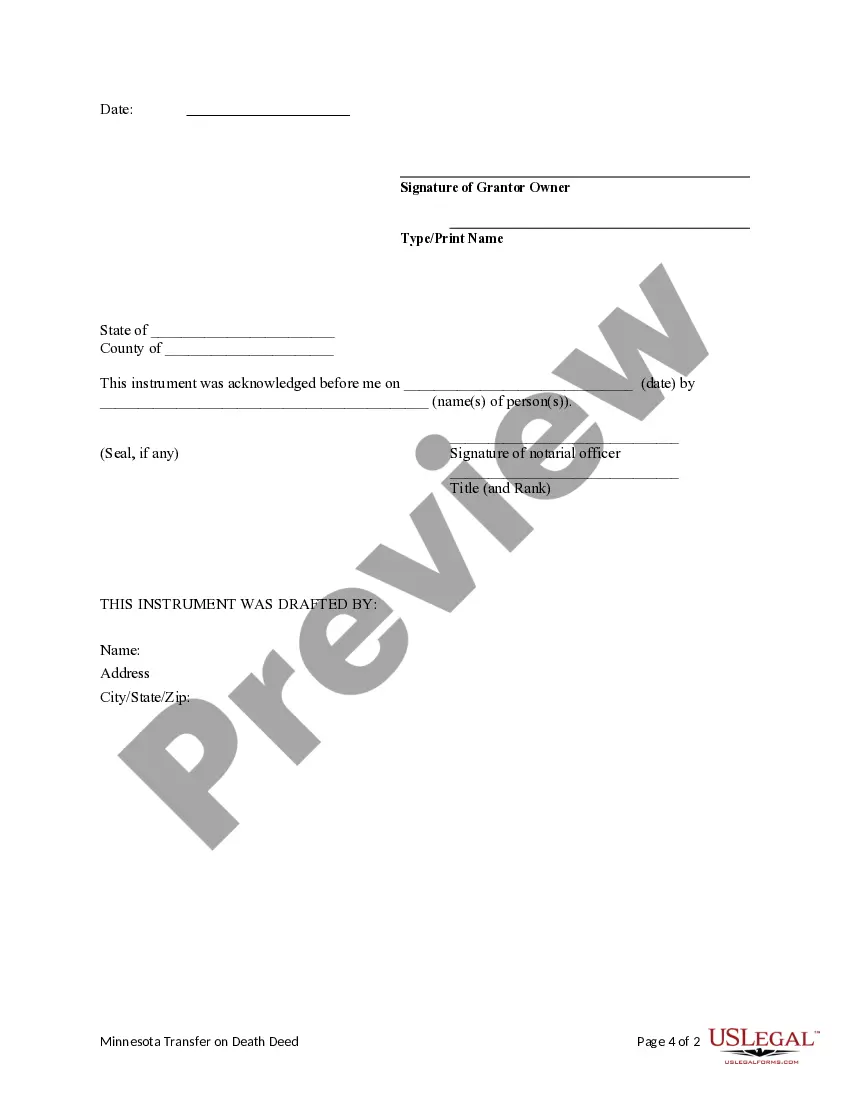
How to fill out Minnesota Transfer On Death Deed - Individual To Individual?
Securing a reliable source for obtaining the most up-to-date and suitable legal documents is a significant part of dealing with bureaucracy. Locating the appropriate legal forms requires precision and careful attention, which is why it's essential to obtain samples of Minnesota Transfer Deed Withholding Tax exclusively from trustworthy providers, such as US Legal Forms. An incorrect template can squander your time and delay your situation. With US Legal Forms, you have minimal concerns. You can access and review all the information related to the document’s applicability and significance for your circumstances and in your state or county.
Follow these outlined steps to complete your Minnesota Transfer Deed Withholding Tax.
Eliminate the hassle associated with your legal documents. Browse the extensive US Legal Forms collection where you can discover legal samples, assess their relevance to your situation, and download them immediately.
- Utilize the library navigation or search feature to locate your sample.
- Examine the form’s description to ensure it aligns with your state and county requirements.
- Check the form preview, if available, to confirm it is indeed the document you seek.
- Return to the search and find the appropriate document if the Minnesota Transfer Deed Withholding Tax does not meet your needs.
- If you are confident about the form’s suitability, download it.
- If you are an authorized user, click Log in to verify and access your chosen templates in My documents.
- If you haven't created a profile yet, click Buy now to acquire the template.
- Select the pricing plan that accommodates your requirements.
- Proceed to the registration to finalize your purchase.
- Conclude your transaction by choosing a payment method (credit card or PayPal).
- Select the document format for downloading the Minnesota Transfer Deed Withholding Tax.
- Once you have the form on your device, you can modify it with the editor or print it out and fill it in manually.
Form popularity
FAQ
In Minnesota, the seller is typically responsible for paying the deed tax when a property is sold. This tax is calculated as part of the Minnesota transfer deed withholding tax, which ensures that the state collects appropriate revenue on property transactions. However, sellers and buyers can negotiate who pays this tax during the sale process. Using a reliable service like USLegalForms can help clarify these responsibilities and streamline the transaction.
In Minnesota, seniors may qualify for property tax deferral or reduction programs starting at age 65. However, they are not exempt from paying property taxes entirely. These programs can significantly lower the burden of property taxes, including considerations for the Minnesota transfer deed withholding tax when the property is sold. It is advisable for seniors to consult local resources to explore their options.
To register for Minnesota withholding tax, you must complete the appropriate forms provided by the Minnesota Department of Revenue. You can find these forms online and submit them electronically or by mail. It is essential to register before initiating any property sale to ensure compliance with the Minnesota transfer deed withholding tax. Utilizing platforms like USLegalForms can simplify this process by providing guidance and necessary forms.
The deed transfer tax in Minnesota applies to the sale or transfer of real property and is based on the property's value. The standard rate is $0.33 per $100 of the assessed value. When engaging in property transactions, understanding the Minnesota transfer deed withholding tax can help you budget accordingly. Be sure to factor this tax into your overall financial planning.
In Minnesota, sales tax does not apply to the transfer of real estate. However, there may be other fees associated with the title transfer, such as recording fees. For real estate transactions, it’s crucial to consider the implications of the Minnesota transfer deed withholding tax. Consulting with a real estate expert can help clarify any uncertainties.
$495 must be paid when the deed is recorded. Who is responsible for paying the tax? The mortgagor (borrower) is liable for the MRT, while the seller is liable for the deed tax.
Minnesota includes all net capital gains income in taxable income and subjects it to the same tax rates as apply to other income: 5.35, 7.05, 7.85, and 9.85 percent. Minnesota recognizes the federal exclusions on the sale of the taxpayer's home and the sale of qualified small business stock.
In Minnesota there is a tax on the transfer of property, commonly called the deed tax. Typically the tax is paid by the seller of property, although a purchase agreement can be negotiated to have the buyer pay the tax.
Minnesota Statute 287.21 provides for deed tax to be paid on deeds to be recorded. The rate is 0.0033 of the purchase price (Example: $105,250 X 0.0033 = $347.33 deed tax). The minimum deed tax amount is $1.65.