Minnesota Transfer Death Deed With Life Estate
Description

Get your form ready online
Our built-in tools help you complete, sign, share, and store your documents in one place.
Make edits, fill in missing information, and update formatting in US Legal Forms—just like you would in MS Word.
Download a copy, print it, send it by email, or mail it via USPS—whatever works best for your next step.
Sign and collect signatures with our SignNow integration. Send to multiple recipients, set reminders, and more. Go Premium to unlock E-Sign.
If this form requires notarization, complete it online through a secure video call—no need to meet a notary in person or wait for an appointment.
We protect your documents and personal data by following strict security and privacy standards.

Make edits, fill in missing information, and update formatting in US Legal Forms—just like you would in MS Word.

Download a copy, print it, send it by email, or mail it via USPS—whatever works best for your next step.

Sign and collect signatures with our SignNow integration. Send to multiple recipients, set reminders, and more. Go Premium to unlock E-Sign.

If this form requires notarization, complete it online through a secure video call—no need to meet a notary in person or wait for an appointment.

We protect your documents and personal data by following strict security and privacy standards.
Looking for another form?


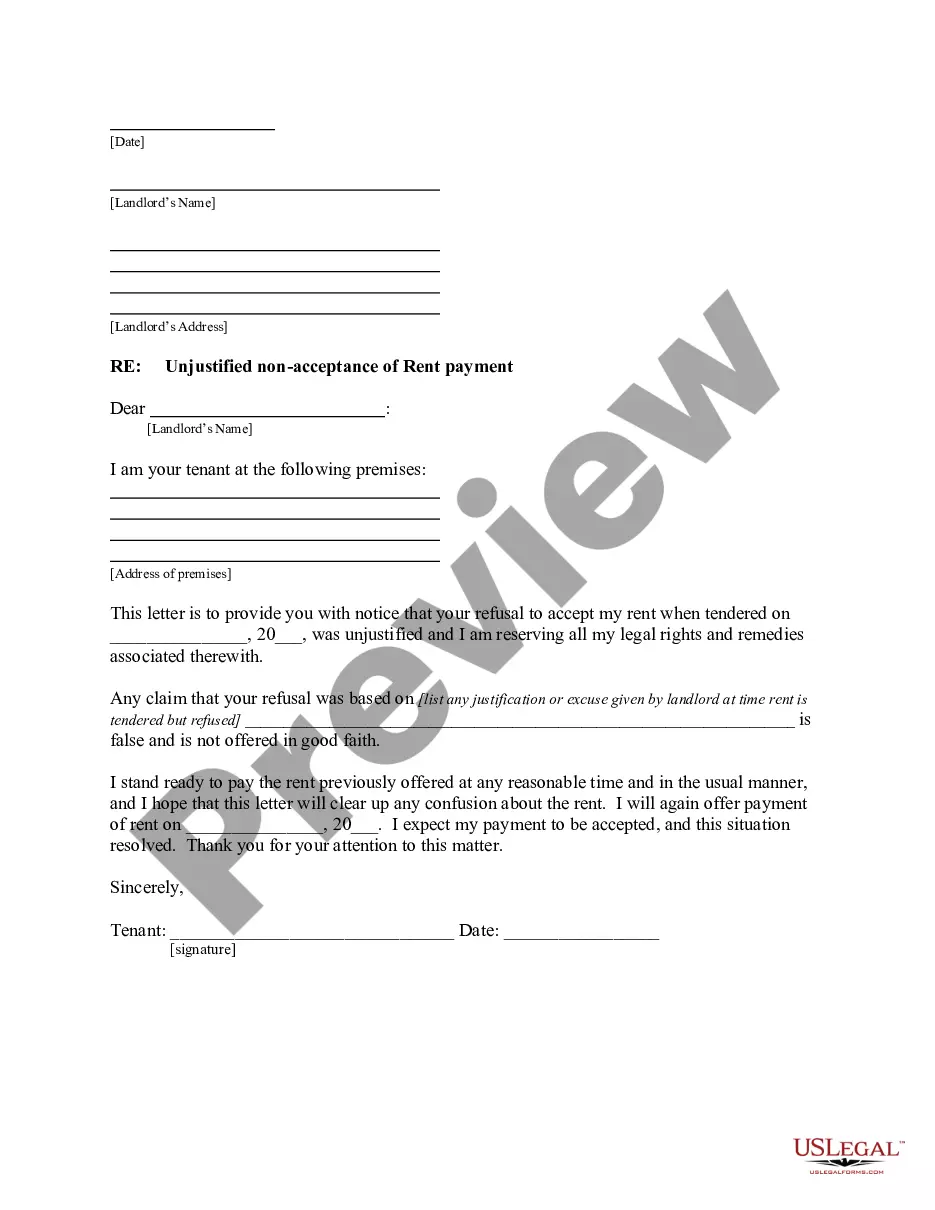



How to fill out Minnesota Transfer On Death Deed - Individual To Individual?
Legal administration can be exasperating, even for the most experienced professionals.
When you seek a Minnesota Transfer Death Deed With Life Estate but lack the opportunity to search for the appropriate and current version, the process can become overwhelming. An extensive web form directory could revolutionize the experience for anyone aiming to navigate these circumstances effectively.
Gain entry to a repository of articles, guides, handbooks, and materials pertinent to your situation and needs.
Conserve time and effort in searching for the documents you require by using US Legal Forms' sophisticated search and Preview feature to locate your Minnesota Transfer Death Deed With Life Estate and obtain it.
Experience the US Legal Forms web directory, supported by 25 years of expertise and reliability. Transform your daily document management into a straightforward and user-friendly process today.
- If you hold a monthly subscription, Log In to your US Legal Forms account, find the form, and download it.
- Check the My documents section to view the documents you have saved previously and manage your folders as needed.
- If it's your first encounter with US Legal Forms, create an account to enjoy unrestricted access to all benefits of the library.
- After acquiring the desired form, confirm its accuracy by previewing it and reviewing the details.
- Ensure the sample is validated in your state or county.
- Click Buy Now once you're ready.
- Choose a subscription plan.
- Select the format you prefer, and Download, fill it out, eSign, print it, and submit your documents.
- Access state- or county-specific legal and organizational documents.
- US Legal Forms meets any requirements you might have, from personal to business paperwork, all in one place.
- Utilize advanced tools to fill out and handle your Minnesota Transfer Death Deed With Life Estate.
Form popularity
FAQ
To transfer a property title to a family member in Minnesota, you typically need to execute a new deed that clearly indicates the transfer. This deed should be properly filled out, signed, and notarized before it is recorded with the county recorder's office. Utilizing a Minnesota transfer death deed with life estate can also streamline this process, as it ensures that ownership grace is guaranteed without the hassles of probate.
An Affidavit of Survivorship is a legal document used in Minnesota to transfer the ownership of real estate from one party to another when one of the parties has died. It is typically used by the heirs of a deceased party to transfer the deceased's ownership interest in real estate to the surviving owner.
What Is the Difference Between TOD and Beneficiary? A transfer on death is an instrument that transfers ownership of specific accounts and assets to someone. A beneficiary is someone that is named to receive something of value.
The deed could get complicated, and its validity contested if it is not recorded correctly or if the legal criteria are not met. If there is no provision for a contingent beneficiary, the transfer on the death deed is rendered ineffective if the named beneficiary passes away before the property owner.
Because a TOD deed, also known as a beneficiary deed, bypasses probate, it can simplify the inheritance process and reduce costs for your loved ones. Consider working with a financial advisor as you plan how your estate will be distributed upon your death.
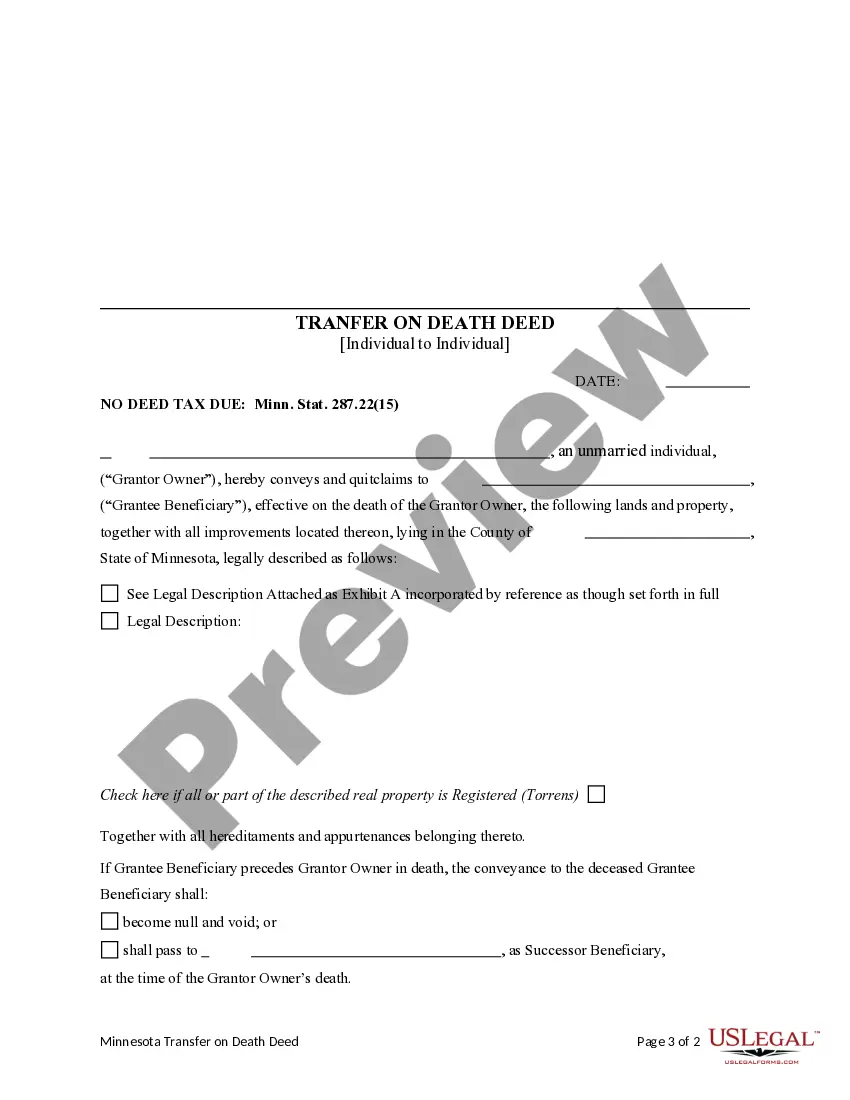
A Minnesota TODD must be either filed, or recorded, in the proper county real estate office before the death of the Grantor Owner(s) in order to achieve the objective of avoiding probate upon the death of the Grantor Owner(s) with respect to any real property interest identified in the Transfer on Death Deed.