Limited Company Meaning
Description
Get your form ready online
Our built-in tools help you complete, sign, share, and store your documents in one place.
Make edits, fill in missing information, and update formatting in US Legal Forms—just like you would in MS Word.
Download a copy, print it, send it by email, or mail it via USPS—whatever works best for your next step.
Sign and collect signatures with our SignNow integration. Send to multiple recipients, set reminders, and more. Go Premium to unlock E-Sign.
If this form requires notarization, complete it online through a secure video call—no need to meet a notary in person or wait for an appointment.
We protect your documents and personal data by following strict security and privacy standards.

Make edits, fill in missing information, and update formatting in US Legal Forms—just like you would in MS Word.

Download a copy, print it, send it by email, or mail it via USPS—whatever works best for your next step.

Sign and collect signatures with our SignNow integration. Send to multiple recipients, set reminders, and more. Go Premium to unlock E-Sign.

If this form requires notarization, complete it online through a secure video call—no need to meet a notary in person or wait for an appointment.

We protect your documents and personal data by following strict security and privacy standards.
Looking for another form?









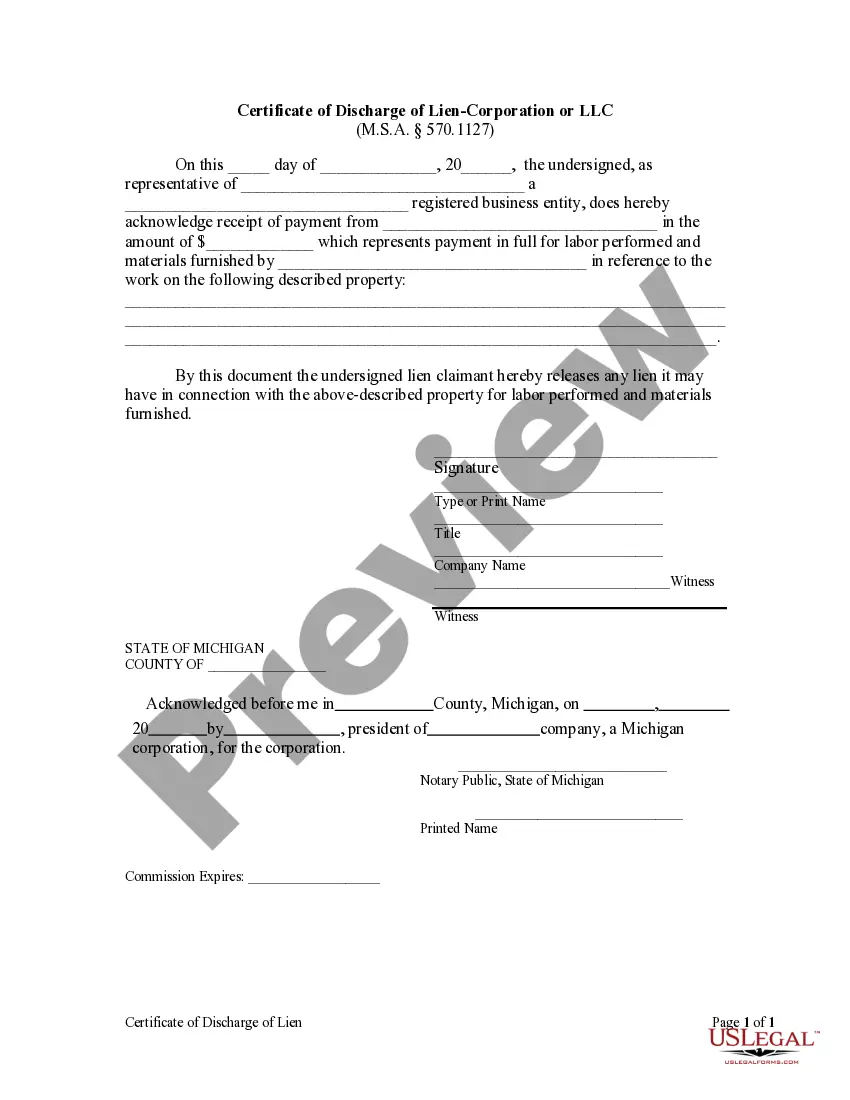
How to fill out Michigan Certificate Of Discharge Of Lien - Corporation Or LLC?
- If you are a returning user, simply log into your account and find the required form template using the Download button. Ensure your subscription remains active; if not, renew as per your plan.
- For first-time users, start by previewing the form description to ensure it fits your specific needs and local jurisdiction requirements.
- If you require a different template, use the Search tab to find the appropriate document.
- Once you find the right form, click on the Buy Now button and select your preferred subscription plan. You will need to create an account to access the resources.
- Proceed with the payment by entering your credit card information or utilizing your PayPal account for a hassle-free purchase.
- Download the completed form and save it on your device. Access it anytime from the My Forms section of your profile.
In conclusion, US Legal Forms empowers users with an extensive library of legal forms, making it easier than ever to handle legal documentation efficiently. With over 85,000 fillable documents and expert assistance available, you'll ensure your paperwork is precise and legally sound.
Don't wait; explore US Legal Forms today and streamline your legal form process!
Form popularity
FAQ
You are considered a limited company if you have registered your business in a way that offers limited liability protection to its owners. This legal distinction helps shield your personal assets from business debts and liabilities. The formalities include registration with the appropriate state authorities and adherence to corporate governance standards. Exploring the limited company meaning can guide you in ensuring all necessary criteria are met for your business to enjoy the associated protections.
To determine if you are a limited company, check your business registration documents and decide if the company name includes 'Limited', 'Ltd.', or similar designations. If your business is registered with the state and you have filed Articles of Incorporation, you likely are a limited company. Additionally, you can verify your status through your state’s business entity database. Clarifying the limited company meaning is vital for understanding your business's legal standing.
Choosing to become a limited company can provide various benefits, including liability protection and potential tax advantages. Many entrepreneurs opt for this structure to separate their personal finances from their business activities, which reduces personal risk. Furthermore, a limited company often boosts credibility with clients and suppliers. Grasping the limited company meaning can help you make an informed decision about your business registration.
A limited company is a business structure where the owners' liabilities are limited to their investment in the company. This means that if the company faces financial difficulties, the personal assets of the owners are generally protected. To qualify as a limited company, it must be registered with the state, maintain official records, and comply with specific reporting requirements. Understanding limited company meaning is essential for anyone considering this business structure.
The meaning of a limited company refers to a business organization where owners have limited liability for its debts. This means that their financial risk is confined to their investment in the company, safeguarding personal assets. By choosing to form a limited company, you can enjoy various operational advantages and legal protections that enhance business growth.
The main difference between a limited company and an LLC lies in their structure and regulation. A limited company is a broader term that can encompass various types of businesses with limited liability, while an LLC is a specific legal form commonly used in the U.S. Grasping these distinctions will deepen your understanding of limited company meaning.
The term LLC, or Limited Liability Company, often refers to a specific type of limited company found in the United States. While both structures provide limited liability, an LLC offers more flexibility in management and tax options. Understanding these differences enhances your comprehension of the limited company meaning.
A limited company is a type of business organization where the owners' liabilities are limited to what they invested. Essentially, the company can own assets, incur debts, and enter contracts in its name. This clarity in the limited company meaning emphasizes protection for the owners against personal loss.
Being a limited company means that the business is a separate legal entity from its owners. This separation limits the personal liability of the owners, protecting their personal assets in case of debts or legal issues. Understanding the limited company meaning helps you grasp the benefits of this structure for risk management and financial security.
An example of a limited company is Coca-Cola Company, which operates as a public limited company. This allows the company to raise capital by selling shares to the public while limiting shareholders' liabilities to the amount they invested. The limited company meaning is reflected in how this structure enables big operations while protecting personal assets. Exploring this structure can offer essential insights for those interested in forming a business.