Wedding Planner With Price
Description
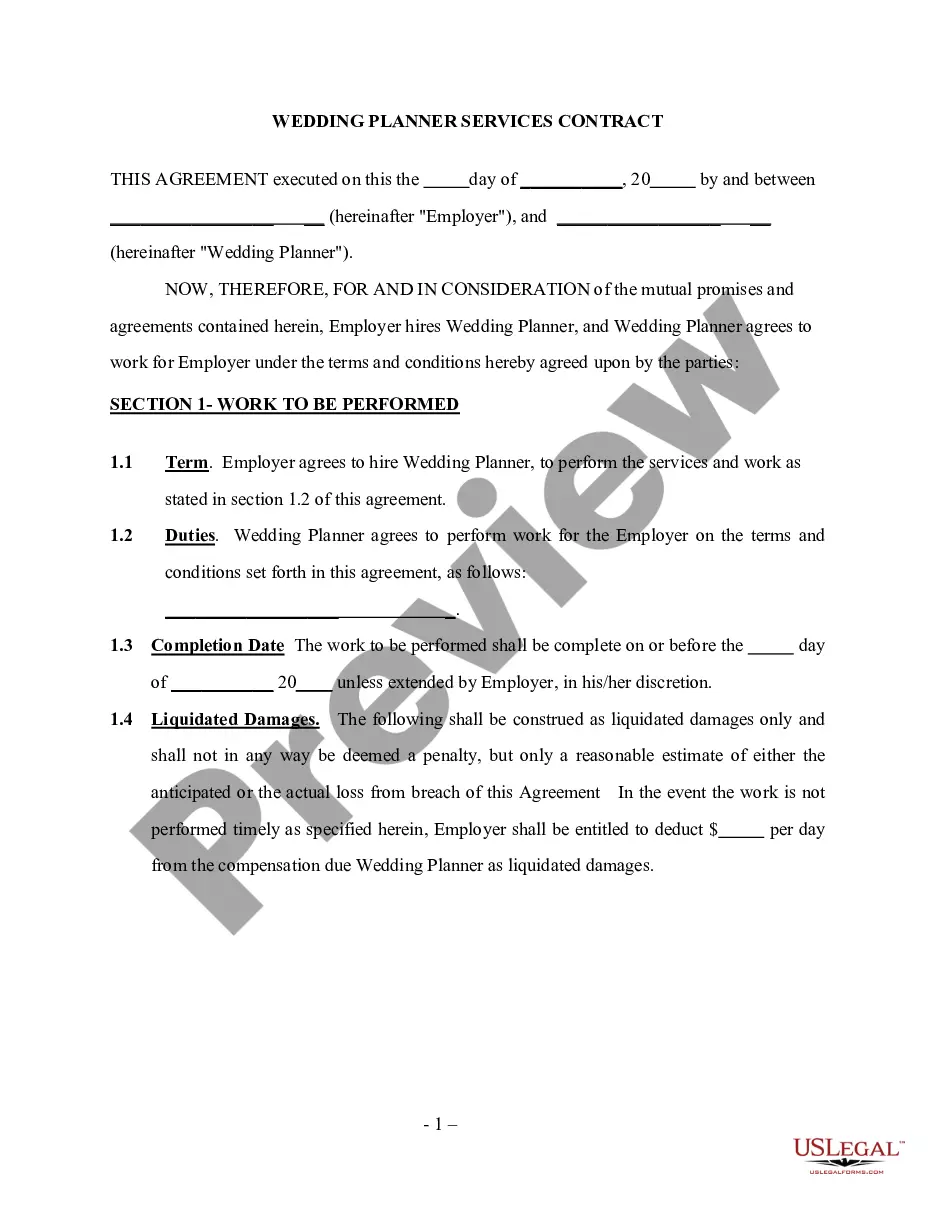

Get your form ready online
Our built-in tools help you complete, sign, share, and store your documents in one place.
Make edits, fill in missing information, and update formatting in US Legal Forms—just like you would in MS Word.
Download a copy, print it, send it by email, or mail it via USPS—whatever works best for your next step.
Sign and collect signatures with our SignNow integration. Send to multiple recipients, set reminders, and more. Go Premium to unlock E-Sign.
If this form requires notarization, complete it online through a secure video call—no need to meet a notary in person or wait for an appointment.
We protect your documents and personal data by following strict security and privacy standards.

Make edits, fill in missing information, and update formatting in US Legal Forms—just like you would in MS Word.

Download a copy, print it, send it by email, or mail it via USPS—whatever works best for your next step.

Sign and collect signatures with our SignNow integration. Send to multiple recipients, set reminders, and more. Go Premium to unlock E-Sign.

If this form requires notarization, complete it online through a secure video call—no need to meet a notary in person or wait for an appointment.

We protect your documents and personal data by following strict security and privacy standards.
Looking for another form?





How to fill out Louisiana Wedding Planning Or Consultant Package?
Regardless of whether it's for commercial reasons or personal issues, everyone must deal with legal matters at some stage in their life. Filling out legal paperwork requires meticulous focus, beginning with selecting the correct form template. For instance, if you choose an incorrect version of the Wedding Planner With Price, it will be rejected upon submission. Thus, it is vital to have a trustworthy source of legal documents such as US Legal Forms.
If you need to obtain a Wedding Planner With Price template, adhere to these easy steps.
With a vast US Legal Forms catalog available, you do not need to waste time searching for the correct template online. Utilize the library’s user-friendly navigation to find the suitable template for any event.
- Locate the template you require using the search bar or catalog navigation.
- Examine the form’s description to verify it aligns with your situation, state, and locality.
- Click on the form’s preview to inspect it.
- If it is the incorrect document, return to the search feature to find the Wedding Planner With Price sample you need.
- Obtain the file if it satisfies your requirements.
- If you already possess a US Legal Forms account, simply click Log in to access previously saved templates in My documents.
- If you do not have an account yet, you may download the form by clicking Buy now.
- Select the appropriate pricing option.
- Complete the account registration form.
- Choose your payment method: you can utilize a credit card or PayPal account.
- Select the file format you desire and download the Wedding Planner With Price.
- Once it is saved, you can fill out the form using editing software or print it and complete it manually.
Form popularity
FAQ
The 50 30 20 rule for weddings is a budgeting strategy that divides your wedding expenses into three categories: 50% for must-haves, 30% for nice-to-haves, and 20% for savings or contingency funds. This rule helps couples make informed decisions when hiring a wedding planner with price options that fit within their budget. By adhering to this rule, you can create a memorable wedding without financial stress.
Dave Ramsey emphasizes that the 50/30/20 rule provides a solid framework for financial planning, including wedding expenses. He suggests that couples should stick to this budget to avoid overspending and financial strain. When searching for a wedding planner with price considerations, applying Ramsey's advice can lead to a more organized and budget-friendly wedding experience.
The 30 5 rule suggests that couples should plan to spend no more than 30% of their total wedding budget on the venue and no more than 5% on the wedding planner. This helps maintain financial balance while ensuring you can still hire a wedding planner with price options that align with your vision. By following this rule, couples can prioritize their spending effectively, making the planning process smoother and more manageable.
The 50 30 20 budget is a guideline that helps couples allocate their wedding expenses efficiently. With this method, you spend 50% of your budget on needs, such as venue and catering; 30% on wants, like décor and entertainment; and 20% on savings or debt repayment. By using this approach, you can hire a wedding planner with price options that fit your budget while ensuring all essential aspects of your wedding are covered.
Most couples allocate about 10% to 15% of their total wedding budget for a wedding planner. If your budget is $30,000, this means you might spend between $3,000 and $4,500 on professional planning services. A wedding planner with price transparency can guide you through the process, ensuring you receive the best value for your investment. Additionally, they can help you save time and reduce stress, making your wedding planning experience enjoyable.
When planning a wedding, a realistic budget for 100 guests typically ranges from $20,000 to $50,000. This figure includes venue costs, catering, decorations, and entertainment. However, your specific budget may vary based on your location and personal preferences. Utilizing a wedding planner with price estimates can help you allocate your funds effectively and avoid any unexpected expenses.
Wedding planner/coordinator: 5?15% (Depending on what type of planner you're using) Just-in-case fund: 5?15% (It's a good idea to have some extra for unexpected expenses)
Better Inquiry Emails Tell us a bit about your wedding: date, venue, theme, time of day, number of guests, size of wedding party?you get the idea. Tell us what made you choose to contact us. ... Tell us where you are and why you're getting married in Maine. And definitely tell us the name of your betrothed.
Perhaps, you and your partner have great negotiation skills but have no idea about how different vendors price for their services. On the other hand, wedding planners work with vendors on a regular basis, they often have established relationships and can negotiate better pricing or additional perks for their clients.
Most wedding planner contract templates include the following: An outline of the services you provide. A payment plan outline with suggested dates. Late fee clause, in case your client misses those payments. Confidentiality clause to protect your trade secrets.