Legal Separation For Tax Purposes
Description



Get your form ready online
Our built-in tools help you complete, sign, share, and store your documents in one place.
Make edits, fill in missing information, and update formatting in US Legal Forms—just like you would in MS Word.
Download a copy, print it, send it by email, or mail it via USPS—whatever works best for your next step.
Sign and collect signatures with our SignNow integration. Send to multiple recipients, set reminders, and more. Go Premium to unlock E-Sign.
If this form requires notarization, complete it online through a secure video call—no need to meet a notary in person or wait for an appointment.
We protect your documents and personal data by following strict security and privacy standards.

Make edits, fill in missing information, and update formatting in US Legal Forms—just like you would in MS Word.

Download a copy, print it, send it by email, or mail it via USPS—whatever works best for your next step.

Sign and collect signatures with our SignNow integration. Send to multiple recipients, set reminders, and more. Go Premium to unlock E-Sign.

If this form requires notarization, complete it online through a secure video call—no need to meet a notary in person or wait for an appointment.

We protect your documents and personal data by following strict security and privacy standards.
Looking for another form?







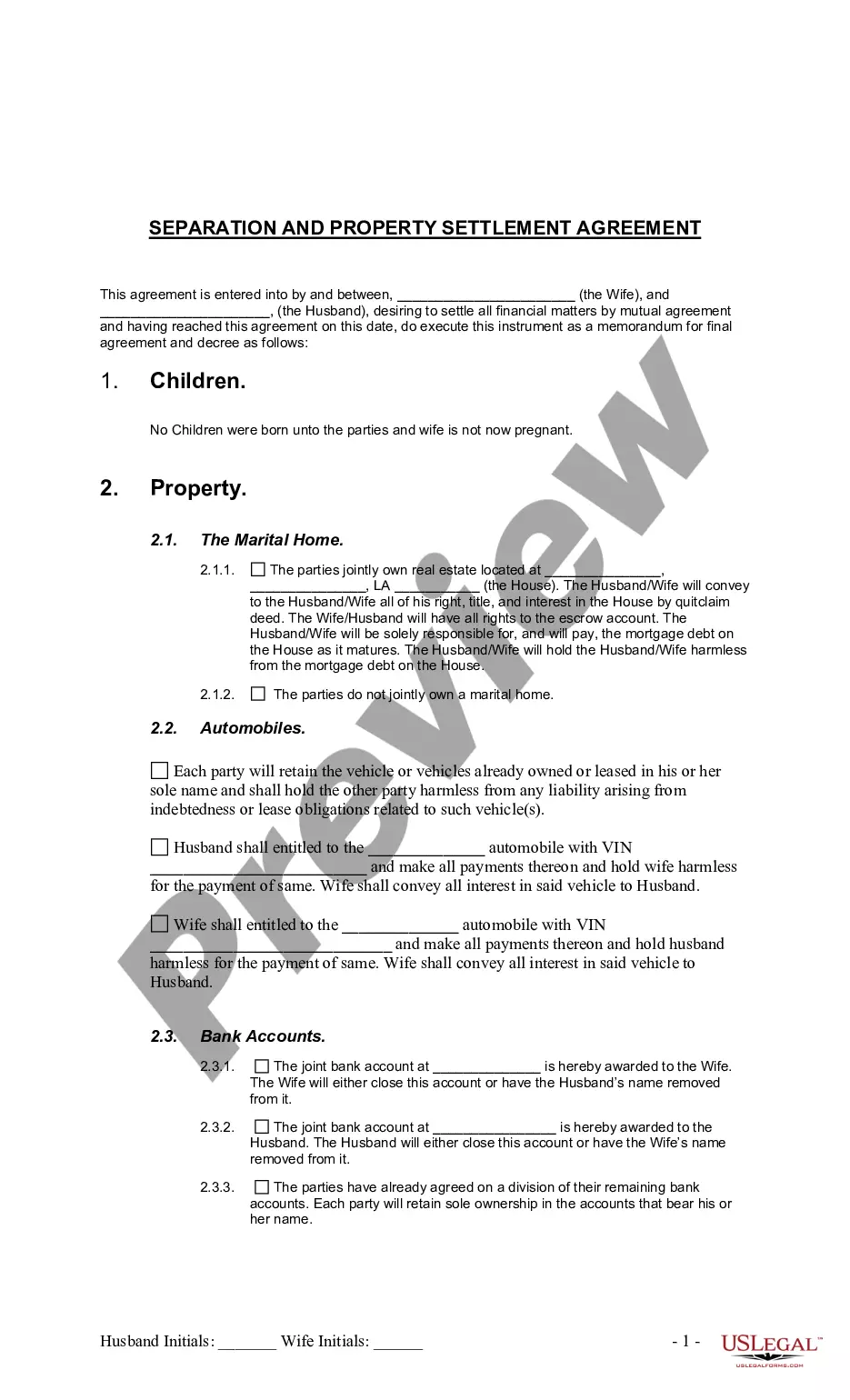
How to fill out Louisiana Marital Legal Separation And Property Settlement Agreement No Children?
Regardless of whether for commercial objectives or personal matters, everyone encounters legal circumstances at some stage in their life.
Completing legal paperwork requires meticulous care, beginning with selecting the correct form template.
Complete the profile registration form. Choose your payment method: use a credit card or PayPal account. Select the desired file format and download the Legal Separation For Tax Purposes. Once saved, you can fill out the form using editing software or print it out to complete it manually. With a vast catalog from US Legal Forms available, you will never need to waste time searching for the right sample online. Utilize the library’s straightforward navigation to find the suitable template for any occasion.
- For example, if you choose an incorrect variant of a Legal Separation For Tax Purposes, it will be rejected upon submission.
- Thus, it is crucial to obtain a trustworthy source of legal documents like US Legal Forms.
- Should you need a Legal Separation For Tax Purposes template, adhere to these straightforward steps.
- Retrieve the sample you require by utilizing the search field or browsing the catalog.
- Review the form's details to ensure it aligns with your situation, state, and locality.
- Click on the form's preview to examine it.
- If it's the incorrect document, return to the search function to find the required Legal Separation For Tax Purposes sample.
- Acquire the template if it satisfies your criteria.
- If you possess a US Legal Forms account, simply click Log in to access previously saved templates in My documents.
- If you do not yet have an account, you can acquire the form by clicking Buy now.
- Select the appropriate pricing option.
Form popularity
FAQ
The IRS considers you married for the entire tax year when you have no separate maintenance decree or decree of legal separation by the final day of the year. If you are married by IRS standards, You can only choose "married filing jointly" or "married filing separately" status.
In a legal separation, you stay married but the court divides your property and debts and makes orders about financial support. If you have children together, you can also ask for orders about their care and support. You can ask the judge to make orders about: The division of your property.
Head of household filers can have a lower taxable income and greater potential refund than when using the single filing status. The head of household status can claim a roughly 50% larger standard deduction than single filers ($20,800 vs $13,850 for 2023).
When people go through a legal separation or divorce, the change in their relationship status also affects their tax situation. The IRS considers a couple married for filing purposes until they get a final decree of divorce or separate maintenance.
Married filing jointly is one of the statuses that taxpayers can choose from when they file their annual tax returns. This status is used by married couples who decide to file a single return together even if one spouse doesn't have any income.