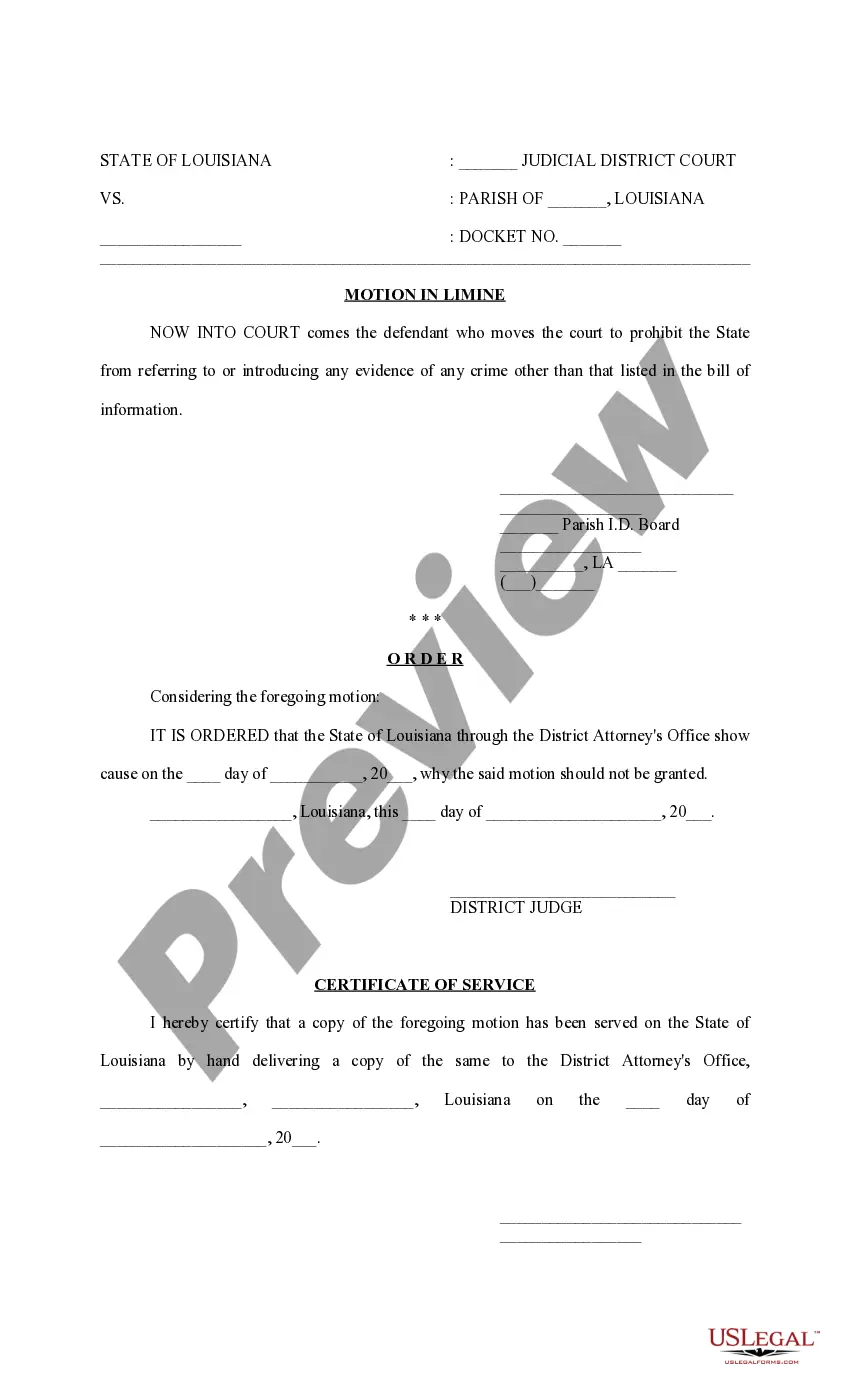
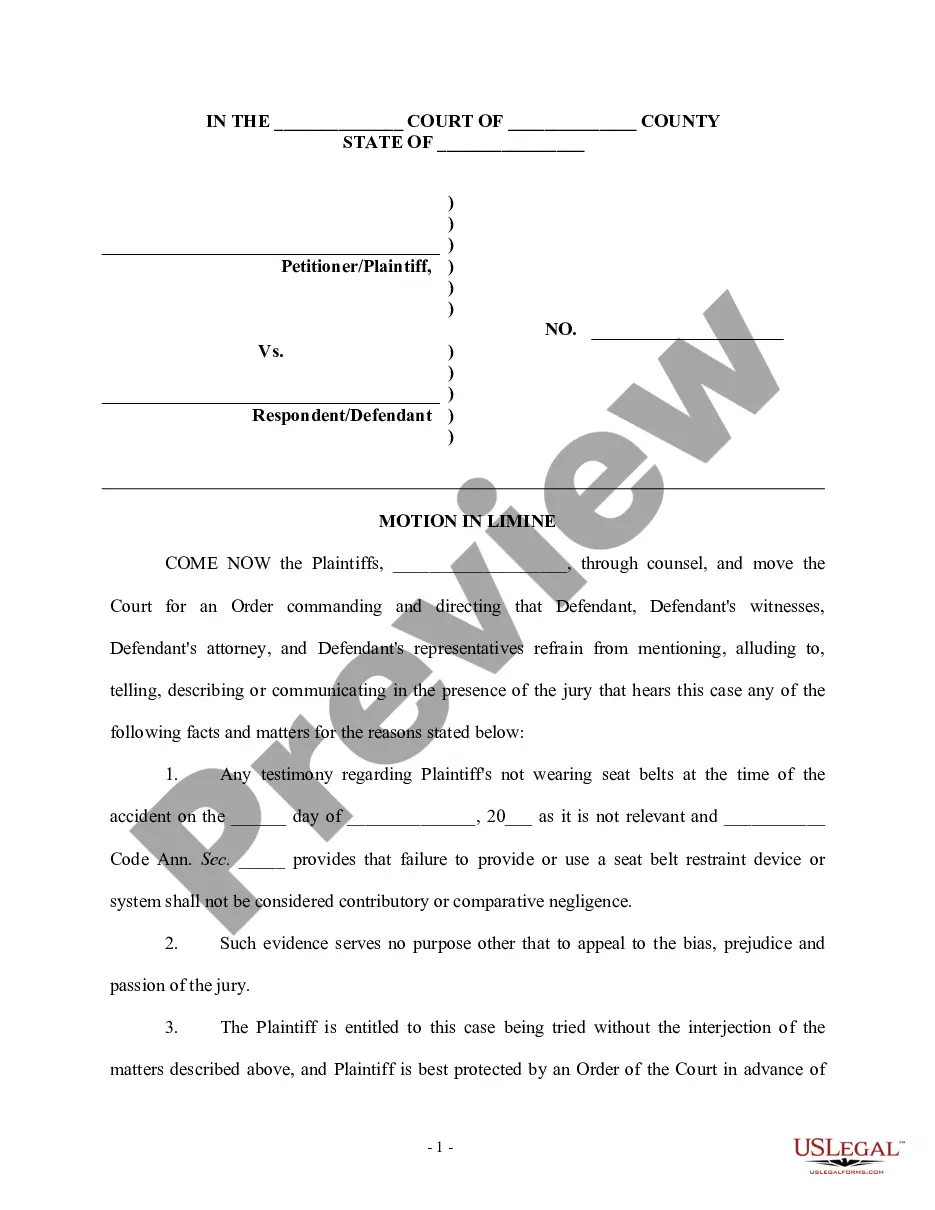
Motion In Limine Louisiana Format
Description
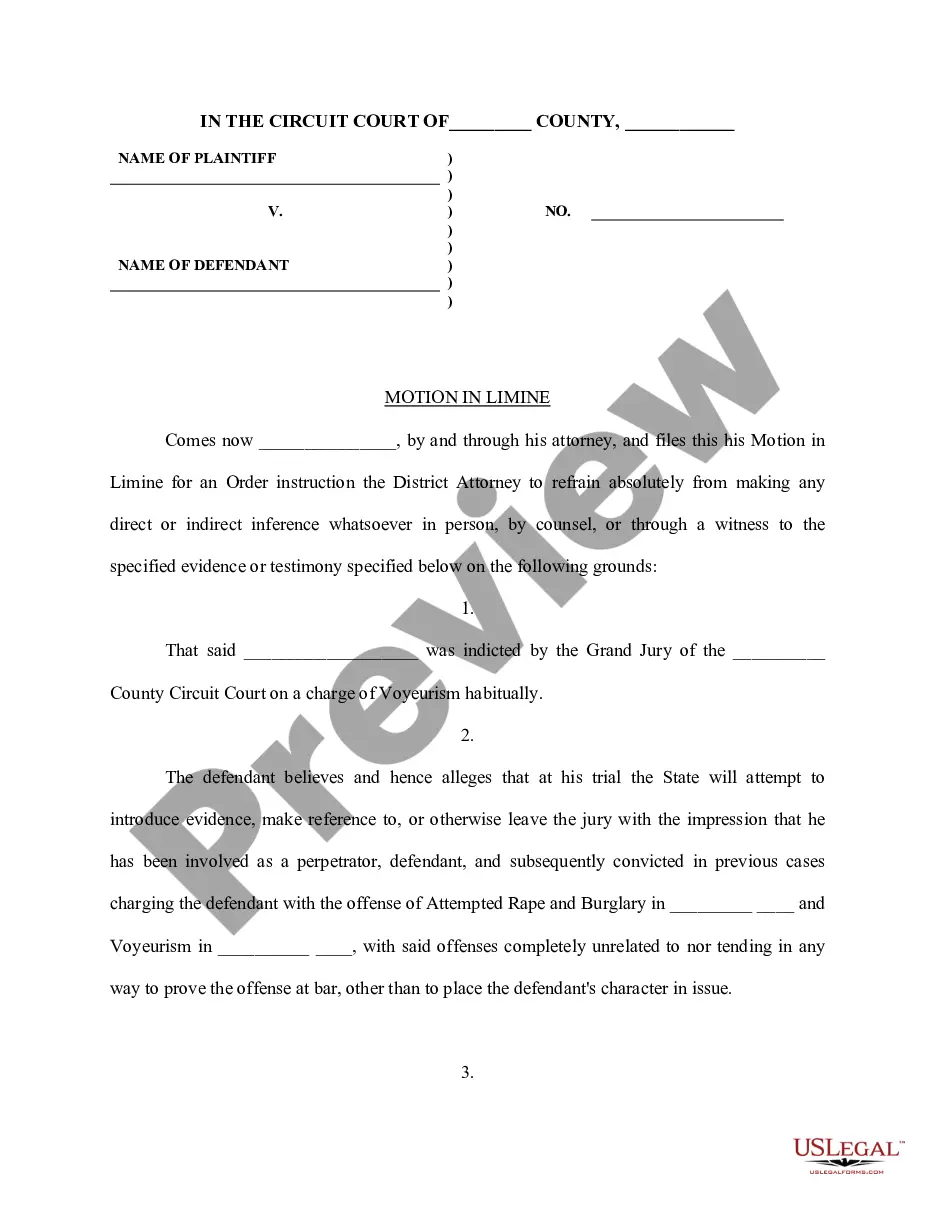
Get your form ready online
Our built-in tools help you complete, sign, share, and store your documents in one place.
Make edits, fill in missing information, and update formatting in US Legal Forms—just like you would in MS Word.
Download a copy, print it, send it by email, or mail it via USPS—whatever works best for your next step.
Sign and collect signatures with our SignNow integration. Send to multiple recipients, set reminders, and more. Go Premium to unlock E-Sign.
If this form requires notarization, complete it online through a secure video call—no need to meet a notary in person or wait for an appointment.
We protect your documents and personal data by following strict security and privacy standards.

Make edits, fill in missing information, and update formatting in US Legal Forms—just like you would in MS Word.

Download a copy, print it, send it by email, or mail it via USPS—whatever works best for your next step.

Sign and collect signatures with our SignNow integration. Send to multiple recipients, set reminders, and more. Go Premium to unlock E-Sign.

If this form requires notarization, complete it online through a secure video call—no need to meet a notary in person or wait for an appointment.

We protect your documents and personal data by following strict security and privacy standards.
Looking for another form?







How to fill out Louisiana Motion In Limine?
Whether for business purposes or for individual affairs, everyone has to manage legal situations sooner or later in their life. Completing legal documents needs careful attention, starting with choosing the proper form sample. For instance, when you choose a wrong edition of a Motion In Limine Louisiana Format, it will be declined when you submit it. It is therefore important to get a dependable source of legal documents like US Legal Forms.
If you have to get a Motion In Limine Louisiana Format sample, follow these simple steps:
- Find the template you need by using the search field or catalog navigation.
- Examine the form’s description to ensure it fits your situation, state, and county.
- Click on the form’s preview to examine it.
- If it is the wrong document, return to the search function to find the Motion In Limine Louisiana Format sample you need.
- Download the template if it meets your requirements.
- If you have a US Legal Forms account, click Log in to gain access to previously saved documents in My Forms.
- If you do not have an account yet, you may download the form by clicking Buy now.
- Pick the proper pricing option.
- Finish the account registration form.
- Pick your transaction method: use a bank card or PayPal account.
- Pick the file format you want and download the Motion In Limine Louisiana Format.
- After it is saved, you can complete the form by using editing applications or print it and finish it manually.
With a large US Legal Forms catalog at hand, you don’t have to spend time seeking for the right template across the web. Take advantage of the library’s straightforward navigation to get the correct form for any situation.
Form popularity
FAQ
Stated in the most general terms, a proper motion in limine is an evidentiary motion that seeks a determination as to whether to exclude (or admit) evidence before it is offered at trial.
A motion in limine is decided by the judge outside of the presence of the jury. The purpose of a motion in limine is to address potentially prejudicial, irrelevant, or inadmissible information that could unduly influence a jury or hinder the fair administration of justice.
Your motion in limine should be broken into two sections: (1) Factual Background and (2) Argument. The ?Factual Background? section of your Memorandum should include all of the facts necessary for the judge to resolve every issue raised in your motion. appropriate, include procedural posture, as well.
Rule 404(a) provides, in pertinent part, that "Evidence of a person's character or a trait of his character is not admissible for the purpose of proving that he acted in conformity therewith on a particular occasion, except: (1) Character of an accused Evidence of a pertinent trait of his character offered by an ...
The motion in limine is an important device for securing a fair trial, enabling the trial court to prevent prejudicing the jury with inflammatory, irrelevant, or potentially inadmissible evidence. See 21 Wright & Graham, supra, Federal Practice & Procedure?Evidence 2d § 5037.10 (citing cases).