Injunctions For Protection
Description
Get your form ready online
Our built-in tools help you complete, sign, share, and store your documents in one place.
Make edits, fill in missing information, and update formatting in US Legal Forms—just like you would in MS Word.
Download a copy, print it, send it by email, or mail it via USPS—whatever works best for your next step.
Sign and collect signatures with our SignNow integration. Send to multiple recipients, set reminders, and more. Go Premium to unlock E-Sign.
If this form requires notarization, complete it online through a secure video call—no need to meet a notary in person or wait for an appointment.
We protect your documents and personal data by following strict security and privacy standards.

Make edits, fill in missing information, and update formatting in US Legal Forms—just like you would in MS Word.

Download a copy, print it, send it by email, or mail it via USPS—whatever works best for your next step.

Sign and collect signatures with our SignNow integration. Send to multiple recipients, set reminders, and more. Go Premium to unlock E-Sign.

If this form requires notarization, complete it online through a secure video call—no need to meet a notary in person or wait for an appointment.

We protect your documents and personal data by following strict security and privacy standards.
Looking for another form?







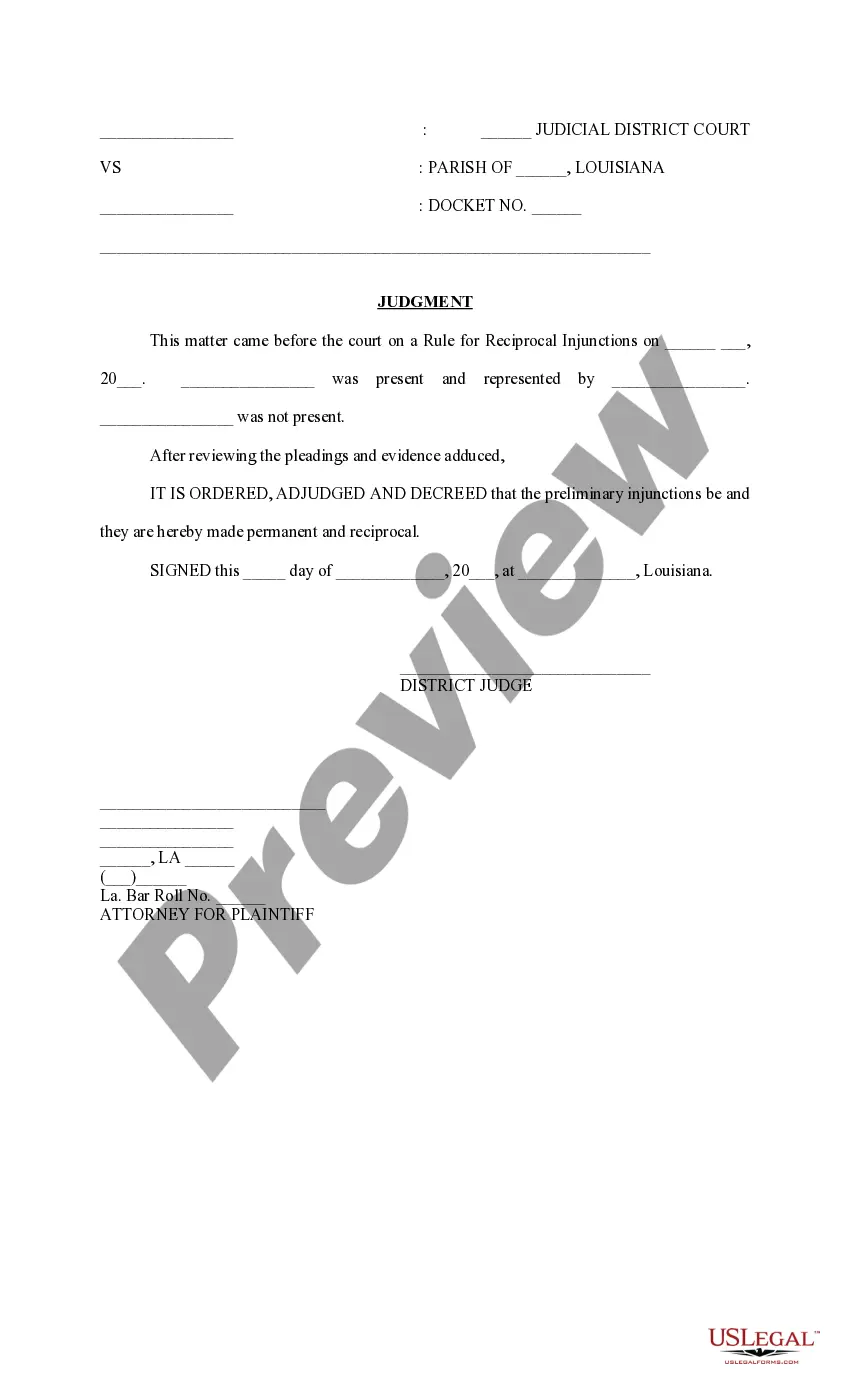
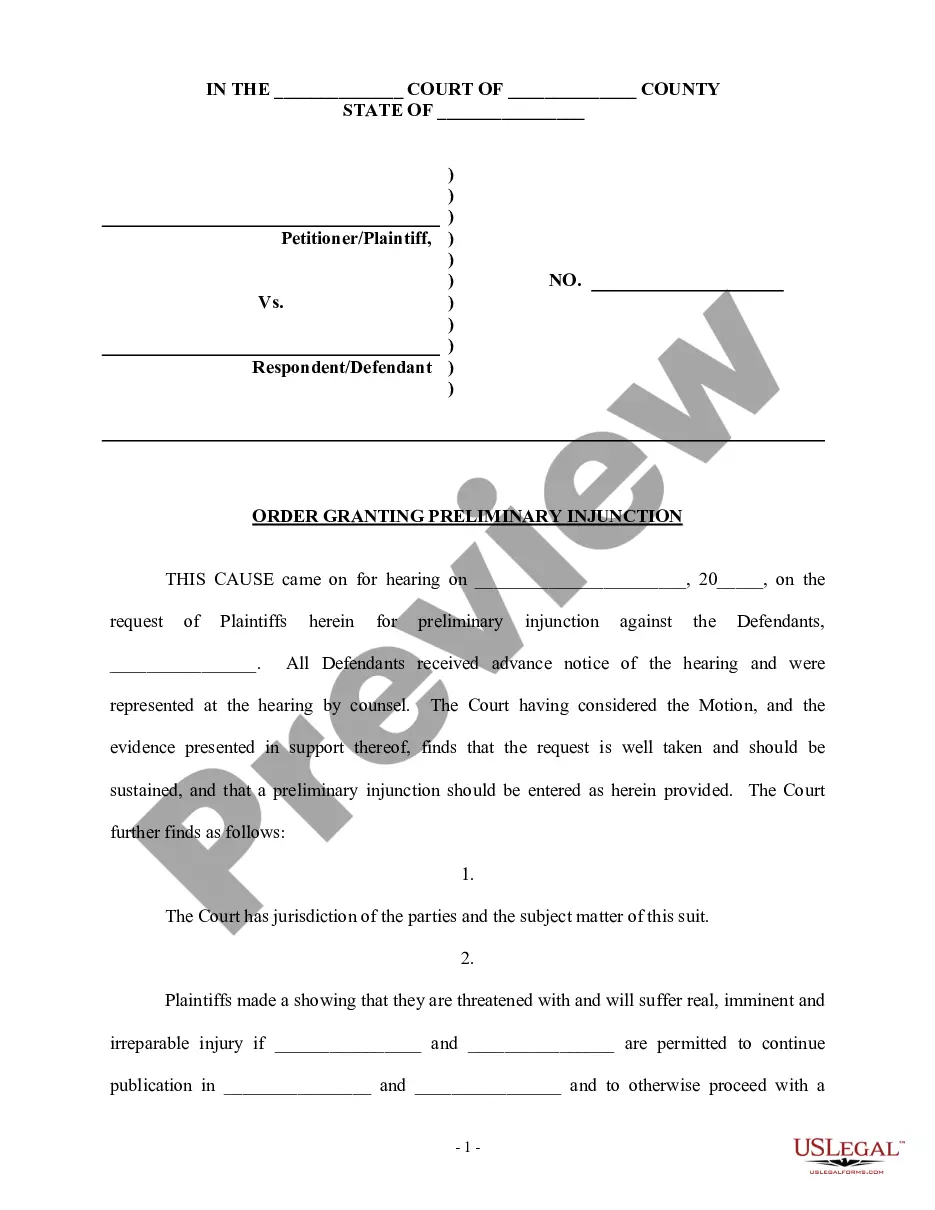
How to fill out Louisiana Judgment On Rule For Reciprocal Injunctions?
Managing legal documents and processes can be a lengthy addition to your schedule.
Injunctions For Protection and similar forms frequently necessitate you to search for them and figure out how to fill them out properly.
As a result, whether you are dealing with financial, legal, or personal issues, having an extensive and straightforward online repository of forms at your disposal will be very beneficial.
US Legal Forms is the premier online source of legal templates, boasting over 85,000 state-specific documents and various tools that will assist you in completing your paperwork swiftly.
Is this your first time using US Legal Forms? Register and create your account in a matter of minutes to gain access to the form library and Injunctions For Protection. Then, follow the steps below to complete your document: Ensure you have the correct form by utilizing the Preview option and reviewing the document details. Click Buy Now when ready, and select the subscription plan that fits your needs. Hit Download, then fill out, eSign, and print the form. US Legal Forms has twenty-five years of experience assisting individuals in managing their legal documentation. Acquire the form you need today and simplify any procedure effortlessly.
- Explore the collection of pertinent documents available to you with just one click.
- US Legal Forms offers state- and county-specific forms available for download at any time.
- Safeguard your document management processes with top-notch assistance that enables you to prepare any form within minutes without extra or hidden charges.
- Simply Log In to your account, find Injunctions For Protection, and obtain it instantly in the My documents section.
- You can also access forms you have previously downloaded.
Form popularity
FAQ
The three most common types of injunctions include temporary restraining orders, preliminary injunctions, and permanent injunctions. Temporary restraining orders provide immediate relief by prohibiting certain actions for a short period. Preliminary injunctions are issued after a hearing, while permanent injunctions are granted after a final judgment. Understanding these types can help you determine the right approach when seeking injunctions for protection.
To file an injunction against someone, start by gathering necessary documents and forms. You will need to complete specific paperwork that outlines your situation and why you seek injunctions for protection. Next, submit the forms to your local court along with any required filing fees. It can be helpful to consult with a legal professional or use platforms like US Legal Forms to ensure your application is accurate and complete.
When considering injunctions for protection, courts typically evaluate four key factors: the likelihood of success on the merits, the potential for irreparable harm, the balance of hardships, and the public interest. Each factor plays a significant role in the court's decision-making process. Understanding these factors can help you present a compelling case. Uslegalforms provides resources that can assist you in navigating these legal considerations effectively.
Injunctions for protection require valid grounds, such as imminent threat, harassment, or violation of rights. The courts assess the circumstances to determine if immediate action is necessary to prevent harm. It’s crucial to gather all relevant facts and documentation to support your claims. Consulting with uslegalforms can help clarify these grounds and strengthen your application.
The difficulty of obtaining injunctions for protection varies based on the specifics of your case. While some individuals find the process straightforward, others may face challenges, particularly if they lack adequate evidence. It is essential to prepare thoroughly and present a strong case. Legal assistance, such as that offered by uslegalforms, can greatly enhance your chances of success.
To obtain injunctions for protection, you must demonstrate a legitimate need for legal relief. Typically, you will need to show evidence of harm or potential harm that justifies the injunction. Additionally, you must provide proof that other remedies are not sufficient to protect your rights. Understanding these requirements can guide you through the process.
In order to be granted an injunction, the plaintiff must demonstrate that he is likely to suffer irreparable harm without it, that the injunction's benefit to him outweighs its burden on the defendant, that the injunction is in the public interest, and (in the case of a preliminary injunction) that he is likely to ...
Injunctions are also used by a court when monetary restitution isn't sufficient to remedy the harm. For example, in addition to making a financial judgment against a defendant, a court might issue a permanent injunction ordering that the defendant does not participate in a certain activity or business.
An injunction is a court order delivered in a civil trial or suit. This court order stops the defendant from pursuing a certain activity. This can include constructing a new building, pursuing a business venture, or making transactions that are harmful to the plaintiff.
Examples: ?I am asking the court to grant me a _____ month/year injunction.? ?I want no contact in person, at home, by phone, at work, by mail or through third parties.? ?I would consider any contact in the future to be a violation.? Tell the court why you would like the temporary restraining order injunction.