Injunction For Defamation
Description
Get your form ready online
Our built-in tools help you complete, sign, share, and store your documents in one place.
Make edits, fill in missing information, and update formatting in US Legal Forms—just like you would in MS Word.
Download a copy, print it, send it by email, or mail it via USPS—whatever works best for your next step.
Sign and collect signatures with our SignNow integration. Send to multiple recipients, set reminders, and more. Go Premium to unlock E-Sign.
If this form requires notarization, complete it online through a secure video call—no need to meet a notary in person or wait for an appointment.
We protect your documents and personal data by following strict security and privacy standards.

Make edits, fill in missing information, and update formatting in US Legal Forms—just like you would in MS Word.

Download a copy, print it, send it by email, or mail it via USPS—whatever works best for your next step.

Sign and collect signatures with our SignNow integration. Send to multiple recipients, set reminders, and more. Go Premium to unlock E-Sign.

If this form requires notarization, complete it online through a secure video call—no need to meet a notary in person or wait for an appointment.

We protect your documents and personal data by following strict security and privacy standards.
Looking for another form?








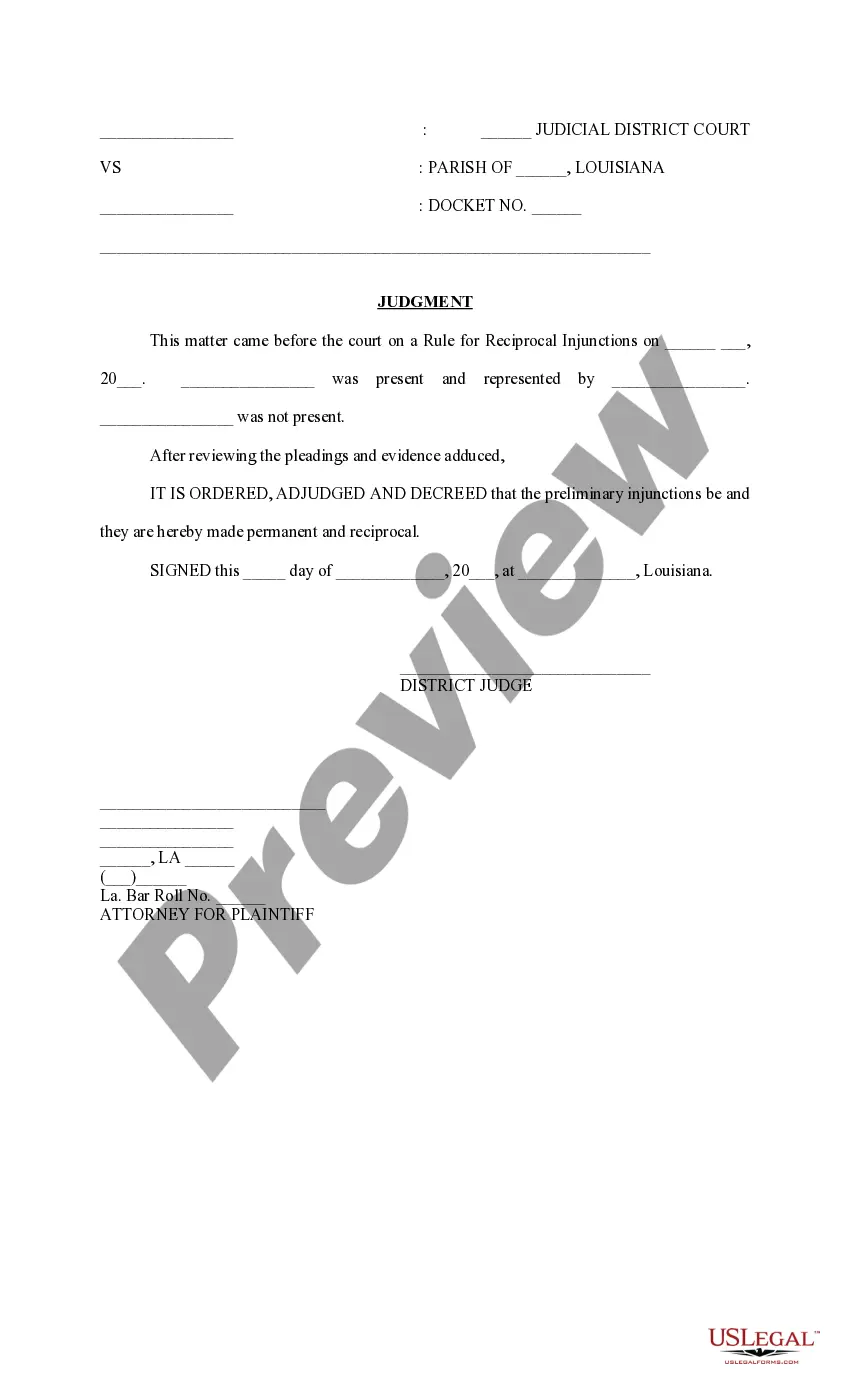
How to fill out Louisiana Judgment On Rule For Reciprocal Injunctions?
Managing legal documents can be exasperating, even for seasoned experts. When you seek an Injunction For Defamation but lack the time to find the correct and current version, the process can be stressful. A comprehensive online form repository could be transformative for anyone aiming to handle these matters efficiently. US Legal Forms stands as a frontrunner in online legal documents, offering over 85,000 state-specific legal forms available to you at any time.
With US Legal Forms, you can.
Save time and effort searching for the documents you need, and use US Legal Forms’ innovative search and Preview feature to locate Injunction For Defamation and download it. If you have a subscription, Log In to your US Legal Forms account, search for the form, and download it. Check the My documents tab to view the documents you’ve previously saved and manage your folders as you wish.
If this is your first experience with US Legal Forms, create a free account and gain unlimited access to all the advantages of the library. Here are the steps to follow after accessing the form you need.
Take advantage of the US Legal Forms online catalog, backed by 25 years of experience and reliability. Streamline your daily document management into a seamless and user-friendly process today.
- Verify it is the correct form by previewing it and reviewing its details.
- Ensure the template is accepted in your state or county.
- Select Buy Now when you are ready.
- Choose a monthly subscription option.
- Select the format you prefer, and Download, complete, eSign, print, and send your document.
- Access legal and business forms specific to your state or county. US Legal Forms meets all your requirements, from personal to corporate documents, all in one location.
- Utilize sophisticated tools to complete and manage your Injunction For Defamation.
- Tap into a resource library of articles, guides, handbooks, and materials pertinent to your situation and requirements.
Form popularity
FAQ
To establish grounds for an injunction for defamation, you must show a legitimate concern about ongoing harm due to false statements. This includes demonstrating that the defamation has already caused damage and that there is a risk of future harm if the injunction is not issued. Solid grounds are essential in persuading the court to grant your request.
Writing a request for an injunction for defamation involves crafting a clear and concise document that outlines your claims and the relief you seek. You should include relevant facts, evidence, and legal reasoning to support your request. Utilizing resources from uslegalforms can simplify this process, ensuring that your request is professionally presented and adheres to legal standards.
The four factors considered for an injunction include the likelihood of success on the merits, the risk of irreparable harm, the balance of harms, and whether the injunction serves the public interest. Each factor plays a role in determining whether the court will grant your request for an injunction for defamation. Understanding these factors can help you prepare a stronger case.
To prove defamation, you must show that the statement was false, damaging, and made without adequate research into its truthfulness. Additionally, you may need to establish that the defamer acted with negligence or malice. Having the right proof not only supports your case but is also crucial when requesting an injunction for defamation.
When seeking an injunction for defamation, you will need to present clear evidence of the false statements made against you. This could include witness statements, written communications, or recordings that substantiate your claims. Gathering solid evidence is vital, as it strengthens your case and supports your request for an injunction.
To obtain an injunction for defamation, you must demonstrate that the statements made are false and have caused harm. Additionally, you need to show that there is a real and immediate threat of further defamation if the injunction is not granted. Meeting these requirements is essential, and platforms like uslegalforms can guide you through the process effectively.
An injunction for defamation is a legal order that prevents someone from making false statements about you that harm your reputation. This type of injunction aims to stop further defamation and can provide immediate relief to the affected party. Understanding the implications of an injunction for defamation is crucial, as it can help protect your personal and professional life.
Petitioning for an injunction involves submitting a formal request to the court. You need to fill out the appropriate forms, state your case clearly, and provide supporting evidence of the defamation. It's important to follow local court rules, as procedures may vary. Using US Legal Forms can provide you with the necessary documents and guidance to streamline your petition process.
To write a request for an injunction, start by identifying the parties involved and the specific actions you want the court to prohibit. Include detailed descriptions of the defamation incidents and how they have impacted you. Be concise yet thorough, ensuring that your legal basis for the request is clear. Consider utilizing US Legal Forms to access templates that simplify the process of writing your request.
In a petition for an injunction, you should clearly state the reasons you are seeking the order. Focus on the harm caused by the defamation and provide evidence that supports your claims. It is essential to explain how the injunction will prevent further damage to your reputation. US Legal Forms offers resources that can guide you in structuring your petition effectively.