Louisiana Divorce Regarding For Non Residents
Description
Get your form ready online
Our built-in tools help you complete, sign, share, and store your documents in one place.
Make edits, fill in missing information, and update formatting in US Legal Forms—just like you would in MS Word.
Download a copy, print it, send it by email, or mail it via USPS—whatever works best for your next step.
Sign and collect signatures with our SignNow integration. Send to multiple recipients, set reminders, and more. Go Premium to unlock E-Sign.
If this form requires notarization, complete it online through a secure video call—no need to meet a notary in person or wait for an appointment.
We protect your documents and personal data by following strict security and privacy standards.

Make edits, fill in missing information, and update formatting in US Legal Forms—just like you would in MS Word.

Download a copy, print it, send it by email, or mail it via USPS—whatever works best for your next step.

Sign and collect signatures with our SignNow integration. Send to multiple recipients, set reminders, and more. Go Premium to unlock E-Sign.

If this form requires notarization, complete it online through a secure video call—no need to meet a notary in person or wait for an appointment.

We protect your documents and personal data by following strict security and privacy standards.
Looking for another form?
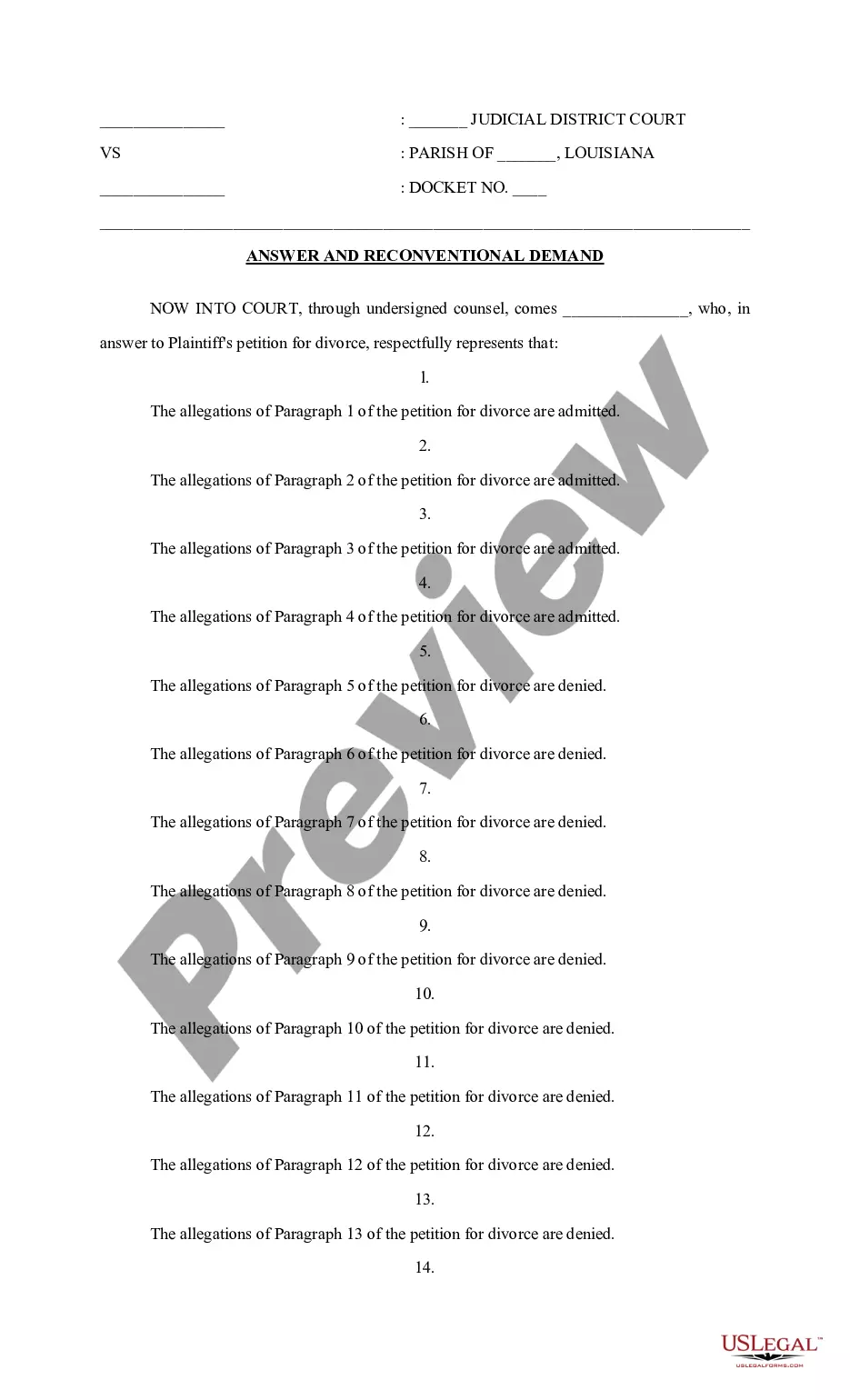
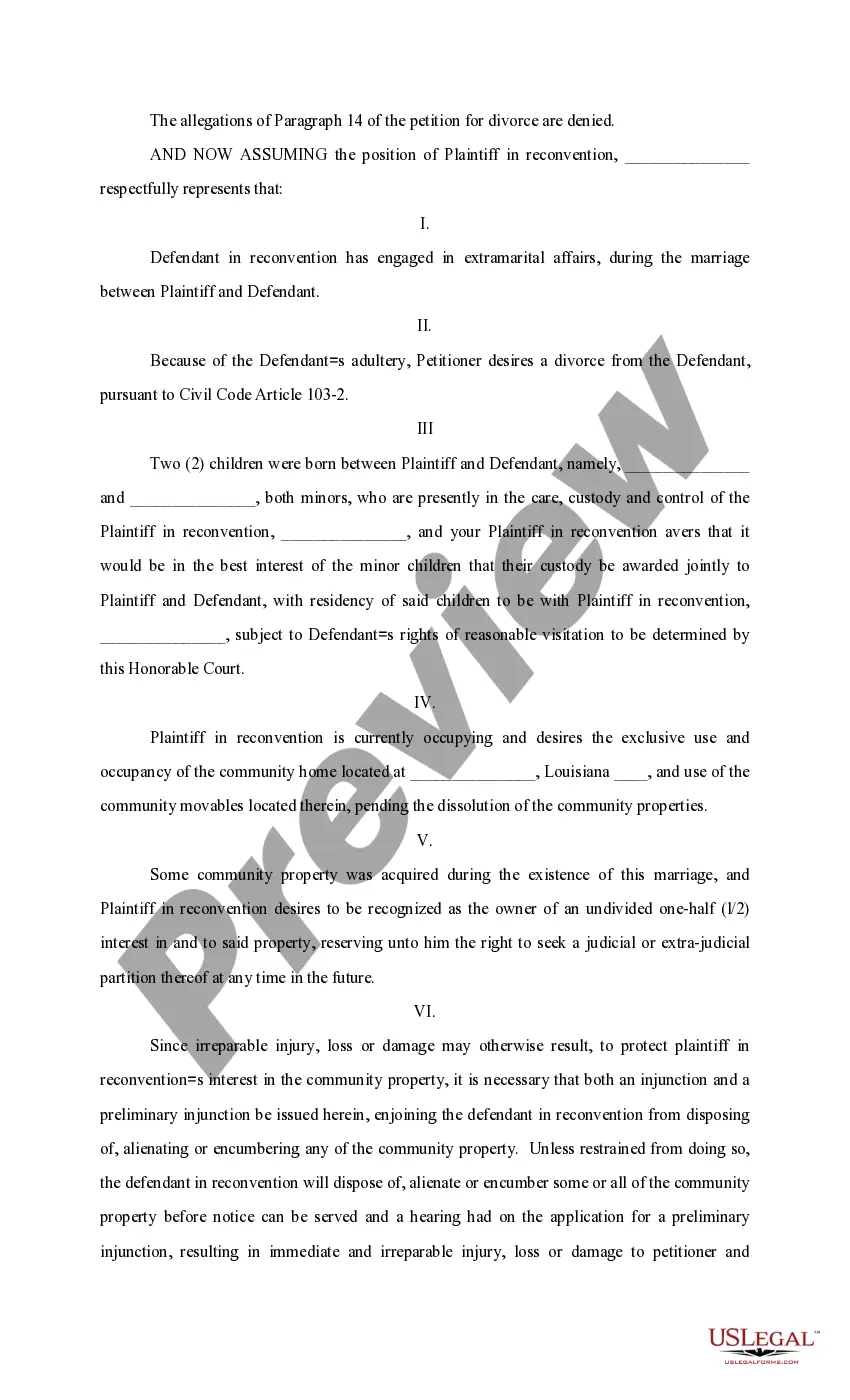
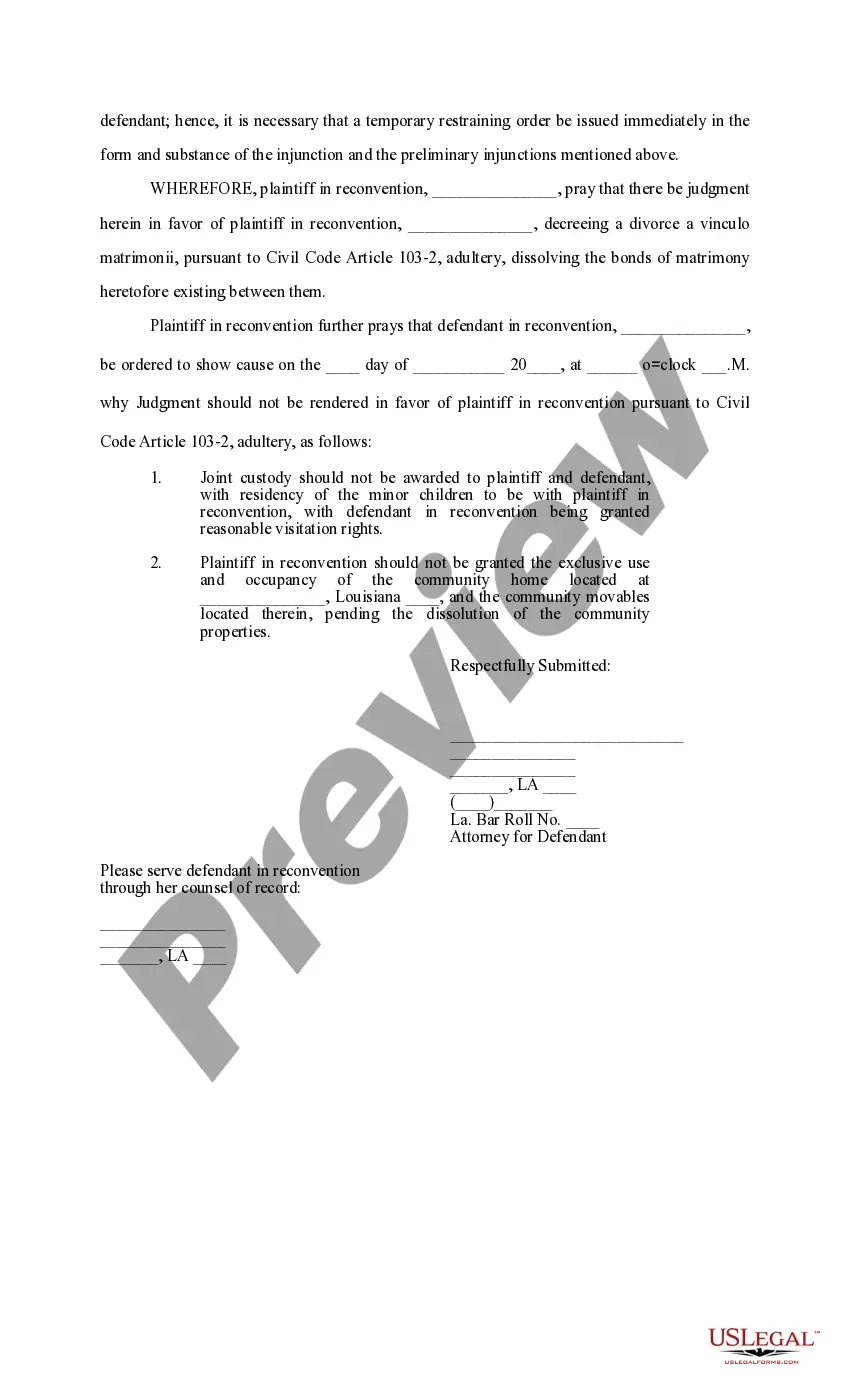
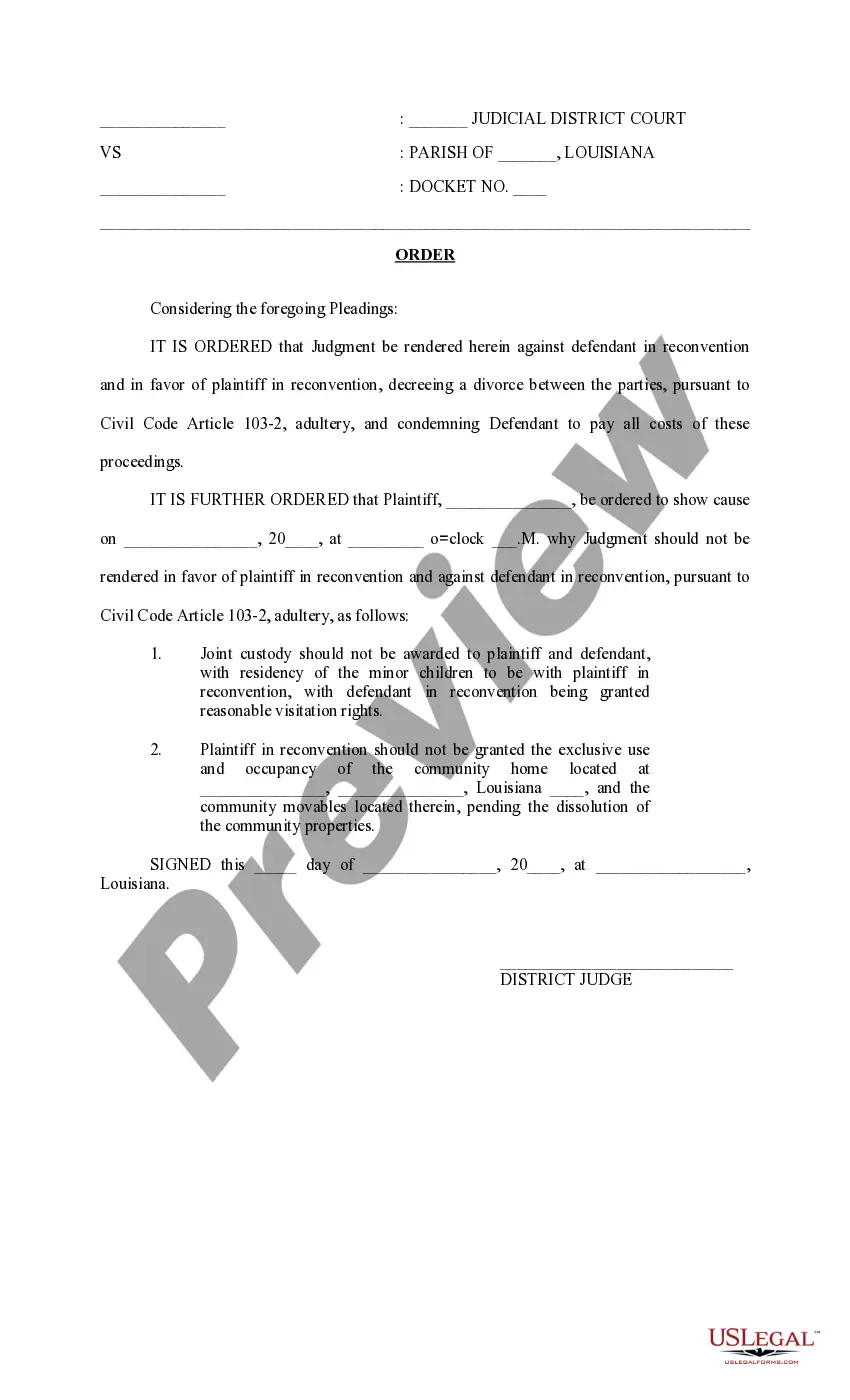
How to fill out Louisiana Answers To Allegations Of Divorce Petition And Reconventional Demand Regarding Custody, Community Property And Restraining Order?
- If you are a returning user, log into your account. Verify that your subscription is active before proceeding to download the necessary forms.
- For first-time users, start by previewing the form descriptions. Confirm that the document aligns with your specific needs and jurisdiction requirements.
- Should you need a different template, utilize the search functionality at the top of the page to locate the appropriate document.
- Once you find the correct form, select the 'Buy Now' option and choose your desired subscription plan. Registration is required for access to our extensive library.
- Complete your transaction by entering your payment details via credit card or PayPal.
- After your purchase, download the form to save it on your device. You can access it anytime through the My Forms section of your profile.
US Legal Forms provides a robust collection of over 85,000 editable legal documents, allowing both individuals and attorneys to execute paperwork efficiently.
Utilizing US Legal Forms empowers you to manage legal processes seamlessly. Start your journey towards a smoother divorce experience today!
Form popularity
FAQ
To file for divorce in Louisiana, one spouse must be a resident for at least six months, and the couple must meet specific grounds for divorce. These grounds can include living apart for a specified period or proof of marital misconduct. For those considering a Louisiana divorce regarding for non residents, understanding these requirements is vital to navigate the process effectively.
Residency requirements for divorce exist to ensure that the court has authority over the case. This is particularly important in Louisiana divorce regarding for non residents, as it helps to prevent jurisdictional disputes. Residency laws also ensure that individuals cannot arbitrarily choose a state with more favorable divorce laws, maintaining fairness in the legal process.
You can file for divorce in Louisiana without a lawyer, but it is recommended to seek assistance, especially for non-residents. The process can be complex, and using a platform like US Legal Forms can simplify the paperwork and provide guidance tailored to your situation. Thus, while self-filing is an option, having support can ease the process and increase your chances of a smoother outcome.
Yes, you can file for divorce in a state where you do not reside, but certain conditions apply. In the context of Louisiana divorce regarding for non residents, you must establish residency for at least six months if you want to file there. Hence, understanding the residency requirements is essential before choosing to file in a state where you do not have a permanent home.
The shortest residency requirement for divorce in Louisiana is that at least one spouse must be a resident of the state for six months prior to filing. This rule is critical for those considering a Louisiana divorce regarding for non residents, as it ensures jurisdiction over the divorce case. Additionally, this requirement helps in establishing a legal connection to the state.
In Louisiana, the two primary types of divorce are contested and uncontested divorces. Contested divorces occur when spouses disagree on key issues, leading to court involvement, while uncontested divorces happen when both parties reach an agreement prior to filing. For non-residents unfamiliar with the law, using platforms like USLegalForms can simplify the paperwork and guide you in choosing the appropriate path for your Louisiana divorce regarding for non residents.
Filing for divorce can sometimes provide a sense of control over the process, but it does not significantly affect legal outcomes in Louisiana. By initiating the divorce, you can set the pace and shape initial discussions, which may benefit non-residents adjusting to unfamiliar legal environments. Nonetheless, it is essential to focus on the resolution that best serves your circumstances, rather than just on who filed.
The main difference between 102 and 103 divorces in Louisiana lies in the level of disagreement between spouses. Article 102 divorces are for contested cases, which means the parties cannot agree on significant issues, while Article 103 divorces are uncontested and require mutual agreement. For non-residents, understanding this distinction is crucial as it can impact how you approach your Louisiana divorce regarding for non residents.
The timeline for a 103 divorce in Louisiana can vary, but it generally takes around 30 to 90 days once the necessary paperwork is submitted. This timeframe can be ideal for non-residents looking for a relatively quick resolution to their marriage. It is important to ensure that all requirements are met and documentation is properly filed to avoid delays in the process.
In Louisiana, an Article 102 divorce is a contested divorce, while an Article 103 divorce is a simpler, uncontested process. The Article 102 route typically involves a trial when disagreements arise, making it potentially more complex for non-residents navigating Louisiana divorce laws. Conversely, Article 103 allows couples to agree on terms without a court trial, which is often smoother and faster for non-residents seeking a dissolution.