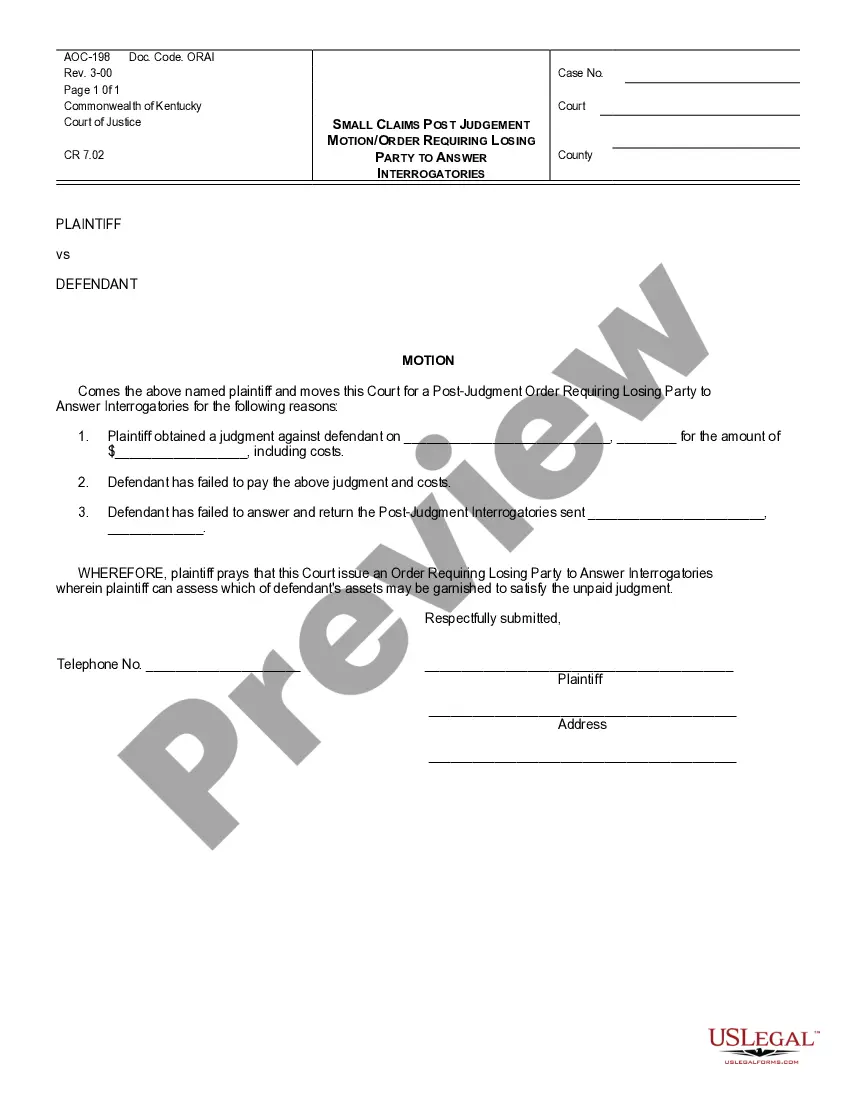
Motion
Note: This summary is not intended to be an all-inclusive
discussion of the law and procedures of small claims in Kentucky, but it
does contain basic and other information. This summary only discusses civil
claims (property and money claims that may be filed in small claims court).
Criminal charges are not discussed.
Definition - Small claims courts,
also sometimes called "Peoples Court", is a court of limited jurisdiction.
Limited jurisdiction means only certain matters may be filed and heard
by the small claims court. There is also a maximum claim amount limitation.
Small claims court offer a quick, informal and inexpensive way of resolving
many types of disputes you may have with particular individuals or companies.
Maximum Amount of Claim Small Claims Court may
hear in Kentucky: $1,500.00
Which Court hears small claims in Kentucky? The
small claims court is a division of the District Court of Kentucky. All
claims with an amount of $1,500.00 or less in controversy will be under
the jurisdiction of the small claims court.
Who hears the claims in small claims court? The
claim will be heard by a judge.
Claims over which the Small Claims Court has Jurisdiction:
The small claims court in Kentucky may hear any of the following
claims if the amount in controversy does not exceed $1,500.00:
1. monetary disputes
2. personal property disputes
3. The above list is not exhaustive but does contain most of the
common claims. However, the following entities may not file a lawsuit in
small claims court: a person or organization in the business of lending
money with interest; a collection agency; a person or organization with
an assigned claim; criminal actions; slander; malicious prosecution; and
abuse of process.
Who may file a claim in small claims court?
An
individual, partnership or corporation (or LLC) may file a claim
against another individual(s), partnership or corporation (or LLC) in small
claims court if jurisdiction exists to hear the claim and the amount of
the claim or property involved does not exceed $1,500.00.
Must you be represented by an attorney? The
parties may be represented by attorneys if they wish to do so.
Things to do before you File a Claim: Get
the facts straight so you can complete the forms correctly and answer any
questions court personnel may need to know. Be sure to obtain the correct
legal name of the defendant, correct address and place/address of employment.
If the defendant is a Corporation or Limited Liability Company you would
use the legal corporate or LLC name as the defendant. If the defendant
is a Corporation or LLC, you may need to contact the secretary of state
in your state and obtain the proper name and address to serve with a copy
of the suit. This person is called a registered agent and is designated
by the corporation to receive process or summons when the corporation is
sued. Be sure to also contact the small claims court to determine the filing
fee for filing the claim.
How to File the Claim: The plaintiff
must file a complaint with the court clerk. The complaint may be filed
in the county where the defendant lives or does business. The complaint
must include the correct address of the person being sued.
Who serves the Defendant with summons or process
and how is the defendant served: The clerk will issue a summons
to the defendant a copy of the complaint will also be sent to the defendant.
The plaintiff must must inform the clerk how the proceed with serving the
defendant. Service may be accomplished by certified mail with a return
receipt requested or the summons may be personally served. The plaintiff
is responsible for all fees associated with serving the complaint.
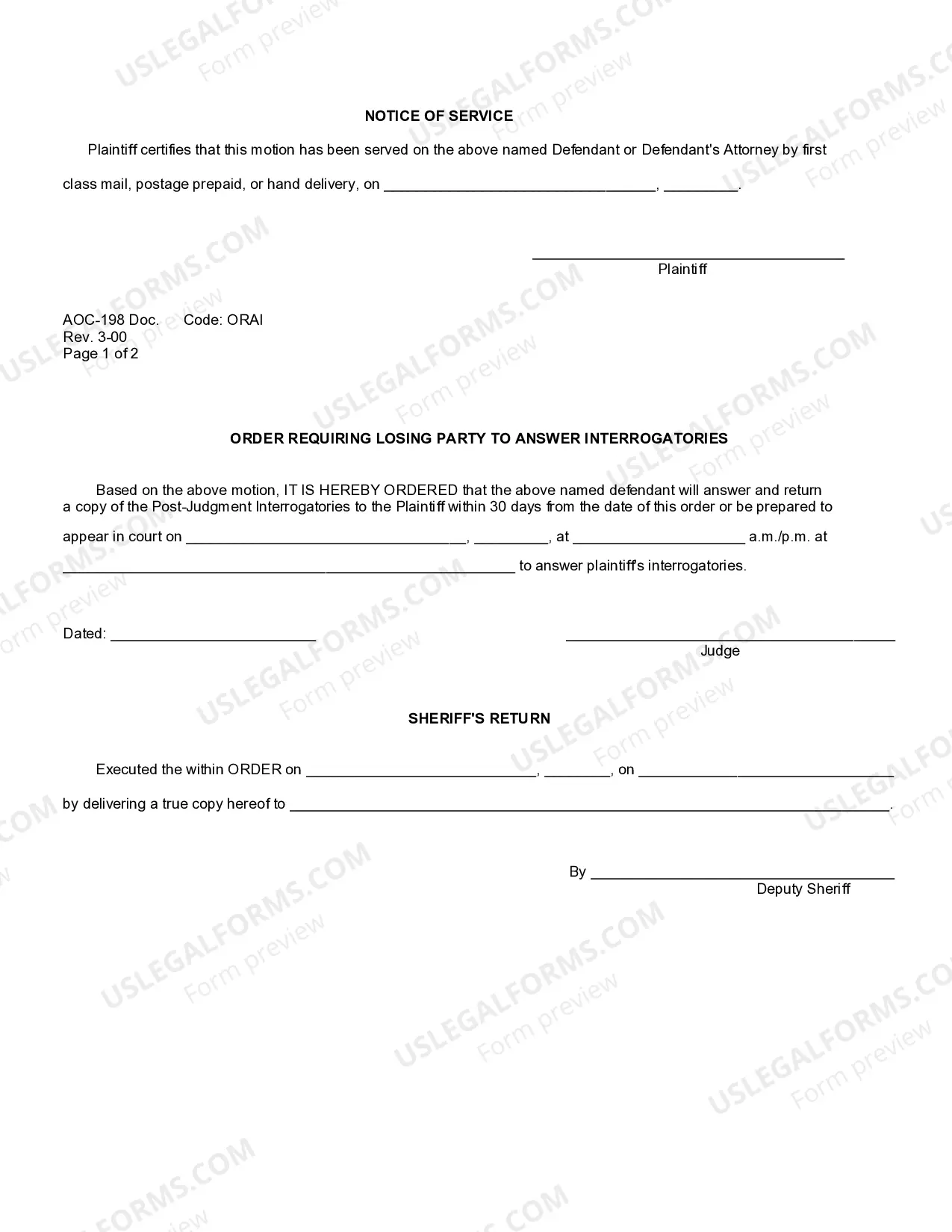
Return of Summons: The sheriff, constable,
or other process server
shall, after effecting service, must endorse that fact on a copy
of the summons and return it to the court clerk who will make the appropriate
entry on the docket sheet of the action.
Removal to another Court: According
to the Kentucky Revised Statutes, Chapter 024A00 Section 24A.310, an action
can be removed from the small claims division to the regular docket of
District or Circuit Court as appropriate whenever the defendant's counterclaim
exceeds the jurisdictional limit of the division or the District Court.
An action may be removed if a party defendant would otherwise have a right
to a jury trial and gives notice to the division requesting a jury trial
as provided in KRS 24A.320(2). The action may be removed from the division
to the District Court if the judge, in his discretion, deems the action
too complex for the simplified procedure of the division. Finally, an action
originally filed in the District or Circuit Courts may be transferred to
the small claims division on motion of the defendant if the claim is within
the jurisdictional limit of, and otherwise could have been brought originally
in, the division, unless the plaintiff demands a jury trial. No action
transferred to the division will be counted in the maximum number of claims
that the plaintiff may bring under KRS 24A.250(1).
How are hearings scheduled? The clerk
of the court will provide you with the procedure to set the case for trial
or hearing at the time you file your claim.
Subpoena of Witnesses: If witnesses
are required but unwilling to voluntarily attend unless they are subpoenaed,
you may obtain a subpoena issued by the court clerk for service on the
witness. The subpoena is an order for the witness to appear at the hearing
and testify. Some employers may require that an employee be subpoenaed
in order to be excused from work.
Trial Procedures: The trial procedure
is generally informal than other courts although the formality will vary
from county to county and judge to judge. The case will usually be called
in open court and you will respond that you are present and ready to proceed.
You will then be advised when to present your claim. Be prepared
to present your claim in your own words. Be prepared to question witnesses
if witnesses are needed.
What happens if the defendant does not appear at
trial? Usually, if the defendant does not appear at trial,
a default judgment will be entered in your favor for the amount of the
claim or other relief.
Judgment: If the defendant fails
to appear, or if the court rules for you after the hearing, a judgment
will be entered by the court for the amount of the claim, or other relief
sought.
Appeal: According to the Kentucky Revised
Statutes Chapter 024A00 Section 24A.340, any party aggrieved by the judgment
of the small claims division may appeal within ten days of the judgment
to the Circuit Court in the judicial circuit where such division is located.
Collection of Judgment: Collection methods
which may be implemented by the court are garnishment, execution, and judgment
lien.
-----------------------
Other Matters:
Are Motions allowed? Motions are allowed
by the parties on a limited basis.
Continuances: A continuance will
only be granted for good cause.
Out-of-Court Settlement: If the parties
decide to settle out of court, the court clerk must be notified. If the
judge approves the settlement, then the settlement is accepted as valid.
When Payment is Received: When the judgment
has been satisfied, the receiving party must send written notice to the
court that the judgment has been satisfied.
Cross-Claims, Counterclaims, and Third-Party Claims:
According
to the Kentucky Revised Statutes 24A.290,the defendant may file with the
clerk a counterclaim against the plaintiff in an amount not in excess of
$1,500 exclusive of interest and costs, if the counterclaim arose out of
the same transaction or occurrence that is the subject matter of the plaintiff's
claim, and if the counterclaim does not require for its adjudication the
presence of third parties over whom the division cannot acquire jurisdiction.
Any counterclaim shall be filed with the clerk, and a copy delivered to
the plaintiff at least five days prior to the time of the hearing. If the
defendant's counterclaim is in excess of the jurisdictional limits of the
division, then the provisions of KRS 24A.310(1) will apply.
What happens if a defendant has filed bankruptcy?
If
the plaintiff has filed a claim against the defendant and the plaintiff
is aware that the claim is listed as a debt in a bankruptcy proceeding,
federal law prohibits the plaintiff from pursuing the claim in small claims
court.
Common Forms used in Small Claims Court:
Claim Statement/Complaint
Summons
Return of Summons
Answer
Subpoena
Abstract of Judgment
Statutes:
To review all statutes which pertain to Kentucky small claims actions,
please see
http://162.114.4.13/KRS/024A00/CHAPTER.HTM.