Suit File For Defamation
Description
Get your form ready online
Our built-in tools help you complete, sign, share, and store your documents in one place.
Make edits, fill in missing information, and update formatting in US Legal Forms—just like you would in MS Word.
Download a copy, print it, send it by email, or mail it via USPS—whatever works best for your next step.
Sign and collect signatures with our SignNow integration. Send to multiple recipients, set reminders, and more. Go Premium to unlock E-Sign.
If this form requires notarization, complete it online through a secure video call—no need to meet a notary in person or wait for an appointment.
We protect your documents and personal data by following strict security and privacy standards.

Make edits, fill in missing information, and update formatting in US Legal Forms—just like you would in MS Word.

Download a copy, print it, send it by email, or mail it via USPS—whatever works best for your next step.

Sign and collect signatures with our SignNow integration. Send to multiple recipients, set reminders, and more. Go Premium to unlock E-Sign.

If this form requires notarization, complete it online through a secure video call—no need to meet a notary in person or wait for an appointment.

We protect your documents and personal data by following strict security and privacy standards.
Looking for another form?






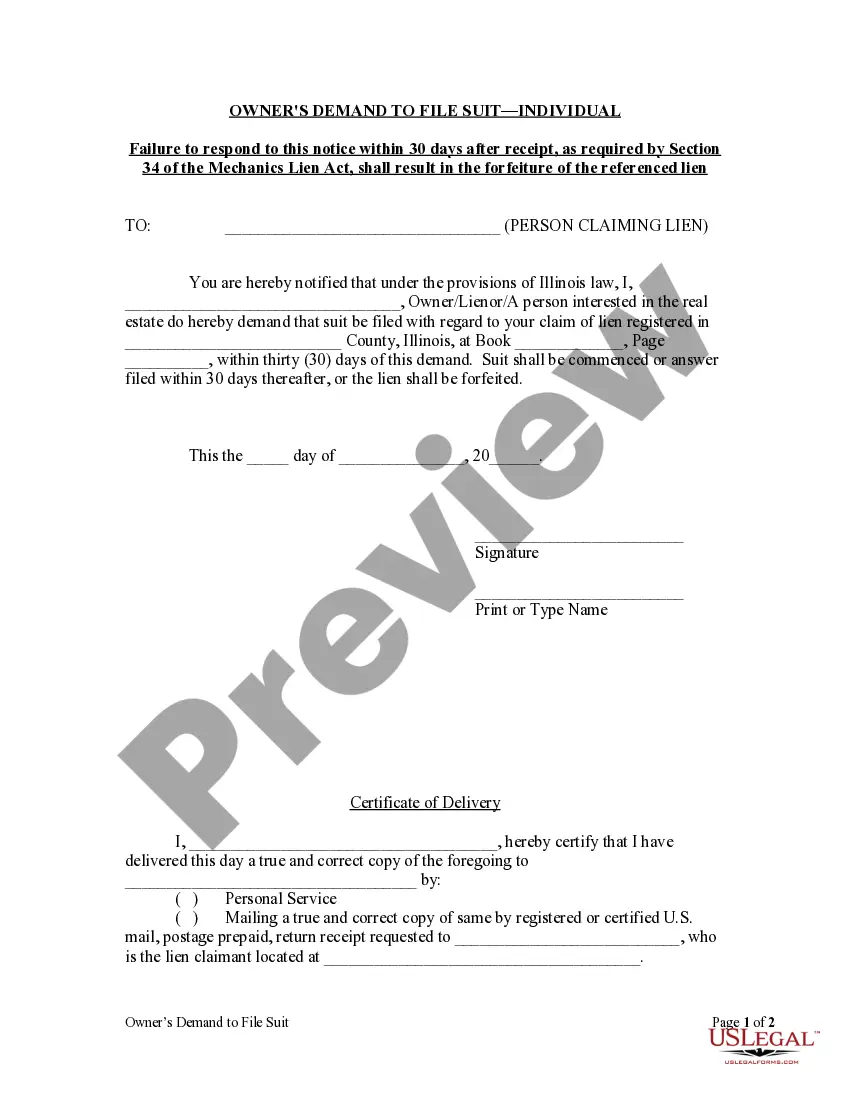
How to fill out Illinois Owner's Demand To File Suit - Mechanics Liens - Individual?
- Access your US Legal Forms account by logging in to initiate the process. Ensure that your subscription remains active; if it has expired, renew your plan to continue accessing documents.
- Review the available templates in Preview mode. Select the suit file for defamation that is aligned with your jurisdiction requirements to guarantee accuracy.
- If the first template doesn’t meet your needs, utilize the Search tool at the top to locate an appropriate form. Confirm that it is suitable for your specific case before proceeding.
- Purchase the chosen template by clicking on the Buy Now button. Choose a subscription plan that best fits your needs and create an account for access.
- Complete your transaction by entering your payment details, whether using a credit card or your PayPal account, to finalize your subscription.
- Download your selected form to your device. Once saved, you can access it anytime in the My Forms section of your account.
By following these steps, you will efficiently acquire the necessary legal forms to file your defamation suit. US Legal Forms not only simplifies the form-filling process but also provides access to numerous resources that help ensure your documents are accurate and compliant.
Take the first step towards protecting your rights and access your suit file for defamation today through US Legal Forms!
Form popularity
FAQ
A defamation lawsuit arises when a person makes false statements about another person that harm their reputation. To successfully suit file for defamation, the affected party must prove that the statements were false, damaging, and made with negligence or actual malice. This can include slander, which involves spoken statements, or libel, which consists of written words. Utilizing the US Legal Forms platform can assist you in navigating the process of filing your suit effectively and efficiently.
To start a defamation lawsuit, first, gather all evidence supporting your claim. Next, consult with a qualified attorney who specializes in defamation cases. They can help you understand the legal process and assist you in preparing the necessary documents. Once you're ready, you can formally suit file for defamation through the appropriate court.
The standard of proof for defamation varies by jurisdiction, but generally, you must show that the statement was made with actual malice or negligence. The higher the burden of proof, the more difficult it may be to win your case. Understanding these legal nuances is important as you prepare to suit file for defamation.
In a defamation lawsuit, you typically need to prove that the statement was false, damaging, and made with negligence or malice. Documentation supporting your claim, like emails or social media posts, can be vital evidence. This proof plays a key role in your case, increasing your chances of a favorable outcome when you suit file for defamation.
Winning a defamation suit can be quite complex. The success depends on various factors, including the strength of your evidence and the nature of the statement made. It's essential to prepare thoroughly and understand the legal standards involved. Consulting professionals can provide guidance on how to effectively suit file for defamation.
Yes, evidence is crucial when you decide to sue for defamation. Without solid proof, your case may struggle to stand up in court. Key evidence can include witness statements, documents, and online posts. It's beneficial to gather all relevant materials before you initiate the process to suit file for defamation.
Proving a defamation case can be challenging. You must demonstrate that the statement made was false, damaging, and made with a certain level of intent. Gathering strong evidence is critical, so it helps to consult a legal expert when you decide to suit file for defamation. Understanding the elements of defamation will aid in building your case.
Winning a defamation lawsuit can be challenging due to the burden of proof placed on the plaintiff. You must clearly establish that the statements made were false and damaging. When you suit file for defamation, you should prepare thoroughly to back up your claims with solid evidence. Services like US Legal Forms provide helpful templates and guidance to assist you through this complex legal journey.
The success rate in defamation cases varies, but statistics show that roughly 30% to 50% lead to favorable outcomes for plaintiffs. Winning a case can depend on factors like evidence and the strength of the claims. When you suit file for defamation, having well-prepared documentation significantly boosts your chances of a win. Platforms like US Legal Forms offer resources to strengthen your case.
Yes, many defamation cases settle before going to trial. This often happens because both parties prefer to avoid the risks and costs associated with a court case. When you suit file for defamation, settlement negotiations can lead to a resolution that works for everyone involved. Additionally, platforms like US Legal Forms can help you navigate the settlement process effectively.