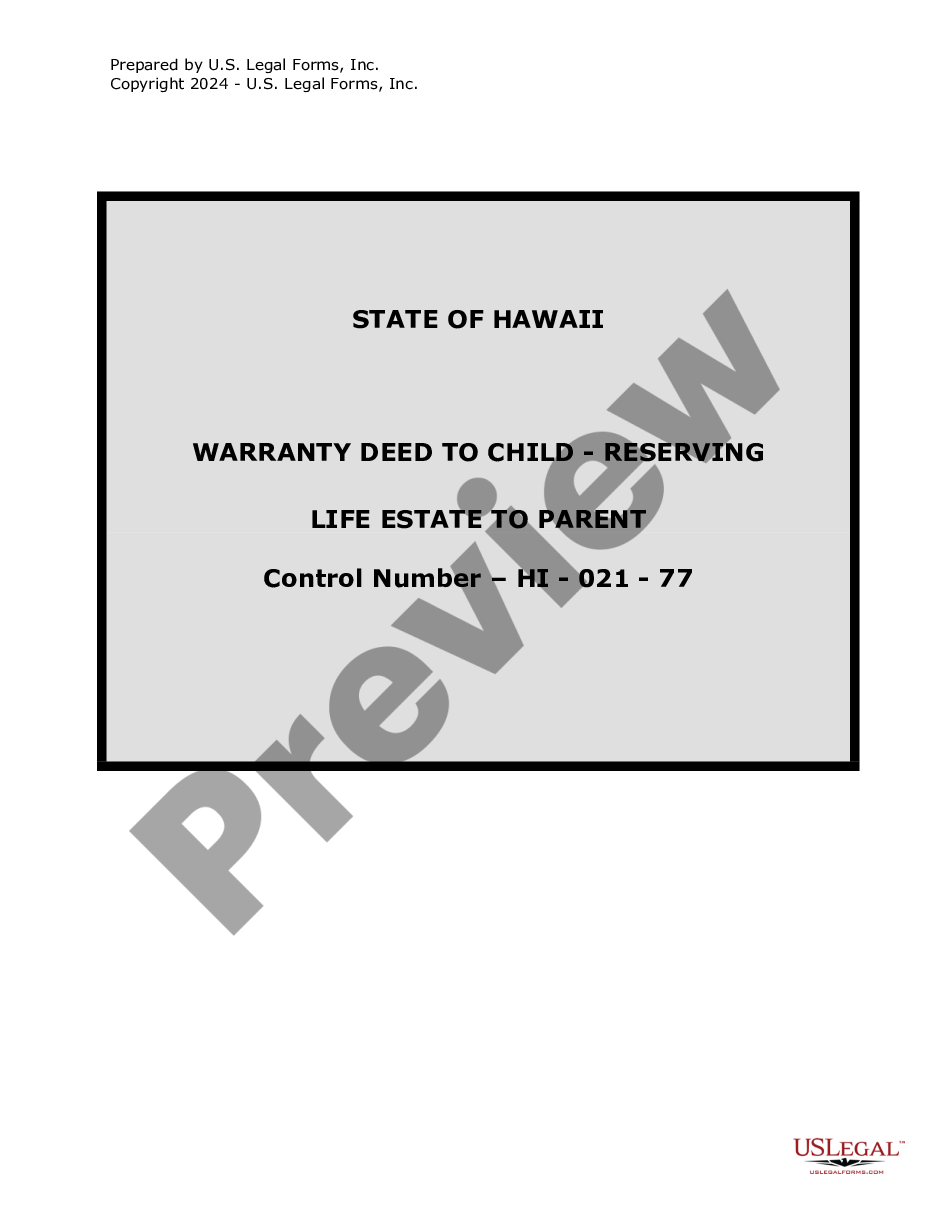
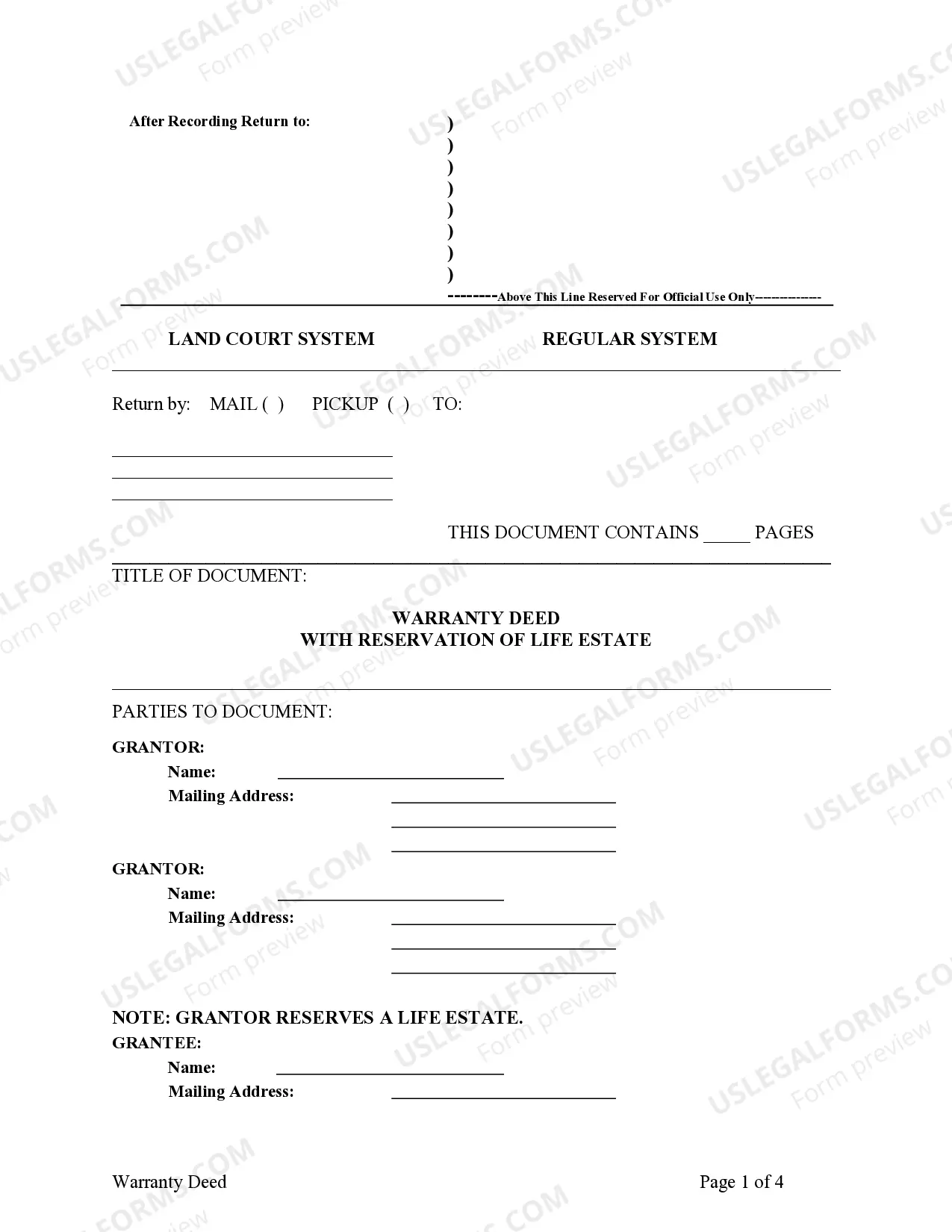
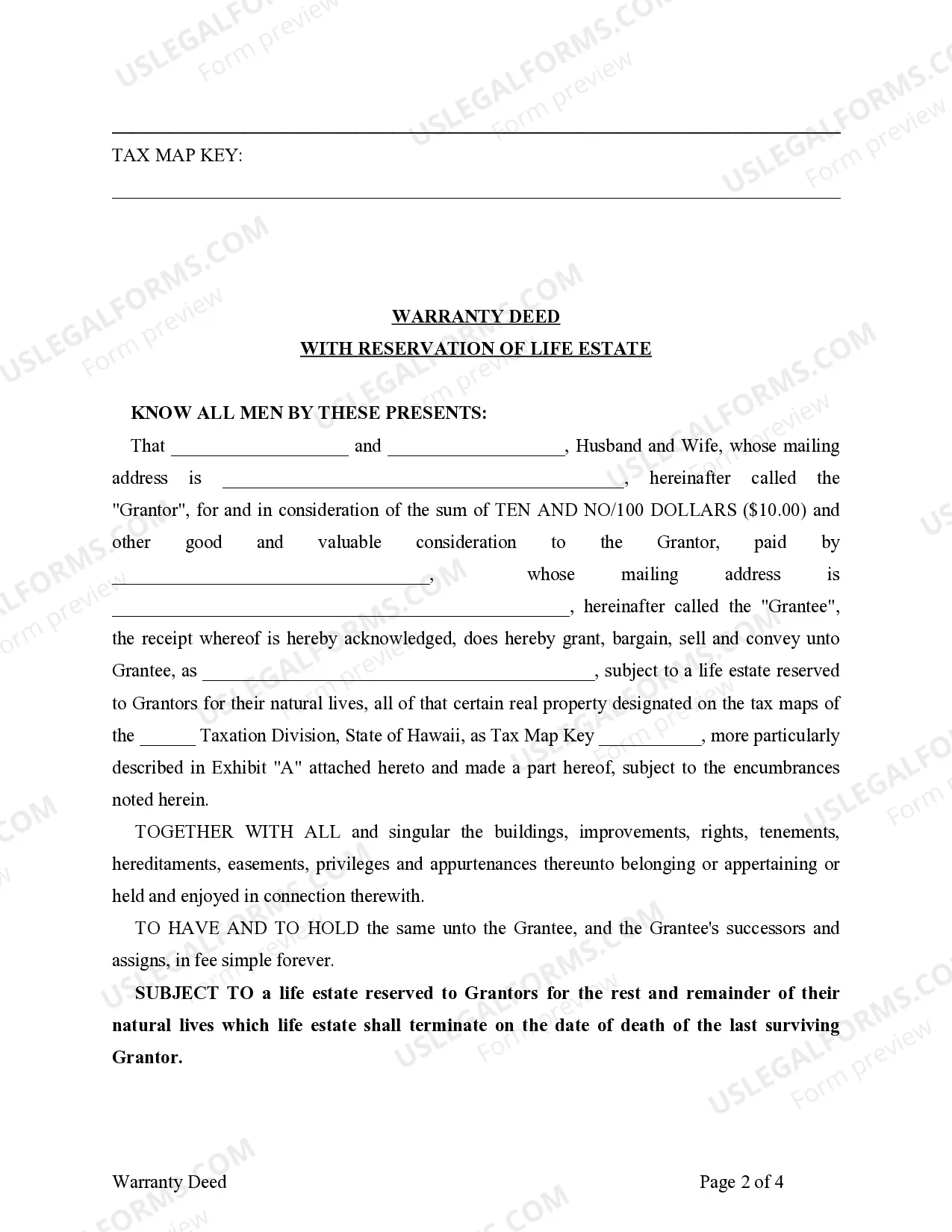
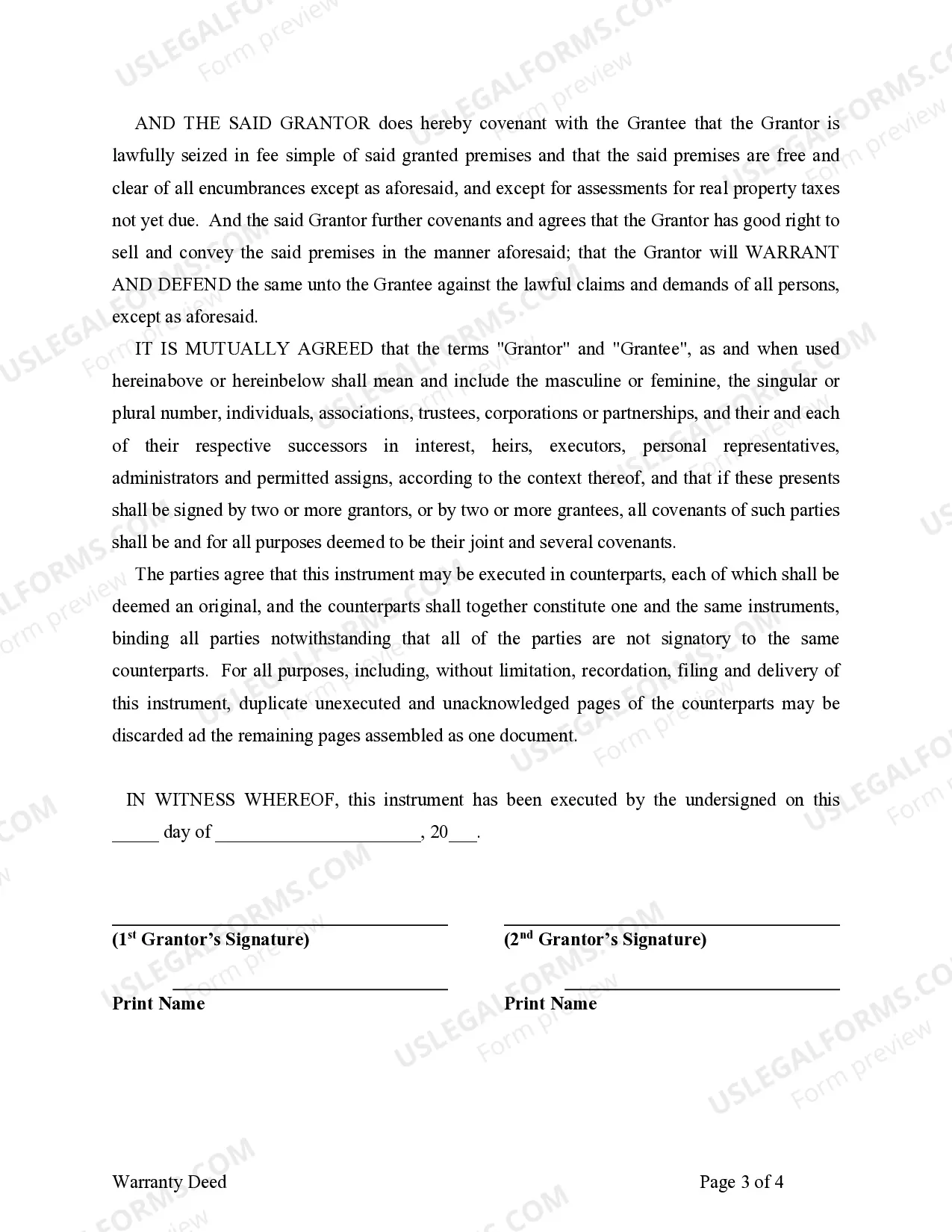
Life Estate Deed Hawaii With Remainder

Description

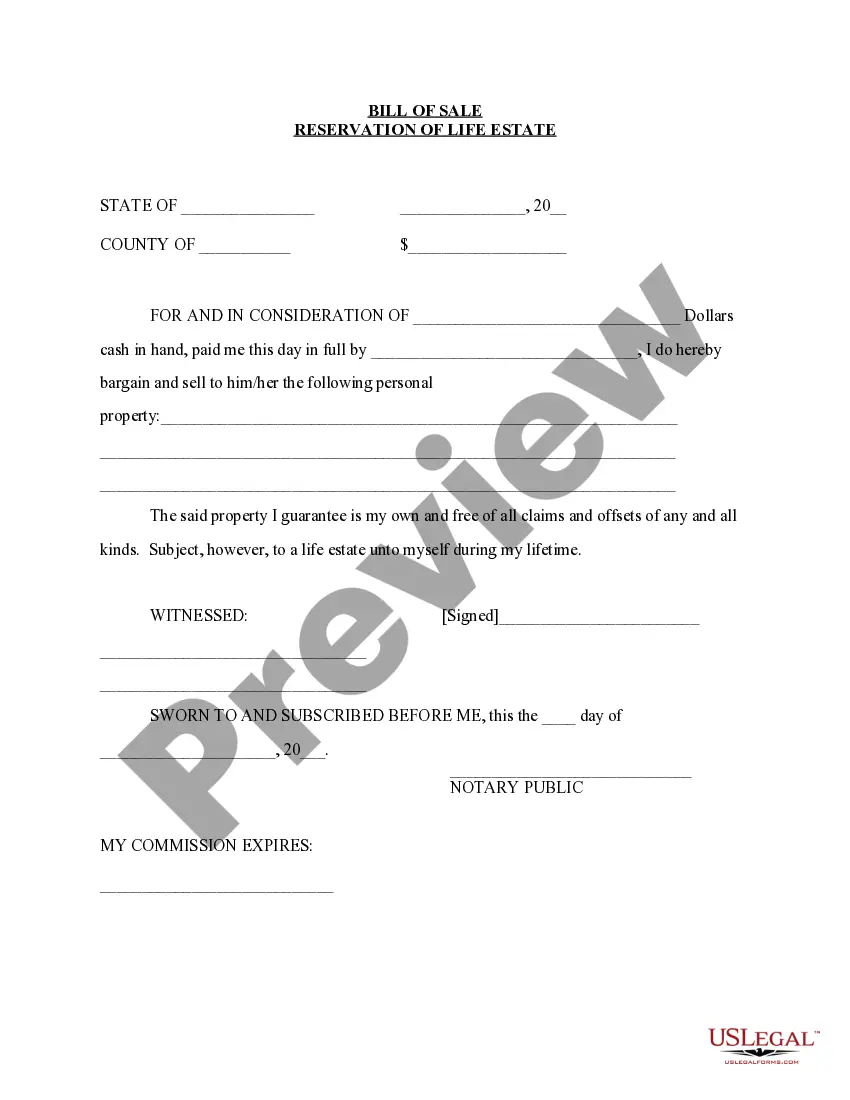
Get your form ready online
Our built-in tools help you complete, sign, share, and store your documents in one place.
Make edits, fill in missing information, and update formatting in US Legal Forms—just like you would in MS Word.
Download a copy, print it, send it by email, or mail it via USPS—whatever works best for your next step.
Sign and collect signatures with our SignNow integration. Send to multiple recipients, set reminders, and more. Go Premium to unlock E-Sign.
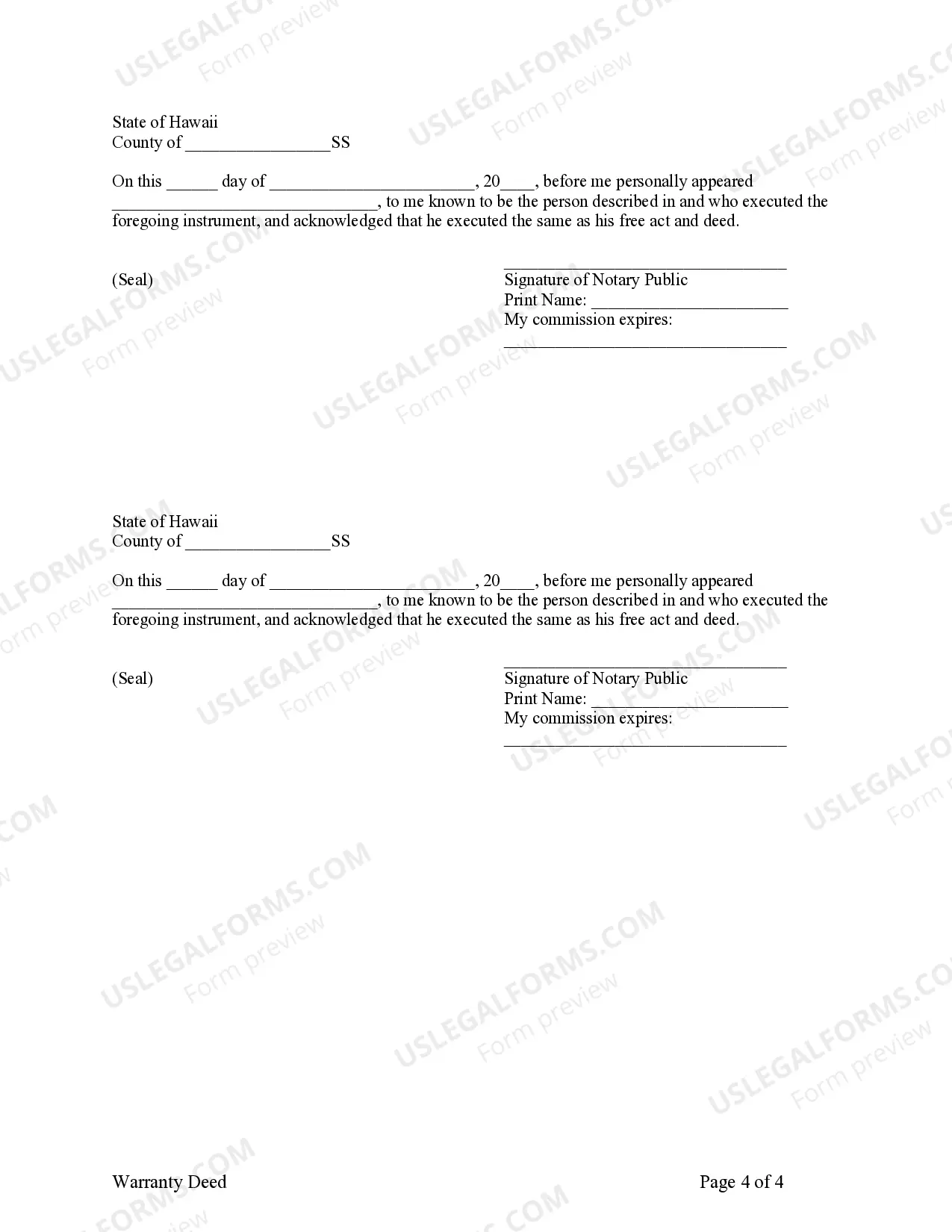
If this form requires notarization, complete it online through a secure video call—no need to meet a notary in person or wait for an appointment.
We protect your documents and personal data by following strict security and privacy standards.

Make edits, fill in missing information, and update formatting in US Legal Forms—just like you would in MS Word.

Download a copy, print it, send it by email, or mail it via USPS—whatever works best for your next step.

Sign and collect signatures with our SignNow integration. Send to multiple recipients, set reminders, and more. Go Premium to unlock E-Sign.

If this form requires notarization, complete it online through a secure video call—no need to meet a notary in person or wait for an appointment.

We protect your documents and personal data by following strict security and privacy standards.
Looking for another form?
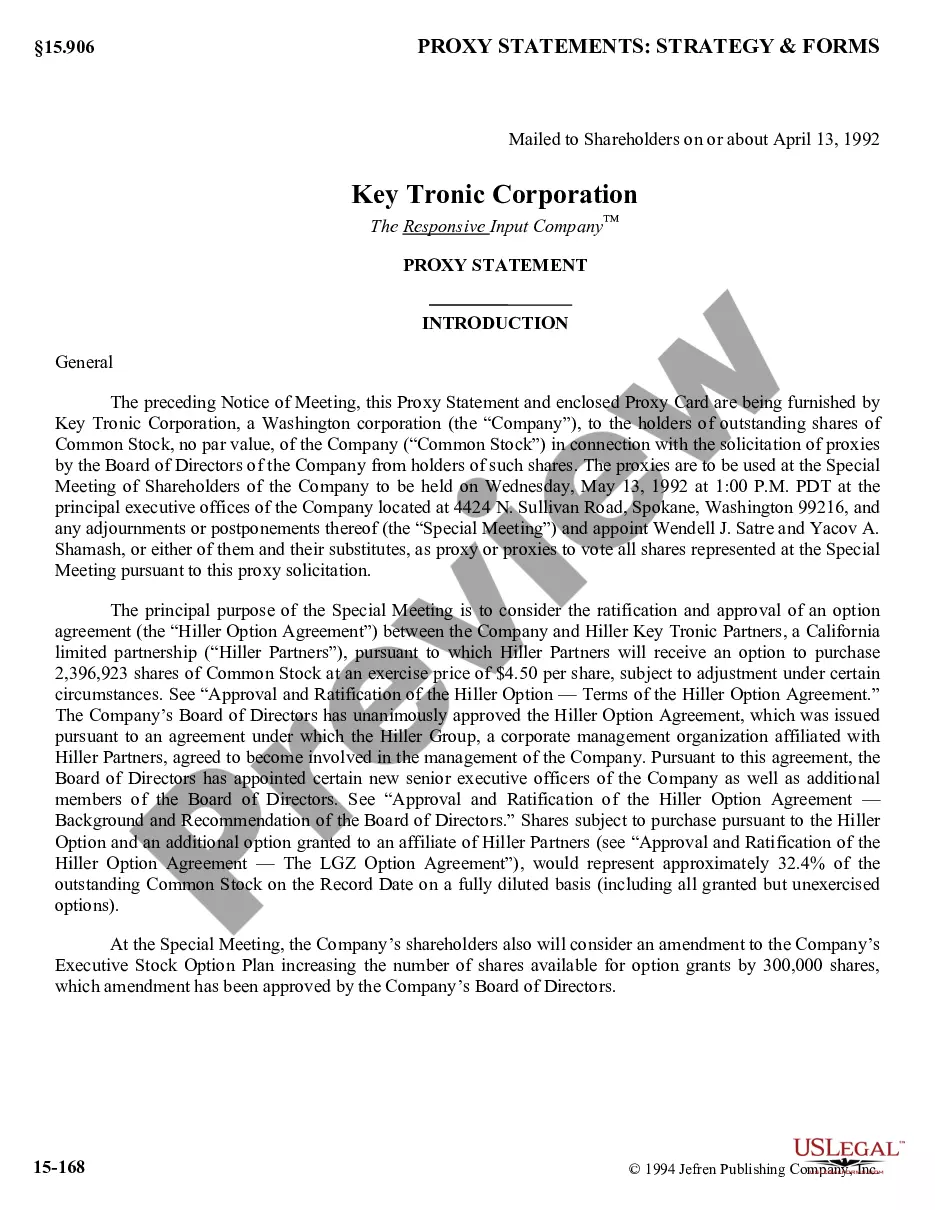
How to fill out Hawaii Warranty Deed To Child Reserving A Life Estate In The Parents?
How to locate professional legal documents that comply with your state's laws and create the Life Estate Deed Hawaii With Remainder without consulting an attorney.
Numerous online services offer templates for various legal needs and formalities.
However, it might require some time to determine which of the available samples meet both the intended use and legal requirements for you.
If you don't yet have an account with US Legal Forms, follow the steps below: Review the webpage you have opened to verify if the form meets your requirements.
- US Legal Forms is a reliable service that aids you in finding official documents constructed according to the most recent state law revisions, helping you save money on legal fees.
- US Legal Forms is not just a conventional online directory; it boasts over 85k verified templates for numerous business and personal situations.
- All documents are organized by category and state, streamlining your search experience.
- The platform also features powerful tools for PDF editing and eSignature, allowing users with a Premium subscription to swiftly complete their paperwork online.
- Acquiring the necessary forms requires minimal time and effort.
- If you already possess an account, sign in and confirm your subscription is active.
- Download the Life Estate Deed Hawaii With Remainder by clicking the corresponding button next to the file name.
Form popularity
FAQ
A transfer on death deed in Hawaii allows property owners to designate a beneficiary who will automatically receive the property upon their death. This deed ensures that the property bypasses the probate process, making the transition smoother for your heirs. Using a life estate deed Hawaii with remainder can be an efficient estate planning tool, providing flexibility and clarity in how your real estate is handled after your passing.
A will does not avoid probate in Hawaii; instead, it typically initiates the probate process. The probate process can sometimes be lengthy and costly, which may delay the distribution of your assets. Understanding how options like a life estate deed Hawaii with remainder can work alongside your will can help streamline the handling of your estate, providing peace of mind.
The choice between transfer-on-death and naming a beneficiary depends on your individual needs. A transfer-on-death deed can help you avoid probate, while a beneficiary designation may apply to financial accounts or insurance. However, using a life estate deed Hawaii with remainder strikes a balance by allowing you to retain control of the property during your lifetime while ensuring a smooth transfer to your chosen heir.
Yes, Hawaii does allow transfer-on-death deeds to facilitate the inheritance of real property. This means you can name a beneficiary who will take ownership of your property automatically upon your passing. Understanding how a life estate deed Hawaii with remainder works can help you set up your estate plan effectively and minimize potential challenges for your heirs.
Transfer-on-death (TOD) refers to a method of transferring property to a beneficiary upon an owner's death. In Hawaii, this allows property owners to name someone who will receive their property without going through probate. Utilizing a life estate deed Hawaii with remainder can sometimes simplify this process, ensuring that your property is securely passed to your desired beneficiary.
In Texas, a remainderman does not have ownership of the property until the life tenant dies. The remainderman has a future interest in the property but cannot use or control it while the life tenant is alive. This distinction is important when discussing life estate deed arrangements, including those like life estate deeds in Hawaii with remainder.
'Remainder of estate' refers to the portion of property that is to be transferred to the remainderman upon the death of the life tenant. This ensures that ownership clearly shifts after the life tenant's passing. When dealing with estate planning, understanding the remainder aspect is crucial, especially for life estate deeds in Hawaii with remainder.
While life estate deeds can simplify inheritance, they have drawbacks you should consider. For example, a life tenant cannot sell or modify the property without consent from the remainderman. Additionally, the property may be exposed to creditors during the life tenant's lifetime, impacting family finances when planning with a life estate deed in Hawaii with remainder.
A life estate deed with remainder interest grants a person the right to use a property for life, after which the property passes to another designated individual. This legal arrangement provides clear instructions for property transfer after the life tenant's death. For those exploring life estate deed options in Hawaii with remainder, this structure offers a stable plan for future generations.
A life estate is often referred to as a 'life tenancy.' This type of arrangement allows a person to live in and use a property throughout their lifetime. After their passing, the property transfers to another individual, known as the remainderman. Understanding terms related to life estate deeds in Hawaii with remainder is essential for effective property planning.